
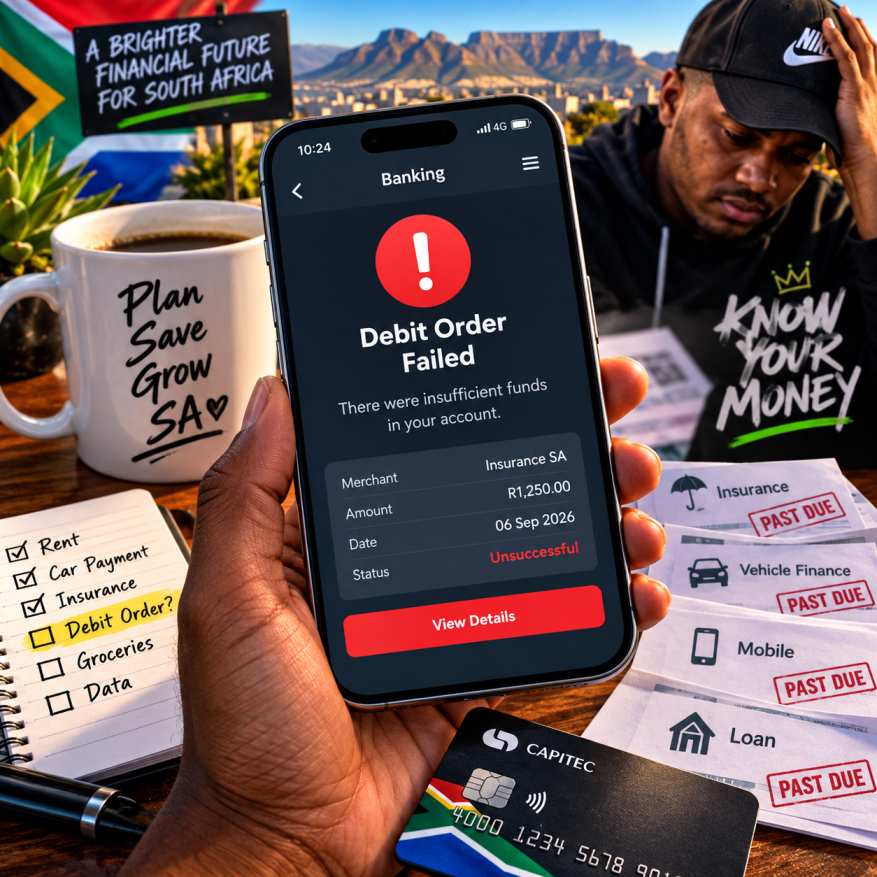
A failed debit order can look like a small banking problem, but the consequences can travel much further than your bank account. Here is what actually happens when there isn’t enough money for a debit order, whether it may be tried again, what it can cost you, and when a missed payment can affect your credit record.
For many South Africans, payday is followed by a familiar sequence of transactions. Salary comes in, and shortly afterwards the debit orders begin: rent or a bond, vehicle finance, insurance, a personal loan, cellphone contract, subscriptions and perhaps a few smaller accounts.
When everything goes according to plan, you barely notice them.
The situation becomes more complicated when a debit order arrives and there isn’t enough money in the account.
Suppose you have R1,100 available, but your vehicle insurance debit order for R1,250 is due that morning. Does the bank pay part of it? Does the debit order disappear? Will the company try again? Will you be charged? Can it damage your credit score?
The short answer is that a failed debit order normally means the payment has not been successfully made. What happens afterwards depends on your bank, the type of debit order, the agreement with the service provider and what the payment was for.
Importantly, a failed debit order and an unpaid debt are related concepts, but they aren’t exactly the same thing.
This guide explains the difference.
Quick answer: If there isn’t enough available money in your bank account when a debit order is presented, the collection may be returned unpaid. Depending on the debit-order system, another collection attempt may occur when funds become available. Your bank may charge a returned-debit fee, while the company you owe may regard your account as unpaid and potentially charge interest or other contractually permitted costs. For credit agreements, an ongoing missed payment can also become part of your payment history.
What Is a Debit Order?
A debit order is an arrangement that allows a business or service provider to collect money from your bank account according to an agreed mandate.
The mandate normally establishes important details such as:
- Who may collect the money;
- The amount or permitted amount;
- The collection date;
- How frequently collections occur; and
- Other conditions applying to the debit.
The Payments Association of South Africa (PASA) currently identifies three types of debit orders: DebiCheck, Registered Mandate (RM) and EFT debit orders. (PASA)
That distinction matters because not every debit order behaves in precisely the same way.
DebiCheck
DebiCheck allows you to electronically authenticate a debit-order mandate through your bank at the beginning of an agreement.
Your bank therefore has information about what you authorised and can check a collection against the authenticated mandate. The South African Reserve Bank says the system was introduced as part of efforts to make collections safer and combat debit-order abuse. (South African Reserve Bank)
Registered Mandate
Registered Mandate, or RM, is another collection stream. PASA says the current RM stream was introduced in May 2025 and supports credit tracking for up to 10 days, which can improve the chances of successful collection when funds aren’t immediately available. (PASA)
EFT debit orders
With an EFT debit order, the mandate is generally held by the service provider rather than electronically authenticated with your bank in the same way as DebiCheck.
The important point for the consumer is simple:
Giving a company permission to debit your account creates a payment method. It doesn’t make the underlying financial obligation disappear if that payment method fails.
Why Does a Debit Order Fail?
Insufficient funds are probably the situation most people think of first, but they’re not the only possible reason.
A debit order may be unsuccessful because:
| Possible reason | Simple example |
|---|---|
| Insufficient available funds | R900 is available but a R1,200 debit order is presented |
| Salary arrives later than expected | Debit is processed before salary clears |
| Money was spent before collection | You used funds that had been reserved mentally for debit orders |
| Wrong or outdated account | You changed banks but didn’t successfully update the provider |
| Account restrictions | The account cannot process the transaction normally |
| Administrative problem | Provider or banking details contain an error |
| Mandate issue | The collection doesn’t comply with the applicable mandate |
| Timing mismatch | Debit order and expected income arrive at different times |
A surprisingly common budgeting mistake is to look at your balance and assume everything showing there is available for spending.
If R12,000 lands in your account today but R8,500 of debit orders are due over the next several days, you don’t really have R12,000 available for discretionary spending.
You effectively have:
R12,000 − R8,500 = R3,500
available after those known commitments.
That distinction is one of the easiest ways to prevent returned debit orders.
What Actually Happens When There Isn’t Enough Money?
Consider this example.
Thando’s account on payday
| Item | Amount |
|---|---|
| Salary deposited | R18,500 |
| Rent paid manually | −R7,000 |
| Groceries and transport | −R3,200 |
| Other spending | −R1,700 |
| Remaining balance | R6,600 |
Thando still has the following debit orders coming:
| Debit order | Amount |
|---|---|
| Vehicle instalment | R3,900 |
| Insurance | R1,450 |
| Personal loan | R1,700 |
| Cellphone | R650 |
| Total | R7,700 |
There’s a R1,100 shortfall.
If all four collections arrive while only R6,600 remains, at least one payment may fail depending on collection timing and the account arrangements.
This illustrates something important:
Having money in your account doesn’t necessarily mean you have enough money to honour all outstanding debit orders.
Stage 1: The Collection Is Presented
The service provider sends a collection instruction through the relevant payment system.
Your bank processes the instruction according to the applicable rules, mandate and account conditions.
If sufficient available funds exist and everything else is valid, the debit normally succeeds.
If sufficient funds aren’t available, the collection may be unsuccessful.
Stage 2: The Payment May Be Returned
A failed collection means the company expecting the money hasn’t necessarily been paid.
That’s the first major consequence.
If your insurance premium was R900 and its debit order failed, don’t assume that the insurer somehow received R900 anyway.
Similarly, a failed R3,000 loan instalment doesn’t automatically become next month’s problem with no consequences.
You should establish whether payment is outstanding.
Can the Debit Order Be Tried Again?
Yes, in some circumstances.
This is one of the most important things to understand because many consumers assume:
“It bounced this morning, so I can use the money that arrived this afternoon.”
That assumption can cause a second problem.
PASA explains that where there are insufficient funds on the collection date, a bank may process certain debit orders when sufficient funds subsequently reach the account. PASA also notes that RM supports credit tracking for up to 10 days. (PASA)
That means money arriving after an unsuccessful initial attempt may potentially be collected later, depending on the collection arrangement.
Example
Imagine your R1,800 debit order is due on Monday.
Your balance on Monday morning is only R500.
Your employer then deposits R4,000 on Tuesday.
If the collection arrangement permits another attempt or tracking, you shouldn’t automatically assume the entire R4,000 is now free to spend.
The safest approach is to check your account and contact the provider if you’re uncertain.
What Is DebiCheck Credit Tracking?
Credit tracking is particularly useful to understand.
Rather than treating a collection as permanently finished the instant there aren’t enough funds, an eligible collection may continue looking for available funds within the permitted period.
For consumers, this can create an awkward situation:
Your available balance can change after money reaches your account because an outstanding collection may still be waiting.
Suppose:
- Monday: R2,000 debit order is due;
- Monday balance: R300;
- Tuesday: R1,000 enters the account;
- Wednesday: another R2,500 enters;
- An eligible tracked collection remains outstanding.
Once sufficient funds are available, the collection may potentially proceed according to the applicable system and mandate.
The practical lesson isn’t to panic whenever a debit order fails.
It’s to avoid spending newly deposited money until you understand the status of the outstanding collection.
Do South African Banks Charge for Failed Debit Orders?
They can.
However, the amount isn’t universal and bank pricing changes, so you should check your own bank’s current pricing guide rather than relying on an old number from the internet.
As one current example, Capitec’s published transaction-fee information lists a R6 digital charge for a debit order returned because of insufficient funds. (Capitec Bank)
That figure is an example, not a standard South African fee.
Different accounts and banks may have different pricing structures.
This is precisely why an evergreen article shouldn’t claim:
“Every failed debit order costs R___.”
There is no single fee that applies to every South African bank account.
The Real Cost Can Be Bigger Than the Bank Fee
The returned-debit fee itself may be the smallest part of the problem.
Consider a hypothetical R2,500 loan instalment.
Illustrative example only
| Consequence | Possible amount |
|---|---|
| Missed instalment | R2,500 |
| Illustrative bank return fee | R10 |
| Illustrative contractual late cost | R75 |
| Illustrative additional interest/cost | R45 |
| Amount now requiring attention | R2,630 |
These numbers are illustrative, not actual charges from a particular provider.
The point is that the cost of a failed debit order can have several layers:
banking cost + unpaid account + contractual charges/interest + possible service consequences.
The exact charges must be permitted by your agreement and applicable law.
Illustrative Cost of Repeated Failures
Here’s another hypothetical example showing why several failures can become expensive.
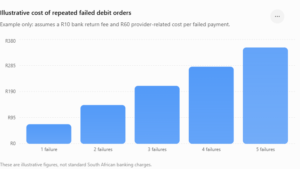
Nothing about those figures is intended to predict what your bank will charge. They’re there to illustrate the compounding effect: small recurring penalties become meaningful when the underlying cash-flow problem continues.
Does a Failed Debit Order Hurt Your Credit Score?
This requires an important distinction.
A returned debit order is not identical to a credit default
Suppose your gym debit order fails.
That’s not the same situation as failing to pay an instalment under a credit agreement.
Likewise, if an insurance premium fails, the main risk may concern the insurance contract rather than a conventional credit repayment.
But suppose the debit order was collecting:
- A personal-loan instalment;
- Vehicle finance;
- A credit agreement;
- A store account;
- A credit-card payment; or
- Another reportable credit obligation.
Now the underlying missed payment matters.
The National Credit Act framework recognises a consumer’s pattern of payment or default as consumer credit information, and registered credit providers have reporting obligations relating to credit information. (NCR)
So the more accurate way to explain it is:
It’s generally the unpaid credit obligation and resulting payment history that should concern you—not merely the mechanical fact that a debit-order instruction was returned.
Capitec similarly warns that disputing a valid debit order can result in an unpaid instalment, a lower credit score and difficulty obtaining new credit. (Capitec Bank)
One Failed Payment vs a Pattern of Missed Payments
One cash-flow mistake shouldn’t be treated as if your financial future is automatically destroyed.
The more serious concern is allowing an unpaid account to remain unresolved or developing a pattern of late/missed payments.
Imagine two consumers.
Consumer A
A debit order fails because salary arrives a day late.
The consumer notices immediately, contacts the lender, settles the amount and adjusts the collection date.
Consumer B
Debit orders fail repeatedly for several months.
The consumer ignores calls and messages, doesn’t make alternative payments and allows arrears to accumulate.
Those situations are obviously very different.
The lesson is:
Act quickly.
If a debit order linked to a debt fails, don’t wait until next month to see what happens.
What Happens If an Insurance Debit Order Fails?
Insurance deserves special attention because consumers sometimes assume missing one debit order simply means paying double next month.
That isn’t something you should assume.
Your policy terms determine what happens following a missed premium. Depending on the policy and circumstances, consequences can eventually include interruption or cancellation of cover if the unpaid premium isn’t resolved in accordance with the applicable terms and law.
This matters enormously with vehicle insurance.
Imagine your premium fails on the 1st.
On the 4th, you have an accident.
You don’t want to discover after the accident that there’s a dispute about the status of your premium or cover.
If an insurance debit order fails:
- Check whether the debit was actually unsuccessful.
- Contact your insurer.
- Ask whether another collection will occur.
- Ask how you should settle the outstanding premium.
- Confirm whether your cover is affected.
- Keep evidence of payment and communication.
Don’t simply make assumptions about insurance cover.
What Happens If a Loan Debit Order Fails?
With a loan, the underlying repayment remains important.
If a R2,000 instalment doesn’t successfully reach your lender, the loan doesn’t become R2,000 cheaper.
Depending on your agreement and circumstances, the account may become overdue and applicable interest or charges may continue.
Your first step should be to contact the credit provider.
Ask:
“My debit order was unsuccessful. Has another collection been scheduled, or should I make a manual payment?”
That question is better than immediately transferring the money yourself.
Why?
Because if you manually pay R2,000 and a tracked debit order subsequently also collects R2,000, you’ve temporarily paid R4,000.
That may eventually be reconciled, but it can leave you short for everything else.
What Happens to a Cellphone or Subscription Debit Order?
Again, the debit order is only the payment mechanism.
The underlying contract determines the consequences.
A failed payment might eventually result in:
- An overdue balance;
- Additional collection attempts;
- Restricted service;
- Suspension;
- Cancellation;
- Contractual charges; or
- Debt-collection activity.
Netflix failing isn’t necessarily the same financial event as vehicle finance failing.
That’s why the words “debit order failed” don’t tell you the entire story.
You always need to ask:
What obligation was that debit order supposed to pay?
Can a Debit Order Go Off Before or After the Agreed Date?
There are circumstances where the actual collection date can differ from the calendar date you expected.
PASA notes that if the agreed collection date falls on a weekend or public holiday, collection may occur on the previous or next business day. PASA also explains that insufficient funds can result in later processing when sufficient funds become available. (PASA)
This is particularly relevant around:
- Month-end;
- December holidays;
- Public holidays;
- Employers paying early;
- Employers paying late; and
- Months where your normal payday falls on a weekend.
A good budget therefore shouldn’t depend on a debit order happening at exactly the same hour every month.
What Should You Do Immediately After a Debit Order Fails?
Here’s a practical sequence.
1. Don’t ignore it
Open your banking app and establish what actually happened.
Look for wording such as:
- Returned;
- Unpaid;
- Rejected;
- Insufficient funds; or
- Reversed.
The terminology varies.
2. Work out why it failed
Was there insufficient money?
Did your salary arrive late?
Was the wrong account used?
Was there an administrative problem?
Did you intentionally stop the debit order?
Understanding the cause determines the next step.
3. Keep enough money available
If the debit order may be resubmitted or tracked, don’t immediately spend the money when it arrives.
4. Contact the service provider
Ask whether:
- The account is now overdue;
- Another debit attempt will occur;
- You should make a manual payment;
- Any fees or interest have been added;
- Your service or cover is affected; and
- Your debit date can be changed.
5. Keep proof
Save:
- Payment confirmations;
- Emails;
- SMS messages;
- Reference numbers; and
- Screenshots where appropriate.
If a dispute develops later, documentation can be extremely useful.
Should You Pay Manually After a Failed Debit Order?
Sometimes—but confirm first.
This deserves repeating because paying too quickly can create a double-payment problem.
Example
Naledi’s R1,500 loan debit fails on Monday.
She receives R2,000 on Tuesday and immediately makes a manual R1,500 EFT.
On Wednesday, an eligible collection is processed against her account.
Another R1,500 leaves.
Naledi has now paid R3,000 while expecting to pay R1,500.
The lender may eventually allocate or refund the additional payment, but Naledi might now be unable to buy groceries.
A better approach is:
Check → contact provider → establish collection status → pay using the agreed method.
Can You Just Reverse a Debit Order to Get Money Back?
This is where consumers need to be careful.
There’s an enormous difference between:
An unauthorised debit order
You don’t recognise the company, never agreed to the debit, or believe the collection doesn’t comply with your mandate.
and
A valid debit order you simply don’t want to pay this month
These aren’t the same thing.
PASA says consumers have the right to query collections they believe were incorrectly debited, although not every dispute necessarily results in a reversal. PASA recommends approaching the service provider first and then the bank if necessary. (PASA)
Banks also warn consumers against using debit-order disputes as a cash-management technique. Capitec, for example, explicitly says its dispute facility is for unauthorised debits, and warns that disputing valid debit orders can lead to consequences including unpaid instalments and adverse credit effects. (Capitec Bank)
FNB similarly warns that disputing a valid debit order may put a consumer in breach of an underlying agreement and potentially affect future credit applications. (FNB)
So don’t think of a dispute button as:
“Undo my bill because I need the money.”
It isn’t designed for that purpose.
Stopping a Debit Order Does Not Cancel Your Contract
This is another costly misunderstanding.
Suppose you’ve cancelled a gym membership.
You stop the debit order through your bank and assume everything is finished.
But if you haven’t actually cancelled the contract according to its terms, you may still owe the provider money.
PASA states clearly that suspending a DebiCheck debit order prevents future processing but doesn’t itself cancel the underlying contract; cancellation needs to be dealt with directly with the service provider. (PASA)
Capitec gives the same warning. (Capitec Bank)
Think about it this way:
Debit order = payment method
Contract = legal/commercial obligation
Stopping one doesn’t automatically terminate the other.
What If You Don’t Recognise the Debit Order?
Treat that differently from a normal failed payment.
PASA recommends checking whether you gave the company permission. If you don’t recognise the business, query the debit with your bank and establish who initiated it. If you didn’t authorise it, you can follow the applicable dispute process. (PASA)
A sensible response is:
- Check the transaction description.
- Search your legitimate contracts and subscriptions.
- Contact your bank if you cannot identify it.
- Obtain the collector’s details where possible.
- Contact the business if appropriate.
- Dispute/report the debit if it is genuinely unauthorised.
- Monitor the account for further suspicious activity.
Don’t publicly post your bank-account number or other confidential credentials while trying to identify a transaction.
How DebiCheck Helps
DebiCheck was designed partly to reduce abuse on both sides of the debit-order system.
According to PASA, the system addresses problems involving rogue providers processing collections without proper approval as well as consumers unfairly disputing legitimate debit orders. (PASA)
With DebiCheck, you approve mandate details through your bank.
That means your bank has a record of the agreed parameters and can check eligible collections against them.
This doesn’t mean you can forget about your contract.
It means there is stronger authentication around the collection mandate.
A Failed Debit Order Can Become a Cash-Flow Warning
Sometimes the most useful thing a failed debit order tells you isn’t that the bank made a mistake.
It’s that your monthly commitments are too close to your monthly income.
Consider this illustrative household:
| Monthly item | Amount |
|---|---|
| Take-home income | R22,000 |
| Housing | R7,000 |
| Vehicle | R4,200 |
| Credit repayments | R2,500 |
| Insurance | R1,500 |
| Utilities | R1,400 |
| Transport/fuel | R2,000 |
| Food | R2,600 |
| Cellphone/data | R800 |
| Total commitments | R22,000 |
There’s nothing left.
Not R500.
Not R100.
R0.
One unexpected school expense, electricity purchase, tyre puncture or medical cost can now cause a debit order to fail.
The issue isn’t necessarily irresponsibility.
It’s lack of financial breathing room.
Example Household Budget
Here’s a healthier hypothetical version of the same R22,000 income:
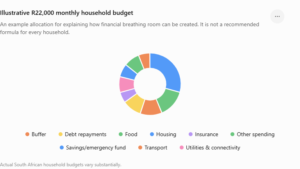
This isn’t a universal budgeting rule. Someone in Johannesburg commuting daily may spend much more on transport; someone living with family may spend much less on housing.
The valuable feature is the R1,300 buffer.
That buffer helps absorb small timing problems before they turn into missed payments.
The “Debit-Order Buffer” Strategy
One practical approach is to build a small amount of money that permanently remains in your transaction account.
Let’s call it a debit-order buffer.
Suppose your monthly debit orders total R8,000.
You eventually build a R2,000 buffer.
Your bank balance shouldn’t mentally reach zero anymore.
Your new personal “zero” becomes:
R2,000.
If your app shows R2,300, you mentally have only R300 available.
This isn’t the same as a full emergency fund.
It’s a small cash-flow cushion designed specifically to deal with:
- Salary timing differences;
- Slightly variable debit amounts;
- Weekend/public-holiday timing;
- Forgotten small payments; and
- Ordinary month-end fluctuations.
Start small if necessary.
R100 → R250 → R500 → R1,000.
The objective is resilience, not perfection.
Align Debit Orders With Payday
If your salary normally reaches your account on the 25th but several important debit orders run on the 20th, you have a predictable timing problem.
Contact providers and ask whether collection dates can be moved closer to payday.
For example:
Before
Salary: 25th
Loan: 20th
Insurance: 21st
Vehicle: 23rd
Potentially better
Salary: 25th
Loan: 26th
Insurance: 27th
Vehicle: 28th
Whether a provider allows this depends on its policies and your contract.
But when it is available, aligning payments with income can reduce avoidable failures.
Don’t Put Every Debit Order on the Exact Same Day
There are two sides to this.
Having important debit orders immediately after payday can help ensure the money is available.
But putting everything on one day can make account management difficult if there is ever a salary delay or unexpected problem.
A useful approach may be to prioritise obligations.
For example:
First priority
Housing, insurance, essential credit commitments.
Second priority
Utilities, connectivity and necessary contracts.
Lower priority
Non-essential subscriptions and discretionary memberships.
This doesn’t change your contractual obligations. It simply helps you understand where your money is going and which commitments deserve the closest monitoring.
Keep a Debit-Order Calendar
You don’t need complicated financial software.
A simple note can work:
| Date | Debit order | Expected amount |
|---|---|---|
| 25th | Vehicle finance | R3,850 |
| 26th | Insurance | R1,120 |
| 27th | Personal loan | R1,400 |
| 28th | Fibre | R699 |
| 1st | Cellphone | R599 |
| Total | R7,668 |
When salary arrives, mentally reserve R7,668 before deciding how much you can spend.
That one habit can prevent a large number of accidental returned payments.
Watch Variable Debit Orders
Not every debit order is necessarily the exact same amount every month.
Some agreements allow variable collections within defined conditions.
That’s why budgeting the exact previous month’s figure with no margin can cause trouble.
If an account normally ranges between R800 and R1,000, budgeting R800 every month is optimistic.
Budgeting closer to the upper expected amount gives you more protection.
What If Your Salary Is Late?
If you know your salary will arrive after an important debit date, don’t wait for the failure.
Contact the provider beforehand.
Explain that the payment timing has changed and ask what options are available.
Depending on the provider, there may be a legitimate way to:
- Change the debit date;
- Arrange an alternative payment;
- Reschedule collection; or
- Deal with the temporary shortfall.
Never assume a provider will agree—but asking before the account becomes overdue is generally better than disappearing after payment fails.
What If You Can’t Afford All Your Debit Orders?
This is different from forgetting to leave enough money in the account.
If your income genuinely cannot cover your financial obligations month after month, rearranging debit dates won’t solve the underlying problem.
You need to examine the numbers.
Example
Net income: R17,000
Essential living expenses: R12,000
Debt and contractual debit orders: R7,000
Total required: R19,000
Monthly shortfall:
R19,000 − R17,000 = R2,000
There is no banking trick that permanently solves that R2,000 gap.
You may need to:
- Cut discretionary expenses;
- Cancel services you can lawfully do without;
- Contact creditors before accounts deteriorate;
- Review expensive debt;
- Increase income where realistically possible; or
- Seek appropriate debt/financial assistance.
Repeated returned debit orders are sometimes a symptom rather than the disease.
A Simple Payday System
A practical system can look like this:
Step 1 — Salary arrives
Suppose: R25,000
Step 2 — Reserve debit orders immediately
Total debit orders: R9,400
Remaining:
R25,000 − R9,400 = R15,600
Step 3 — Reserve essential living costs
Food: R4,000
Transport: R2,500
Electricity: R1,200
Other essentials: R1,300
Total: R9,000
Remaining:
R15,600 − R9,000 = R6,600
Step 4 — Save before discretionary spending
Emergency savings: R1,500
Remaining:
R5,100
Step 5 — Decide what the remaining money must cover
Only now do you have a realistic picture of your discretionary capacity and other upcoming expenses.
The mistake is reversing the order:
spend first → debit orders later.
Debit Order vs Stop Order vs Recurring Card Payment
Consumers sometimes use these terms interchangeably, but they aren’t identical.
| Payment method | Basic idea |
|---|---|
| Debit order | Provider initiates collection under an agreed mandate |
| Stop order | Traditionally an instruction arranged through your bank to make recurring payments |
| Recurring card payment | Merchant charges your card according to an agreement |
| Scheduled EFT | You instruct your banking platform to make a scheduled transfer |
Understanding the payment method matters when trying to stop, dispute or replace it.
A “subscription” appearing on your statement isn’t automatically a debit order.
Common Myths About Failed Debit Orders
Myth 1: “If it bounced once, it’s gone.”
Not necessarily. Depending on the collection system and mandate, further processing or tracking may occur. (PASA)
Myth 2: “If I reverse it, I don’t owe the company.”
Wrong.
Reversing or suspending the payment doesn’t automatically cancel the underlying contract. (PASA)
Myth 3: “Every failed debit order ruins your credit score.”
Too simplistic.
The nature of the underlying obligation matters. A missed payment under a credit agreement can become relevant to your payment history, but not every returned debit order represents the same type of credit event. (NCR)
Myth 4: “I can manually pay immediately and forget about it.”
Be careful. Confirm whether another collection attempt is pending first.
Myth 5: “The bank decides whether I still owe the company.”
No.
Your bank processes the payment instruction. The underlying agreement is generally between you and the provider.
Frequently Asked Questions
What happens if I don’t have enough money for a debit order?
The collection may be unsuccessful, and you may incur a bank fee depending on your account and bank. The service provider may regard the underlying payment as outstanding. Depending on the debit-order arrangement, another collection attempt may also occur.
Will the bank take part of the debit order?
Generally, consumers should not assume a normal debit order will simply take whatever amount happens to be available and treat the remainder as paid. Check the specific transaction and your bank/provider if you’re uncertain.
Can a debit order retry automatically?
Certain collection arrangements can involve further attempts or credit tracking. PASA states that the RM stream supports credit tracking for up to 10 days, for example. (PASA)
Can money be taken after my salary arrives?
Potentially, depending on the debit-order arrangement and whether the collection remains eligible for processing. Don’t assume a previously unsuccessful debit is permanently finished simply because the first attempt failed. (PASA)
Does a failed debit order affect my credit score immediately?
The better question is whether the underlying credit obligation becomes unpaid and is reported as part of your payment history. South African credit information includes patterns of payment or default. (NCR)
What happens if my insurance debit order fails?
Contact the insurer promptly. Don’t make assumptions about the status of your policy or whether another collection will occur.
Should I manually pay after a debit order fails?
Confirm with the provider first, particularly where another collection attempt may still occur. Otherwise, you could accidentally pay twice.
Can I dispute a debit order I authorised?
A dispute mechanism isn’t intended simply to recover money from a legitimate payment because you’re short of cash. A valid underlying contract can remain enforceable even if you dispute or stop its payment mechanism. (FNB)
What if I never authorised the debit order?
Contact your bank and investigate it. PASA advises consumers to query debit orders they don’t recognise and dispute/report unauthorised collections through the appropriate process. (PASA)
Does stopping a debit order cancel my contract?
No. PASA explicitly distinguishes suspending a debit order from cancelling the underlying agreement with the service provider. (PASA)
Can a debit order be collected on a different date?
In some circumstances, yes. PASA notes, for example, that weekend/public-holiday timing and insufficient funds can affect when a collection is processed. (PASA)
How do I prevent debit orders from failing?
The most effective habits include keeping a list of debit dates, reserving debit-order money immediately after payday, maintaining a small account buffer, monitoring variable payments and contacting providers early when you know there will be a problem.
A Failed Debit Order Is Usually Fixable—Ignoring It Is the Bigger Risk
Seeing “debit order returned” on your banking app can be stressful, particularly when money is already tight.
But the most important thing is what you do next.
First, establish why the collection failed. Then determine whether another collection attempt may occur. Contact the company expecting payment before manually transferring money, and establish whether your account is overdue or whether any service, insurance cover or credit agreement may be affected.
If the debit order wasn’t authorised, treat that as a separate issue and use the appropriate query or dispute process.
And if debit orders are failing repeatedly, look beyond the individual transactions.
Repeated failures can be an early warning that your monthly financial commitments have moved too close to—or beyond—your available income.
A small debit-order buffer, better collection dates and a simple payday plan can solve timing problems. But where income genuinely doesn’t cover expenses and debt repayments, the underlying budget needs attention.
The most useful rule is remarkably simple:
Know what must still leave your account before deciding what is available to spend.
That habit can turn debit orders from month-end surprises into predictable parts of your financial plan.
| failures | cost |
|---|---|
| 1 failure | 70 |
| 2 failures | 140 |
| 3 failures | 210 |
| 4 failures | 280 |
| 5 failures | 350 |
| category | amount |
|---|---|
| Housing | 6,500 |
| Food | 3,200 |
| Transport | 2,500 |
| Debt repayments | 2,200 |
| Insurance | 1,200 |
| Utilities & connectivity | 1,800 |
| Savings/emergency fund | 1,500 |
| Other spending | 1,800 |
| Buffer | 1,300 |