


Your credit score can influence whether you qualify for a personal loan, vehicle finance, a credit card or a home loan—but the number displayed on a credit-bureau app is only one piece of the puzzle. This deep dive explains what really sits behind a South African credit profile, why two people with similar salaries can receive completely different lending decisions, and how to build healthier credit without falling into the trap of borrowing simply to “chase a score.”
Imagine two people.
Both earn R25,000 per month.
Both have permanent jobs. Neither has a judgment. Both apply for a R50,000 personal loan at the same lender.
The first applicant is approved.
The second isn’t.
From the outside, that can feel arbitrary. The rejected applicant might even have checked their credit score that morning and thought it looked perfectly respectable.
But lenders don’t see only a three-digit number.
They can consider your payment history, existing debt, recent credit applications, available credit, affordability, information contained in your credit report, their existing relationship with you and their own internal risk models.
That distinction is crucial.
A credit score is not a financial report card where 800 automatically means “approved” and 600 automatically means “declined.”
It is better understood as one signal extracted from your broader borrowing history.
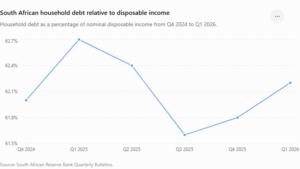
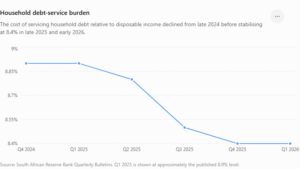
And in South Africa, where household debt remains substantial, understanding that distinction matters. The South African Reserve Bank reported that household debt stood at 62.2% of nominal disposable income in the first quarter of 2026, while households’ debt-service cost was equivalent to 8.4% of disposable income. (South African Reserve Bank)
Credit is therefore not a niche subject affecting a handful of borrowers.
It is woven deeply into household finances.
So let’s get underneath the number.
🧠 First: Forget the Idea of One Universal South African Credit Score
One of the biggest misconceptions about credit scoring is:
“My credit score is 720.”
That statement is incomplete.
720 according to whom?
South Africa has multiple registered credit bureaus, and bureaus don’t necessarily use identical scoring models or ranges.
Even more importantly, the score shown to you by a credit bureau isn’t necessarily the score a bank uses internally when deciding whether to lend you money.
TransUnion currently explains that its consumer score can range from 0 to 999, with higher scores generally indicating a healthier credit profile. Its published consumer bands are:
| TransUnion score | Published band |
|---|---|
| 0–615 | Poor |
| 615–729 | Fair |
| 730–821 | Good |
| 822–917 | Very Good |
| 918–999 | Excellent |
But don’t turn that table into a national law.
Experian also offers a score on a 0–999 scale, while explaining that credit scores are calculated from information in a consumer’s overall credit profile.
Different models can evaluate information differently.
Experian has explicitly explained that bureau scoring calculations and bands can differ, meaning the same consumer can receive different numbers from different bureaus.
So which score is the “real” one?
Potentially all of them—within their own models.
Think of your financial history as a learner writing one exam.
Different teachers could mark the same essay using slightly different rubrics.
The underlying essay hasn’t changed.
The scoring method has.
That’s similar to credit scoring.
Your objective shouldn’t therefore be:
“How do I reach exactly 800?”
A better objective is:
“How do I build a credit report that consistently demonstrates manageable borrowing and reliable repayment?”
That’s a much healthier way to think about credit.
📄 Your Credit Report and Your Credit Score Are Not the Same Thing
This distinction is fundamental.
Your credit report is the underlying collection of information about your credit behaviour.
Your credit score is a numerical assessment calculated from information within that profile.
Think of it this way:
Credit report = the story
Credit score = a summary of aspects of that story
TransUnion describes a credit report as a compilation of information supplied by lenders and service providers concerning your financial history and payment behaviour. (TransUnion)
Experian says its reports can include information such as:
- Accounts you’ve opened;
- What you owe creditors;
- Payment behaviour;
- Missed payments;
- Defaults;
- Judgments;
- Debt collections; and
- Other relevant credit-profile information. (Experian)
So when somebody tells you:
“Improve your credit score.”
What you really need to improve is usually something inside your credit profile.
The number follows the underlying behaviour.
🔬 What Actually Goes Into a Credit Score?
This is where we need to avoid a common problem with financial articles online.
You’ll often see something like:
Payment history = 35%
Credit utilisation = 30%
Credit age = 15%
Those percentages are commonly associated with certain overseas scoring systems.
They should not simply be copied and presented as the formula for every South African credit bureau.
South African scoring models are proprietary and can differ.
What we can identify reliably are the major categories of information that matter.
TransUnion says its scoring considers factors including:
- Payment history;
- Amount of debt;
- Where debt is held;
- Adverse listings;
- Length of credit history;
- Recent account applications; and
- Enquiry history.
Let’s examine those properly.
1. Your Payment History: The Part That Tells a Story About Reliability
If there’s one concept worth remembering from this article, it’s this:
Credit providers care about whether you repay what you agreed to repay.
That sounds obvious.
But your payment history can reveal much more than whether you eventually paid an account.
Imagine three borrowers each owe R1,500 per month.
Borrower A
Pays R1,500 before or on the agreed date every month.
Borrower B
Pays eventually, but frequently runs 30 days behind.
Borrower C
Has missed several instalments and is now substantially in arrears.
All three technically have the same monthly contractual obligation.
Their behaviour is completely different.
TransUnion identifies payment history—including whether accounts are paid at the correct amount and time—as an important part of credit scoring.
The National Credit Act framework is also relevant here. NCR guidance notes that consumer credit information includes a person’s pattern of payment or default, and credit providers have obligations concerning the reporting of credit information. (NCR)
That is why one of the most effective long-term credit habits is also one of the least exciting:
Pay agreed instalments properly and consistently.
No trick.
No secret loophole.
No R499 “credit repair package.”
Consistency matters.
⚠️ One Late Payment and Six Months of Arrears Are Not the Same Story
People sometimes discover one late payment and panic:
“My credit is destroyed.”
That’s an exaggeration.
A credit profile is a history, not simply a binary switch marked GOOD or BAD.
TransUnion notes that increasingly severe late payment can be more damaging—for example, a payment 90 days late represents a worse situation than one 30 days late.
That gives us a useful principle:
The sooner you address an overdue account, the better.
If you miss a payment because your salary arrived late, don’t think:
“Well, I’ve already missed it. I’ll deal with it in three months.”
Contact the credit provider.
Find out what is outstanding.
Correct the account.
Then prevent the problem from becoming a pattern.
2. How Much Debt You Carry Matters Too
Paying on time doesn’t automatically mean you aren’t overextended.
Imagine someone earns R30,000 net per month.
Their credit repayments are:
| Commitment | Monthly amount |
|---|---|
| Vehicle finance | R6,200 |
| Personal loan | R3,400 |
| Credit card | R2,000 |
| Clothing accounts | R1,300 |
| Furniture account | R1,100 |
| Total debt repayments | R14,000 |
Before rent, food, electricity, transport, insurance or school expenses, 46.7% of their R30,000 take-home income is already committed to these illustrative debt repayments.
That doesn’t automatically tell us whether a lender will approve or reject them.
But it clearly tells us something important about their financial position.
A high score cannot magically create spare income.
This brings us to perhaps the biggest misunderstanding in this entire topic.
💥 A Good Credit Score Does NOT Mean You Can Afford More Debt
You can have a respectable credit history and still fail an affordability assessment.
TransUnion explicitly says lenders’ risk assessments can incorporate much more than the consumer bureau score, including income, expenses, affordability, employment history, the type of credit requested and other information. (TransUnion)
Let’s build an example.
Ayanda
Net income: R32,000
Debt repayments: R5,000
Essential living expenses: R14,000
Money before other/discretionary commitments:
R13,000
Jason
Net income: R32,000
Debt repayments: R13,000
Essential living expenses: R16,000
Money before other/discretionary commitments:
R3,000
Now suppose both have broadly healthy bureau profiles.
Does that mean they should automatically qualify for the same new R150,000 loan?
Clearly not.
Their capacity to absorb another repayment is very different.
A credit score is about risk information.
Affordability asks a different question:
Can this person reasonably carry the proposed obligation?
Those questions overlap, but they aren’t interchangeable.
🇿🇦 South African Households Already Carry Significant Debt
This isn’t just a hypothetical concern.
The latest SARB Quarterly Bulletin available at the time of writing reports:
Household debt-to-disposable-income ratio: 62.2% in Q1 2026
Household debt-service cost relative to disposable income: 8.4%
The debt-to-income measure has also moved over recent quarters:
| Period | Household debt as % of disposable income |
|---|---|
| Q4 2024 | 62.0% |
| Q1 2025 | 62.7% |
| Q2 2025 | 62.4% |
| Q3 2025 | 61.6% |
| Q4 2025 | 61.8% |
| Q1 2026 | 62.2% |
Sources: SARB Quarterly Bulletins. (South African Reserve Bank)
Notice something important.
The ratio moves.
It isn’t permanently climbing or permanently falling.
That’s what genuine economic data looks like.
And it reinforces why borrowing decisions should be based on your household’s actual financial capacity rather than an obsession with obtaining the highest possible score.
3. Credit Utilisation: The R20,000 Limit Doesn’t Mean R20,000 Is Yours
Now we reach one of the more misunderstood parts of credit.
Suppose your credit card limit is:
R20,000
and your balance is:
R18,000
Your utilisation is:
R18,000 ÷ R20,000 × 100 = 90%
You haven’t technically exceeded your limit.
But you’re using almost all the revolving credit available to you.
That can signal financial pressure.
TransUnion currently suggests keeping revolving balances below approximately 35% of the available credit limit, and says balances above roughly 35–50% can begin to negatively affect its score. (TransUnion)
That isn’t a universal legal threshold.
It also doesn’t mean your score instantly collapses at 36%.
Treat it as bureau guidance, not a cliff edge.
Here’s what different utilisation levels look like on a R20,000 limit:
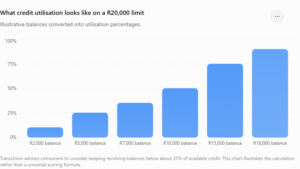
The practical point is more important than the scoring mechanics:
A credit limit is a maximum borrowing facility—not a spending target.
💳 Why Maxing Out a Credit Card Can Look Risky Even If You Pay
Consider these two profiles.
Profile A
Credit limit: R30,000
Typical balance: R4,000
Payments: on time
Profile B
Credit limit: R30,000
Typical balance: R28,500
Payments: on time
Both consumers may be meeting required payments.
But Profile B appears far more dependent on available revolving credit.
If a car repair costs R5,000 tomorrow, Profile B has almost no credit headroom.
If income falls, there is little buffer.
That is why lenders don’t only care whether you paid.
They also care about how much borrowing you’re already carrying.
4. Your Credit History Has an Age
Suppose you’ve responsibly maintained a credit account for eight years.
That gives a scoring model years of behavioural information.
Now compare that with someone who opened their first account three months ago.
The second person may have done absolutely nothing wrong.
There simply isn’t much history yet.
TransUnion lists length of credit history among the information that contributes to its scoring assessment. (TransUnion)
This creates an interesting situation for young consumers.
No bad credit isn’t necessarily the same as established good credit.
If you’ve never borrowed before, a lender has less historical information showing how you manage credit.
Experian describes this type of situation as having a limited or “thin” credit profile.
That doesn’t mean you should immediately borrow thousands of rand just to manufacture a score.
It means credit history develops over time.
🌱 “I Have No Debt—Why Isn’t My Score Excellent?”
This question makes sense emotionally.
If you’ve never borrowed money, surely you’re the safest customer imaginable?
From your perspective:
“I don’t owe anybody anything.”
From a credit-risk model’s perspective:
“There is limited repayment history to analyse.”
Those aren’t contradictory statements.
A credit score is not measuring your worth as a human being or whether you’re financially intelligent.
It is primarily trying to extract risk information from your recorded credit behaviour.
If there’s little behaviour, there’s less information.
That’s why somebody with no credit history can sometimes face more uncertainty than somebody who has responsibly managed a modest credit facility for years.
🚫 But Don’t Take Out an Expensive Loan Just to “Build Credit”
This is where online credit advice can become dangerous.
Someone tells you:
“Take a R20,000 loan. It’ll build your score.”
But suppose the loan carries meaningful interest and fees.
You’re now paying real money solely to generate a repayment history.
That can be a terrible trade.
The purpose of credit should primarily be to meet a legitimate financial need under terms you can afford.
Building a healthy credit record should be a by-product of responsible borrowing, not an excuse for unnecessary debt.
If you already have an appropriate credit facility, managing it responsibly can contribute to your history.
You don’t need to create expensive debt for entertainment.
5. Too Many Credit Applications Can Work Against You
Imagine this sequence:
Monday: personal loan application.
Tuesday: credit card application.
Wednesday: store account.
Friday: another personal loan.
Next Monday: vehicle-finance application.
From the consumer’s perspective:
“I’m just shopping around.”
From a risk perspective, repeated applications in a short period can look like rapidly increasing demand for credit.
TransUnion includes enquiry history and recent account applications among the factors it evaluates, and notes that numerous applications over a short period can indicate higher risk.
That doesn’t mean:
One enquiry = damaged credit forever.
It means repeatedly applying everywhere because the first lender said no can become counterproductive.
🛑 The “Application Spiral”
Here’s a behaviour worth avoiding.
You need R30,000.
Bank A declines you.
You panic.
You apply to Banks B, C and D.
Then two online lenders.
Then a retail credit provider.
Then another loan platform.
Within days you’ve created a cluster of enquiries while still not addressing the reason the first application failed.
A better response after a decline is:
Stop → understand → review → correct → then reconsider.
Ask yourself:
- Is there an affordability problem?
- Is there incorrect information on my credit report?
- Are my balances high?
- Have I missed payments?
- Have I applied too often recently?
- Is the requested amount unrealistic relative to my finances?
Fixing the cause is more useful than multiplying applications.
6. Adverse Information Matters—But Your Report Is Not Permanent Punishment
Credit reports can contain negative information such as defaults and judgments, subject to the National Credit Act and applicable retention rules.
Experian’s consumer platform identifies negative information including notices, defaults, judgments and debt collections as information that can appear within a consumer profile. (Experian)
This understandably scares people.
But your credit report isn’t designed as a permanent punishment register.
Different categories of information have applicable retention periods and legal rules.
And where information is inaccurate, consumers have dispute rights.
The key distinction is:
Accurate negative information
You can’t simply demand deletion because you dislike it.
Incorrect information
You should challenge it through the appropriate bureau process.
That brings us to one of the most important things you can do for your credit health.
🔎 Check Your Own Credit Report
Many South Africans only think about their credit profile after being declined.
That’s backwards.
You should know what is being reported before you urgently need finance.
TransUnion says consumers can obtain a free credit report annually, and Experian provides consumers access to a free report and score through its platform.
When reviewing yours, don’t just stare at the score.
Look deeper.
Check your personal details
Are they yours?
Check open accounts
Do you recognise all of them?
Check balances
Do they look reasonable based on recent reporting?
Check payment history
Are accounts incorrectly showing missed payments?
Check enquiries
Do you recognise the lenders that accessed your report?
Check adverse information
Is anything listed that you believe is inaccurate or doesn’t belong to you?
The report is far more useful than the number alone.
🕵️ Your Credit Report Can Also Help Spot Identity Fraud
Imagine your report suddenly contains:
New clothing account — R8,000
You’ve never opened it.
That’s not simply a scoring problem.
It could indicate identity misuse or an administrative error requiring urgent investigation.
TransUnion specifically notes that credit reports can help consumers identify potential identity theft and fraud.
This is another reason regular monitoring matters.
You’re not checking only whether you’re “good enough for a loan.”
You’re checking whether the financial history associated with your identity is accurate.
⚖️ What If Your Credit Report Contains a Mistake?
Don’t pay someone on Facebook who promises to “wipe your credit profile.”
Use the formal dispute process.
TransUnion allows consumers to log disputes against information they believe is inaccurate and may request supporting documents. It says disputes can be tracked through the consumer dashboard.
Keep documentation.
For example:
- Settlement letters;
- Account statements;
- Payment confirmations;
- Correspondence from the creditor;
- Identity documents where required; and
- Dispute reference numbers.
A legitimate correction process is very different from somebody promising:
“Give me R1,500 and I’ll clear your ITC.”
Be extremely cautious with claims like that.
🤔 What Is “ITC” Anyway?
South Africans still commonly say:
“I’m blacklisted on ITC.”
That phrase has survived long after it stopped being a useful description of how modern credit reporting actually works.
Consumers have credit information held by registered credit bureaus.
The meaningful questions aren’t:
“Am I on ITC?”
They are:
What information appears on my credit report?
Is it accurate?
What does my payment history show?
Are there defaults or judgments?
How much credit am I carrying?
What are lenders likely to see when assessing me?
That’s far more precise.
🏦 Why Your Bank May Decline You Even With a “Good” Bureau Score
Here’s where we leave the bureau and enter the lender’s world.
TransUnion makes this distinction explicit: under the National Credit Act, a credit provider may use its own scoring or evaluation mechanism. The lender’s assessment can incorporate bureau information alongside affordability, income, expenses, customer relationship, collateral and other factors.
Imagine your consumer score is 780.
That may sit in a healthy band on one model.
But you apply for a R500,000 unsecured loan while earning R18,000.
Your score does not override basic affordability.
Or perhaps you have excellent repayment history but your income is irregular.
Or the lender’s internal risk policy doesn’t favour your particular application.
Or your existing obligations leave insufficient disposable income.
So:
Credit score ≠ guaranteed approval.
And:
Declined application ≠ necessarily terrible credit score.
There can be many reasons.
🏠 The Same Person Can Be Assessed Differently for Different Products
Credit risk isn’t identical across every product.
Consider:
R5,000 retail account
versus
R700,000 vehicle finance
versus
R2.5 million home loan
The amounts, terms, security and risk characteristics are completely different.
Experian notes that lenders can develop custom scoring models for specific forms of lending, such as vehicle finance or home loans.
That’s why asking:
“What score do I need to get approved?”
often doesn’t have a reliable universal answer.
There may be no magic number.
💡 A Better Way to Think About Credit Health
Instead of obsessing over a number, picture your credit profile as five pillars:
🟢 Reliability
Do you pay as agreed?
🔵 Capacity
Can your income realistically support your commitments?
🟡 Debt load
How much do you already owe?
🟣 Stability
Does your history show consistent management over time?
🟠 Recent behaviour
Have you suddenly applied for lots of new credit or accumulated new debt?
A strong profile is usually built through the interaction of these factors.
Not through one hack.
📊 Meet Three Fictional South African Borrowers
Let’s make this practical.
These are original illustrative examples, not real consumer data.
| Nomsa | Bradley | Kabelo | |
|---|---|---|---|
| Net income | R28,000 | R28,000 | R28,000 |
| Monthly debt repayments | R4,500 | R11,500 | R3,000 |
| Revolving credit utilisation | 22% | 87% | 15% |
| Recent missed payments | None | 2 | None |
| New applications in 6 months | 1 | 7 | 0 |
| Credit-history length | 6 years | 8 years | 8 months |
All earn the same amount.
But their profiles tell very different stories.
Nomsa
Moderate debt, low revolving utilisation, established history, clean recent repayment pattern.
Bradley
Same income, but substantially heavier debt, high utilisation, recent missed payments and many recent applications.
Kabelo
Low debt and low utilisation, but relatively little historical information.
Which one gets approved?
We cannot know.
That’s intentional.
A lender’s proprietary assessment, affordability calculations and product requirements still matter.
The exercise demonstrates why salary alone doesn’t determine creditworthiness.
📉 The Debt-Service Burden Matters in the Real Economy Too
The SARB’s household debt-service ratio shows the proportion of household disposable income going toward the cost of servicing debt at an economy-wide level.
Recent published figures include:
| Quarter | Debt-service cost relative to disposable income |
|---|---|
| Q4 2024 | 8.9% |
| Q1 2025 | ~8.9% |
| Q2 2025 | 8.8% |
| Q3 2025 | 8.5% |
| Q4 2025 | 8.4% |
| Q1 2026 | 8.4% |
Remember: that’s an economy-wide ratio.
It does not mean the average person personally pays exactly 8.4% of their salary toward debt.
Household circumstances differ enormously.
🔧 So How Do You Actually Build a Healthier Credit Profile?
Forget quick fixes.
Think in months and years.
Pay your obligations on time
This is the foundation.
Set reminders.
Align debit orders with payday where possible.
Keep enough money available for scheduled repayments.
If something goes wrong, address it quickly rather than allowing one missed payment to become three.
Reduce heavily utilised revolving balances
If your credit card is constantly close to its limit, paying it down can improve your financial resilience regardless of what happens to your score.
Example:
Credit limit: R20,000
Balance: R17,000
Utilisation: 85%
You repay R10,000.
New balance:
R7,000
New utilisation:
35%
You’ve also reduced the amount of debt on which interest may be charged.
That’s a genuine financial improvement—not merely a scoring trick.
Stop applying everywhere
If you’ve recently made multiple applications, consider giving your credit profile time to settle while you work on the underlying finances.
Don’t apply for credit simply to test whether you’ll be approved.
An approval isn’t free money.
A decline isn’t a challenge to keep applying until somebody says yes.
Check your report for errors
A healthy repayment history doesn’t help as much if incorrect negative information remains unchallenged.
Review your bureau reports periodically.
Dispute genuine inaccuracies through official channels.
Don’t borrow more than you can manage
This sounds obvious until a lender offers you a larger limit.
Suppose you wanted:
R20,000
but you’re offered:
R50,000
The fact that you can borrow R50,000 doesn’t mean you should.
Ask:
“What problem was I originally trying to solve?”
If R20,000 solves it, borrowing an extra R30,000 creates an additional obligation without necessarily creating additional value.
🚨 Don’t Confuse Available Credit With Wealth
This psychological trap is powerful.
Bank balance:
R2,000
Credit card available:
R35,000
Retail account available:
R10,000
Loan offer:
R50,000
It can feel like you have:
R97,000 available.
You don’t.
You have R2,000 of cash plus potential borrowing facilities that create future repayment obligations.
Credit can increase purchasing power today by using future income.
That’s why responsible credit use requires thinking beyond:
“Can I buy it?”
and asking:
“Can my future budget comfortably repay it?”
🧮 The R1,500 Instalment Test
Here’s an original SAWise exercise.
Suppose you’re considering a new loan with an estimated payment of R1,500 per month.
Before applying, pretend you already have it.
For the next three months, move R1,500 into savings on payday.
Month 1: R1,500
Month 2: R1,500
Month 3: R1,500
Total:
R4,500
If your household budget repeatedly collapses because that R1,500 is missing, you’ve learned something valuable without borrowing anything.
If you manage comfortably, you’ve built R4,500 in savings while testing the budget.
This doesn’t replace a formal affordability assessment.
It’s simply a practical personal stress test.
💰 Why Improving Your Finances Is Better Than Improving a Number
Suppose you reduce your credit-card balance from R25,000 to R10,000.
What happened?
Potentially:
- Your utilisation fell;
- Your monthly interest burden fell;
- Your minimum payment may fall;
- Your emergency borrowing capacity improved;
- Your cash flow strengthened; and
- Your credit profile may look healthier.
Even if your score didn’t immediately jump 100 points, you’ve improved your actual financial position.
That’s the goal.
A credit score should follow financial behaviour.
Your financial behaviour shouldn’t exist solely to manipulate the score.
⏳ How Long Does It Take to Improve a Credit Score?
There is no universal:
“Your score increases by 50 points after 30 days.”
Anyone promising that without seeing the underlying profile is oversimplifying.
TransUnion explains that consumer reports update as credit and service providers submit new information, and the score is calculated from the latest information available at the time it is requested.
How quickly your profile changes therefore depends on:
- What’s hurting it;
- Whether information is accurate;
- When providers report;
- Whether balances fall;
- Whether overdue accounts are corrected;
- How much history you have;
- Whether you continue applying for credit; and
- The scoring model being used.
Credit repair is usually behaviour over time, not a weekend project.
🧹 Can You Pay Someone to “Clear Your Credit Score”?
Be cautious.
There are legitimate professionals and regulated processes that can assist consumers with certain financial situations.
But claims such as:
“We remove all your bad credit in 24 hours.”
should immediately make you sceptical.
Accurate information isn’t simply erased because you paid a stranger.
If information is incorrect, use the formal dispute mechanisms available through the credit bureau.
If the debt is legitimately yours, deal with the creditor and the underlying obligation through lawful processes.
Don’t hand over:
- Banking passwords;
- PINs;
- OTPs;
- Full card credentials; or
- Online-banking access
to someone claiming they can “fix your ITC.”
📱 Does Checking Your Own Credit Score Hurt It?
Consumers sometimes avoid viewing their reports because they believe:
“Every check lowers my score.”
Checking your own credit information isn’t the same thing as repeatedly applying to lenders for new credit.
The enquiries lenders make when assessing applications are relevant to credit-risk models, while accessing your own consumer report is part of monitoring your financial information.
So don’t avoid your own report because you’re scared of looking at it.
Knowing what’s there is useful.
👀 What Lenders May See That You Don’t Think About
When consumers think about lending, they often focus on:
Salary + credit score.
A lender’s decision can be much broader.
Depending on the product and provider, relevant information can include:
- Bureau credit history;
- Existing accounts;
- Repayment behaviour;
- Outstanding debt;
- Income;
- Expenses;
- Affordability;
- Existing relationship with that lender;
- Security/collateral;
- Application information; and
- The lender’s internal risk criteria.
TransUnion confirms that lender-specific risk assessments can incorporate bureau information alongside income, expenses, affordability, demographics, collateral and the customer’s relationship with the lender.
This explains why your friend’s approval tells you almost nothing about whether you’ll be approved.
Even if you earn similar salaries.
🧭 A 12-Month Credit Health Plan
Instead of trying to “boost your score fast,” here’s a more sensible framework.
Months 1–2: Know what exists
Get your reports.
Check every account.
Identify mistakes.
List all debts and limits.
Calculate what you actually owe.
Months 3–4: Stop the leaks
Bring avoidable late payments under control.
Set debit dates intelligently.
Stop unnecessary applications.
Create a small repayment buffer.
Months 5–8: Reduce pressure
Target expensive or heavily utilised debt.
Don’t refill credit facilities immediately after paying them down.
Months 9–12: Maintain
Continue paying reliably.
Review your reports again.
Check whether disputed information has been corrected.
Evaluate your actual financial position—not just your score.
This isn’t a promise that your score will reach a particular number after 12 months.
It is a plan for creating a healthier credit profile and household balance sheet.
That’s more valuable.
🧠 Credit Score Myths South Africans Should Stop Believing
“Everyone starts at zero.”
Not necessarily in the simplistic sense people mean. Credit scoring depends on available profile information and the particular bureau/model.
“A high salary guarantees a good credit score.”
No. Income and credit history are different things.
Someone earning R80,000 can manage debt badly.
Someone earning R15,000 can maintain a clean repayment history.
“Being declined means I’m blacklisted.”
No.
A lender can decline an application for many reasons, including affordability and its own risk criteria.
“Checking my report means I’m applying for credit.”
No.
Monitoring your own credit information isn’t the same as applying to multiple lenders.
“Using 100% of my credit limit proves I can handle credit.”
No.
Constantly using nearly all available revolving credit can signal financial pressure.
“If I settle every account today, I’ll have a perfect score tomorrow.”
Not necessarily.
Credit profiles incorporate history, and reporting doesn’t instantly transform every scoring factor.
“I need debt to be financially successful.”
Absolutely not.
A credit score measures aspects of credit behaviour.
It doesn’t measure your savings, happiness, career success or personal worth.
❓Deep-Dive Questions South Africans Commonly Ask
What is a good credit score in South Africa?
There isn’t one universal South African score band because different bureaus and lenders can use different models. TransUnion currently publishes 730–821 as “Good”, 822–917 as “Very Good” and 918–999 as “Excellent” for its own 0–999 consumer score. Those bands shouldn’t automatically be applied to every bureau or lender.
Is 650 a good score?
You need to know which scoring model produced the 650. A number without the bureau and scoring range can be misleading.
Does paying accounts early improve my score more?
The central issue is maintaining the required payment behaviour. Don’t assume paying 15 days early generates some guaranteed extra number of points. Scoring formulas are proprietary.
Will paying off my credit card improve my credit?
Reducing a high revolving balance can lower your utilisation and debt burden, both of which are relevant to credit health. TransUnion specifically identifies balances and utilisation as scoring considerations.
Can I have a good score and still be declined?
Yes. Lenders can consider affordability, income, expenses, collateral, internal risk criteria and other information beyond your consumer bureau score.
Can I have a lower score and still be approved?
Potentially. Approval criteria vary by lender and product. There is no universal score that guarantees either approval or rejection.
Do missed payments affect my score?
They can. Payment history and late payments are specifically identified as important credit-score factors.
Does having many accounts hurt my score?
The answer depends on the overall profile. Number of accounts, amount of debt, available credit, account age and recent applications can all matter. More accounts aren’t automatically better.
Should I close an old credit account?
Don’t make this decision purely because of a score. Consider fees, temptation to overspend, available credit, account age and your actual financial needs. Closing or keeping an account can have different effects depending on your profile.
How often should I check my credit report?
Periodic monitoring is sensible, and checking before applying for major finance can help you identify errors in advance. TransUnion says consumers are entitled to a free report annually, while bureaus may offer additional consumer-access services.
Can incorrect information be disputed?
Yes. Credit bureaus provide dispute processes. TransUnion, for example, allows consumers to identify the item they dispute and submit supporting documentation where necessary.
Is my salary part of my bureau credit score?
Your lender can consider income during its own risk and affordability assessment. Don’t assume your consumer bureau score itself is simply calculated from salary. The distinction between bureau scoring and lender-specific assessment is important.
Does debt review affect credit information?
Debt review has specific treatment under the National Credit Act. NCR guidance confirms that payment-profile information remains important even for consumers under debt review and explains how information is treated when a clearance certificate is issued. (NCR)
Can I buy a house with a “fair” credit score?
A score band alone cannot answer that question. A home-loan assessment can consider affordability, income, deposit, property/security, existing debt, credit history and the lender’s internal criteria.
📌 The SAWise Credit Health Check
Every few months, ask yourself these seven questions:
1. Have I paid my credit obligations on time?
2. Are any of my revolving accounts close to their limits?
3. Am I carrying debt I no longer need?
4. Have I applied for several new accounts recently?
5. Does my credit report contain anything I don’t recognise?
6. Could I still afford my debt if an unexpected R2,000 expense happened this month?
7. Am I borrowing because I genuinely need the credit—or because credit is available?
Those questions tell you more about your financial health than obsessively refreshing a score every morning.
🌟 Your Credit Score Is a Tool, Not a Status Symbol
There is something slightly dangerous about turning credit scores into a competition.
“Mine is 790.”
“Mine is 840.”
“How do I get to 900?”
A high score doesn’t mean you’re wealthy.
It doesn’t mean you have savings.
It doesn’t mean you own your home.
It doesn’t mean you can afford every loan offered to you.
And it certainly doesn’t mean you should borrow more.
The healthiest outcome isn’t:
“I finally qualify for R300,000 of debt.”
It may instead be:
“I qualify if I need it, but my finances are strong enough that I don’t need to borrow unnecessarily.”
That’s financial flexibility.
And flexibility is worth far more than bragging rights over a three-digit number.
💬 A Final Thought
Your credit profile is built from hundreds of ordinary decisions.
Paying an instalment when it’s due.
Not maxing out a credit card just because the limit exists.
Avoiding six desperate loan applications in one weekend.
Checking your report.
Correcting errors.
Reducing balances.
Borrowing for reasons that make sense.
None of those actions feels dramatic.
Together, they create something valuable: financial credibility.
So don’t wake up tomorrow trying to “hack” your credit score.
Build a financial life that makes the score less frightening in the first place.
Borrow carefully. Pay consistently. Check your information. Protect your future income. And remember: being offered credit is an option—not an instruction to use it. 💚
| quarter | ratio |
|---|---|
| Q4 2024 | 62 |
| Q1 2025 | 62.7 |
| Q2 2025 | 62.4 |
| Q3 2025 | 61.6 |
| Q4 2025 | 61.8 |
| Q1 2026 | 62.2 |
| balance | utilisation |
|---|---|
| R2,000 balance | 10 |
| R5,000 balance | 25 |
| R7,000 balance | 35 |
| R10,000 balance | 50 |
| R15,000 balance | 75 |
| R18,000 balance | 90 |
| quarter | cost |
|---|---|
| Q4 2024 | 8.9 |
| Q1 2025 | 8.9 |
| Q2 2025 | 8.8 |
| Q3 2025 | 8.5 |
| Q4 2025 | 8.4 |
| Q1 2026 | 8.4 |