

A credit report is one of those financial documents many South Africans only think about when something goes wrong.
You apply for vehicle finance and get declined. You try to take out a cellphone contract and the application fails. You apply for a home loan and discover an account you thought was settled years ago is still showing on your profile.
Only then do you start wondering: What exactly is on my credit report?
But checking your credit report should not be something you do only before applying for a loan.
Your report is effectively a financial history of how you have managed credit. It can contain your credit accounts, outstanding balances, repayment behaviour, defaults and certain public-record information. It can also expose mistakes or potentially fraudulent accounts opened using your identity.
South African consumers have the right to access their credit information and challenge information they believe is incorrect. The National Credit Regulator (NCR) confirms that consumers have the right to receive a copy of their credit record and challenge information held by a credit bureau. (NCR)
This guide explains how to check your credit report in South Africa, how to read each important section, what the numbers actually mean, what warning signs to look for and what you can realistically do when something is wrong.
More importantly, we are going to look beyond the credit score itself.
Because a number on a screen does not tell the whole story.
What Is a Credit Report?
A credit report is a record of information about your borrowing and repayment history.
Credit bureaus collect information supplied by lenders and other credit providers with which consumers have accounts. TransUnion describes a credit report as a compilation of data supplied by lenders and service providers relating to your financial history and payment behaviour. (TransUnion South Africa)
Depending on the bureau and the information available, your report may include details such as:
- Your name and identification details
- Current and previous addresses
- Credit accounts
- Personal loans
- Vehicle finance
- Home loans
- Credit cards
- Retail or clothing accounts
- Cellphone or service accounts where applicable
- Account balances
- Monthly repayment history
- Arrears
- Defaults or adverse information
- Judgments or other relevant public information
- Credit enquiries
- Closed accounts
- Your credit score
Experian says its reports can include a consumer’s credit portfolio, payment history, contact and address information, negative information such as defaults and judgments, and debt-collection information. (Experian)
Think of it as a financial CV.
Your employment CV tells an employer about your work history.
Your credit report tells a lender about your credit history.
But there is an important difference: you do not personally write your credit report.
Much of the information comes from institutions with which you have financial relationships. That is one reason checking the information yourself is so important.
Credit Report vs Credit Score: They Are Not the Same Thing
People regularly use these two terms as though they mean the same thing.
They don’t.
Your credit report contains the underlying information about your credit behaviour.
Your credit score is a numerical assessment calculated using information from your credit profile.
A simplified way of thinking about it is:
Credit report = the information
Credit score = a numerical interpretation of some of that information
For example, your report might show:
| Information | Example |
|---|---|
| Personal loan | R35,000 outstanding |
| Credit card | R7,400 balance |
| Retail account | R1,850 balance |
| Payment history | Payments made on time |
| Recent applications | 2 enquiries |
| Arrears | None |
| Judgment | None |
A credit-scoring model then evaluates relevant information and produces a score.
However, there is no single universal South African credit score that every bureau and every lender must use.
For example, Experian currently states that its consumer score ranges from 0 to 999, with a higher score representing a better credit profile and lower predicted risk. (Experian)
That does not mean every score you see elsewhere should be interpreted using Experian’s 0–999 scale.
Different bureaus and lenders may use different models.
This is extremely important
Do not take a credit-score range you found on a random website and automatically apply it to every credit bureau.
A score of a particular number may mean something different under another scoring model.
Instead, read the rating, explanation and score range supplied by the bureau that generated your score.
Why Your Credit Report Matters in South Africa
Your credit profile can influence major financial decisions.
When you apply for credit, a provider may assess your credit information as part of deciding whether to lend to you and under what conditions.
TransUnion notes that credit providers can use credit-report information when evaluating an application and deciding whether to approve credit, offer a lower amount or determine an interest rate. (TransUnion South Africa)
However, your bureau score is not the only factor.
A lender can also consider things such as:
- Your income
- Existing financial commitments
- Affordability
- Employment circumstances
- The amount requested
- The type of credit
- Its internal lending rules
- Information supplied in your application
- Your existing relationship with the institution
TransUnion specifically notes that different lenders use different factors and that a good credit score does not guarantee approval. (TransUnion South Africa)
That distinction matters.
You can have a respectable credit score and still be declined because the lender believes another monthly instalment would be unaffordable.
Likewise, a person with a weaker score isn’t necessarily permanently locked out of the credit market.
Your credit profile changes as new information is reported.
The South African Credit Picture
Credit reports are not a niche concern affecting only a small number of consumers.
According to the NCR’s Credit Bureau Monitor for the quarter ended June 2025, South Africa had approximately 29.24 million credit-active consumers. Of these, approximately 18.70 million were classified as being in good standing. (NCR)
That represented:
| Credit status | Consumers | Percentage |
|---|---|---|
| Good standing | 18.70 million | 63.95% |
| Impaired records | 10.54 million | 36.05% |
| Total credit-active consumers | 29.24 million | 100% |
The NCR reported that 10.54 million credit-active consumers had impaired records at the end of June 2025. (NCR)
Visual Graph 1 – South African Credit Standing
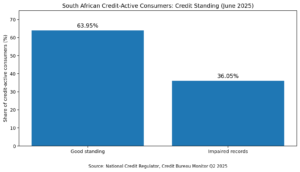
That means roughly 36 out of every 100 credit-active consumers were classified as having impaired records at that point.
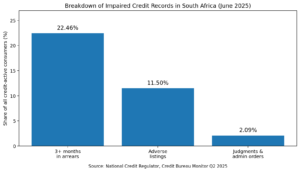
The NCR further broke the total credit-active population down as follows:
- 22.46% were three months or more in arrears.
- 11.50% had adverse listings.
- 2.09% had judgments and administration orders. (NCR)
Visual Graph 2 – Types of Credit Impairment
These statistics provide useful context.
Having credit difficulties is clearly not an unusual South African experience. But ignoring the problem generally doesn’t make it easier to solve.
Understanding exactly what your report says is the logical starting point.
How to Check Your Credit Report in South Africa
You don’t necessarily need to pay a company simply to see your basic credit information.
The NCR explains that South African consumers have the right to obtain a free credit record annually. (NCR)
TransUnion similarly states that consumers can access a TransUnion credit report once a year free of charge. (TransUnion South Africa)
Experian goes further with its current offering and says South African consumers can receive free unlimited access to their Experian personal credit report and score through its Up platform. (Experian)
You can start directly with the bureaus:
Experian South Africa – Free Credit Report
TransUnion South Africa – Annual Free Credit Report
Be cautious about websites promising a “free credit check” that are actually trying to sell you loans, subscriptions or lead-generation products.
When your objective is simply to inspect your credit record, going directly to a registered credit bureau is generally the cleaner starting point.
What You’ll Usually Need
A bureau needs to make sure that the person requesting your sensitive credit information is actually you.
The exact process depends on the bureau.
Experian, for example, says users of its Up service register and submit verification information, including identification and proof of residence, to access their report. (Experian)
Never casually send copies of your ID to an unknown website simply because it promises a credit score.
Credit information is sensitive personal information.
Check that you’re dealing with the legitimate bureau before submitting identification documents.
How to Read Your Credit Report Step by Step
Downloading the report is the easy part.
Understanding it is where the real value begins.
Do not open your report, look only at the score and close it again.
Work through it systematically.
1. Check Your Personal Information
Start with the boring-looking section.
It may include:
- Full name
- ID number
- Date of birth
- Addresses
- Contact details
- Employment information where available
Why care about an old address when you’re interested in your score?
Because incorrect personal information can indicate outdated data, a matching problem or something requiring investigation.
A previous address you recognise isn’t automatically a problem.
An address in a province where you have never lived deserves more attention.
The same applies to unfamiliar contact details.
What to ask yourself
Do I recognise every important piece of identifying information?
If not, investigate it.
2. Review Every Account Individually
This is arguably the most important part of the process.
Do not look only at your total debt.
Read the accounts one at a time.
For each account, identify:
| Check | Question |
|---|---|
| Provider | Do I recognise this company? |
| Account type | Is this actually my account? |
| Open date | Does the date make sense? |
| Balance | Is the amount approximately correct? |
| Instalment | Does it resemble what I pay? |
| Account status | Open, closed, current or overdue? |
| Payment history | Are missed payments shown? |
| Ownership | Did I actually open this account? |
Suppose your report shows:
ABC Retail Account – R4,750
Don’t simply think, “Yes, I owe that store.”
Check the rest.
Maybe you settled the account three months ago.
Maybe you owe R750 rather than R4,750.
Maybe the account was supposed to be closed.
Or perhaps you have never had an account with that retailer at all.
Those situations require different responses.
3. Understand Your Payment History
Payment history gives lenders insight into how you have managed existing obligations.
TransUnion says its credit-report product provides a 24-month overview of account-payment behaviour, showing whether accounts have been paid on time. (TransUnion South Africa)
Imagine two consumers each owe R20,000.
Consumer A
Has consistently paid the agreed instalments on time.
Consumer B
Has repeatedly missed payments and caught up later.
Their total debt may be identical.
Their repayment histories are not.
This is why how you manage debt can matter as much as simply having debt.
Credit itself is not automatically negative.
A home loan, vehicle finance or credit card doesn’t automatically make someone a bad borrower.
The question is how the obligations are being managed.
4. Understand “Current” and “In Arrears”
A current account generally means required payments are up to date according to the information reported.
An account in arrears means required payments have fallen behind.
For example:
Monthly instalment: R1,500
Suppose you miss March’s payment.
You pay R1,500 in April.
It may feel like you’re “paying again”, but depending on what else is due, you could still effectively be behind because April’s obligation has now arrived too.
This is where people sometimes become confused.
Paying something every month does not necessarily mean an account is current.
You need to know:
What amount was due?
What did you pay?
How much is overdue?
5. Look for Defaults, Adverse Information and Judgments
These sections deserve careful attention.
If something negative appears, don’t panic and don’t immediately pay a third party promising to “clear your name.”
First establish:
- What exactly is being reported?
- Who supplied the information?
- Is it accurate?
- Does it relate to you?
- What is the account’s current status?
- Has a debt you settled been updated appropriately?
The NCR states that consumers have the right to challenge information held by a credit bureau if they are unhappy with it. (NCR)
The distinction between accurate negative information and incorrect information is important.
A dispute process isn’t designed to magically erase genuine payment history simply because you don’t like it.
It is there to challenge information that you believe is inaccurate or otherwise improperly reflected.
6. Check Your Credit Enquiries
Credit enquiries can show organisations that have accessed your credit information for relevant purposes.
This section can also help you reconstruct your recent application activity.
Suppose you know that during the past few months you applied for:
- Vehicle finance
- One cellphone contract
- A credit card
Those enquiries may make sense.
But if you see activity connected with credit applications you know nothing about, don’t simply ignore it.
Investigate.
Credit reports can help identify potential identity theft or consumer fraud. (TransUnion South Africa)
7. Check Closed and Paid Accounts
One common assumption is:
“I paid the account, so it should disappear.”
Not necessarily.
Credit reports are histories, not merely lists of today’s outstanding bills.
An account can remain part of your credit history even when its balance is zero or its status is closed, subject to the rules governing how particular information is retained.
What matters is whether the information is accurate.
If an account was paid but still appears to have an outstanding balance that you believe is incorrect, investigate it.
Keep documents such as:
- Settlement letters
- Paid-up letters
- Final statements
- Payment confirmations
- Relevant correspondence
They may become extremely useful if you need to lodge a dispute.
What Does Your Credit Score Actually Mean?
This is where many online articles oversimplify things.
You will often see tables saying:
“600 is good.”
or:
“650 guarantees approval.”
Treat blanket claims like these cautiously.
Credit scoring models differ.
Experian’s South African consumer score, for example, uses a 0–999 scale. (Experian)
Other models may work differently.
Instead of obsessing over a generic internet number, ask:
Is my score improving or deteriorating?
A consistent upward trend can be more informative than comparing your number with an arbitrary table from a different scoring model.
What negative factors does my report identify?
Your report may give you clues about areas requiring attention.
Are my accounts being paid properly?
This is something you can directly influence.
Is everything accurate?
A high score doesn’t make an unfamiliar account acceptable.
Can I actually afford more debt?
This is arguably more important than whether a lender is willing to approve you.
Case Study 1: Thabo Is Declined Despite Never Missing a Payment
Consider a hypothetical but realistic example.
Thabo earns R24,000 per month.
He has:
| Account | Monthly commitment |
|---|---|
| Vehicle finance | R5,400 |
| Personal loan | R2,600 |
| Credit card | R1,200 |
| Retail accounts | R850 |
| Total | R10,050 |
Thabo has never intentionally skipped a payment.
He assumes this means another R50,000 personal loan should be easy to obtain.
He applies and is declined.
His immediate conclusion is:
“My credit score must be wrong.”
Not necessarily.
His existing listed debt commitments already total R10,050 per month.
Calculation:
R10,050 ÷ R24,000 × 100 = 41.9%
That is before considering rent, groceries, transport, insurance, electricity, school costs and other household expenses.
The lesson isn’t that a particular 41.9% ratio automatically means rejection.
Lenders have their own affordability and risk-assessment processes.
The lesson is that good repayment history doesn’t automatically mean unlimited borrowing capacity.
Your credit report and your affordability are related concepts, but they are not identical.
Case Study 2: Lerato Finds an Account She Never Opened
Lerato decides to inspect her credit report before applying for vehicle finance.
Most of the report looks normal.
Then she notices an unfamiliar credit account.
Balance:
R12,800
She has never dealt with the company.
The worst response would be:
“It’s probably nothing.”
Instead, she should investigate promptly.
She should check the details of the account, contact the relevant bureau and follow the appropriate dispute/fraud process.
Experian specifically encourages consumers to regularly check their reports because inaccuracies can misrepresent financial health and a report can help identify identity fraud. (Experian)
This is one of the strongest reasons to check a report even when you’re not planning to borrow money.
Your report is partly a financial security tool.
Case Study 3: Jerome Pays Off His Account but His Report Looks Wrong
Jerome had an old retail account.
Outstanding amount: R6,300
He negotiates payment and eventually settles the amount required.
Several months later, while reviewing his credit information, he believes the account details still don’t accurately reflect what happened.
Fortunately, Jerome kept:
- His final statement
- Bank payment confirmations
- Correspondence with the provider
- A paid-up confirmation
He can now approach the bureau with evidence rather than simply saying:
“I promise I paid it.”
Experian’s dispute process, for example, allows consumers to submit a dispute through its portal and upload supporting documentation such as a paid-up letter. (Experian)
Practical lesson
Don’t delete financial documents immediately after settling an account.
Create a folder — digital, physical or both — called something like:
PAID / CLOSED CREDIT ACCOUNTS
Keep important proof there.
Storage costs almost nothing.
Reconstructing years-old payment history can be much harder.
How to Dispute Incorrect Information on Your Credit Report
If you discover something that genuinely appears incorrect, don’t just complain about it on social media or repeatedly apply elsewhere.
Use the bureau’s dispute process.
Experian currently allows consumers to submit disputes through its Up platform and upload supporting documentation. It states that it has 20 business days to investigate and provide a response. (Experian)
The exact process may differ between bureaus.
A sensible dispute file might contain:
- Copy of your ID where legitimately required
- Proof of address where required
- Account number
- Name of credit provider
- Screenshot or copy of disputed entry
- Payment confirmation
- Paid-up letter
- Settlement letter
- Relevant bank statements
- Correspondence with the creditor
- Short explanation of what you believe is incorrect
Be precise
Weak:
“My credit report is wrong. Please fix it.”
Better:
“Account ending 4582 is shown with an outstanding balance of R4,200. I settled the account on 14 May and have attached the settlement confirmation and proof of payment. Please investigate whether the current information is accurate.”
The second version tells the investigator exactly what needs checking.
What If You Are Declined for Credit?
Being declined does not automatically mean you are “blacklisted.”
That word is commonly used in everyday South African conversation, but it can oversimplify what actually happened.
Your application could potentially be unsuccessful because of:
- Affordability
- Income requirements
- Existing obligations
- Repayment history
- Credit-provider policy
- Information on your credit profile
- The size or type of credit requested
- Verification problems
- Other risk criteria
Experian notes that consumers may ask a credit provider to explain the main reasons for refusing credit, refusing a limit increase, reducing an existing limit or offering a lower limit than requested. Where the credit report was the main problem, information about the relevant bureau should be disclosed so the consumer can inspect the report. (Experian)
That gives you something useful to work with.
Instead of immediately applying to five more lenders, establish why the first application failed.
Why Applying Everywhere Can Be a Bad Strategy
Imagine being declined for a R100,000 loan.
You immediately submit applications to another six lenders.
The thinking is:
“Someone must approve me.”
But if the underlying problem is affordability, incorrect credit information or excessive existing debt, repeated applications don’t solve it.
A better process is:
Application declined → Find out why → Check report → Check affordability → Correct problems → Reassess
not:
Declined → Apply → Declined → Apply → Declined → Apply
Borrowing should solve a legitimate financial need, not become a game of finding whichever institution finally says yes.
How Credit Providers May View the Same Person Differently
Suppose Nomsa applies to Bank A and Bank B on the same day.
Bank A approves her.
Bank B declines her.
That doesn’t automatically mean somebody made a mistake.
TransUnion explicitly notes that different lenders use different factors when assessing credit applications. (TransUnion South Africa)
Consider this simplified illustration:
| Factor | Lender A | Lender B |
|---|---|---|
| Credit score | Considered | Considered |
| Income | Considered | Considered |
| Existing debt | Considered | Considered |
| Internal risk model | Model A | Model B |
| Product criteria | Different | Different |
| Existing customer relationship | Possibly relevant | Possibly relevant |
| Result | Approved | Declined |
The credit bureau provides information and scoring tools.
The lender ultimately makes its own credit decision under its applicable criteria.
Credit Report Red Flags You Should Never Ignore
When checking your report, certain findings deserve immediate attention.
| Red flag | Possible meaning | Action |
|---|---|---|
| Unknown account | Error or possible fraud | Investigate immediately |
| Wrong balance | Reporting/update issue | Compare statements |
| Unknown address | Old data or identity concern | Verify |
| Missed payment you made | Possible reporting error | Find payment proof |
| Unexpected judgment | Serious issue requiring investigation | Verify details |
| Unknown credit enquiry | Possible unauthorised activity | Investigate |
| Paid account showing wrong status | Update/reporting issue | Contact provider/bureau |
| Duplicate-looking debt | Possible duplication | Verify account numbers |
Not every strange-looking entry means fraud.
Data can be old, incomplete or displayed differently than expected.
But unfamiliar financial activity should never simply be assumed to be harmless.
How Often Should You Check Your Credit Report?
The legal free-report entitlement gives consumers an obvious opportunity to review their information, but you don’t have to think about credit health only once every twelve months.
Experian currently provides unlimited free access through Up, while TransUnion provides an annual free report and also offers separate monitoring products. (Experian)
A practical schedule could be:
If you’re financially stable
Check periodically and at least make use of your free access.
Before applying for major finance
Check before applying for:
- A home loan
- Vehicle finance
- A significant personal loan
That gives you time to investigate mistakes.
After resolving a major credit problem
Check again later to see whether the information is accurately reflected.
If you suspect identity theft
Don’t wait for your annual routine.
Check promptly.
After unexplained credit rejection
Find out what contributed to the decision and inspect the relevant report.
A Simple 15-Minute Credit Report Audit
Here’s a practical routine you can actually use.
Minutes 1–3: Identity
Check:
Name → ID → addresses → contact details
Mark anything unfamiliar.
Minutes 4–8: Accounts
Go through every account.
Mark each:
Recognised / Unknown / Needs checking
Minutes 9–11: Payment behaviour
Look for:
Current → late → arrears → default
Compare questionable entries against your records.
Minutes 12–13: Negative information
Check any:
Defaults → adverse information → judgments
Verify that everything genuinely relates to you.
Minute 14: Enquiries
Look for organisations you don’t recognise.
Minute 15: Score and summary
Only now look closely at your score.
By this point, the number has context.
How to Improve Your Credit Profile Over Time
There is no legitimate magic button that transforms a weak credit profile overnight.
Creditworthiness is built through behaviour and accurate reporting over time.
Several practical principles can help.
Pay your obligations on time
Payment behaviour is an important part of credit information.
If possible, automate important payments with debit orders or scheduled transfers — while making sure sufficient money is available.
Deal with arrears rather than ignoring them
If you are struggling, communicate with the provider.
Ignoring letters, calls and statements does not reduce the balance.
Avoid borrowing simply because credit is available
A R40,000 credit limit is not an instruction to spend R40,000.
Available credit and affordable spending are two completely different things.
Keep your information accurate
Check your report periodically.
Don’t submit unnecessary applications
Apply for credit deliberately, not casually.
Build an emergency fund
An emergency fund isn’t technically a credit-score product, but it can help prevent a broken geyser, tyre replacement or unexpected medical bill from immediately turning into new debt.
Keep evidence when settling debt
That documentation can protect you if information later needs to be corrected.
Myth: Checking Your Own Credit Report Ruins Your Score
Consumers sometimes avoid checking their reports because they fear simply viewing the information will damage their score.
Don’t confuse checking your own consumer report with applying for credit.
You are specifically entitled to access your own credit information. The entire purpose of the free-report framework is to enable consumers to inspect what is being held about them. (NCR)
Regularly reviewing your own information is responsible financial behaviour.
Myth: A High Credit Score Means You Should Borrow More
No.
A strong profile might make you more attractive to lenders.
It doesn’t mean taking another loan is financially sensible.
Consider two options:
Option A
You qualify for a R100,000 loan and take it because it is available.
Option B
You qualify but realise you don’t need the money and would rather avoid years of repayments and interest.
The second decision doesn’t become foolish simply because a lender was willing to approve the first.
Creditworthiness measures lending risk. It does not decide whether borrowing serves your financial goals.
Myth: No Debt Automatically Means a Perfect Credit Profile
Not necessarily.
Someone who has never used credit may have less repayment history available than someone who has responsibly managed accounts for years.
The goal should therefore not be:
“I need to borrow money so I can create a score.”
The better goal is:
“When I use credit, I’ll use it responsibly and only when it makes financial sense.”
Never pay unnecessary interest purely because somebody told you that you “need debt” to become financially successful.
The Cost of Not Understanding Your Credit Report
Credit-report mistakes can have consequences.
But even when the report is completely accurate, not understanding it can lead to poor decisions.
Imagine that your report shows:
- Personal loan: R42,000
- Credit card: R18,000
- Retail accounts: R9,000
- Vehicle finance: R165,000
Total listed balances in this simplified example:
R234,000
You focus only on your credit score because it looks respectable.
But your real financial question should be:
Can my household comfortably service all these obligations while still paying for housing, food, transport, insurance, electricity, education and emergencies?
Credit health should never be reduced to chasing a number.
South Africa’s Credit Application Numbers Put This in Perspective
The NCR’s Consumer Credit Market Report for the quarter ended June 2025 recorded approximately 18.48 million credit applications during the quarter, up from 18.08 million in the preceding quarter.
The reported rejection rate was 67.00%. (NCR)
That doesn’t mean every rejection occurred because of a bad credit score.
Quite the opposite: it illustrates why consumers shouldn’t automatically interpret a decline as proof that they have been “blacklisted.”
Credit providers perform broader assessments.
If you’re declined, investigate before guessing.
Your Credit Report Review Checklist
Save this checklist and use it whenever you download a report:
| Question | Yes/No |
|---|---|
| Is my name correct? | ☐ |
| Is my ID information correct? | ☐ |
| Do I recognise my addresses? | ☐ |
| Do I recognise every open account? | ☐ |
| Are the balances reasonably accurate? | ☐ |
| Are settled accounts correctly reflected? | ☐ |
| Is my payment history accurate? | ☐ |
| Do I recognise negative listings? | ☐ |
| Do I recognise judgments shown? | ☐ |
| Do I recognise recent credit enquiries? | ☐ |
| Is there evidence of an account I never opened? | ☐ |
| Do I have documentation for disputed items? | ☐ |
If you answer No to something important, don’t panic.
Mark it and investigate.
Credit Report vs Bank Statement vs Budget
These three financial tools answer different questions.
| Tool | Main question |
|---|---|
| Credit report | How does my reported credit history look? |
| Bank statement | Where has my money actually gone? |
| Household budget | Can my income support my expenses and goals? |
Using all three gives you a much better picture than obsessing over your credit score alone.
For example, your credit report may say all your accounts are current.
Great.
Your bank statements might simultaneously show that you reach R0 five days before payday every month.
That’s a warning sign your credit score cannot solve.
What a Healthy Credit Routine Looks Like
You don’t need to spend every Friday night studying your credit profile.
Make it routine rather than obsessive.
A sensible personal-finance system might look like this:
Every month: Review your budget and account payments.
Periodically: Review outstanding debt balances.
Before major borrowing: Inspect your credit report.
When settling debt: Save proof permanently or for an appropriately long record-keeping period.
When you see suspicious activity: Investigate immediately.
When a report is inaccurate: Use the formal dispute process.
That’s enough for most households.
Final Thoughts: Your Credit Report Is a Tool, Not a Judgment of Your Worth
One of the worst ways to think about a credit report is as a financial school report telling you whether you’re “good” or “bad.”
It isn’t.
It’s data.
And data can be understood, checked and — where genuinely inaccurate — challenged.
South Africa had more than 29 million credit-active consumers by June 2025, with about 10.54 million classified as having impaired records. (NCR)
That statistic alone should remove some of the shame people attach to financial difficulty.
But it shouldn’t encourage complacency either.
If you’re behind on payments, find out exactly where you stand.
If your report contains a mistake, challenge it through the proper process.
If you discover an account you don’t recognise, investigate it.
If your report is accurate but your debt is becoming difficult to manage, focus on affordability and repayment rather than chasing a higher score.
And if everything looks good, don’t treat that as permission to take on unnecessary debt.
A strong financial position is not having the largest amount of credit available.
It is having control over your money, understanding your obligations and knowing exactly where you stand before making your next financial decision.
That is the real value of checking your credit report.
Careertime note: The figures used in the two original charts above are based on the National Credit Regulator’s Credit Bureau Monitor for the quarter ended June 2025. Credit-bureau products, score models and access procedures can change, so readers should verify current requirements directly with the relevant bureau before acting. This article is educational and should not be treated as individual financial or legal advice. (NCR)