
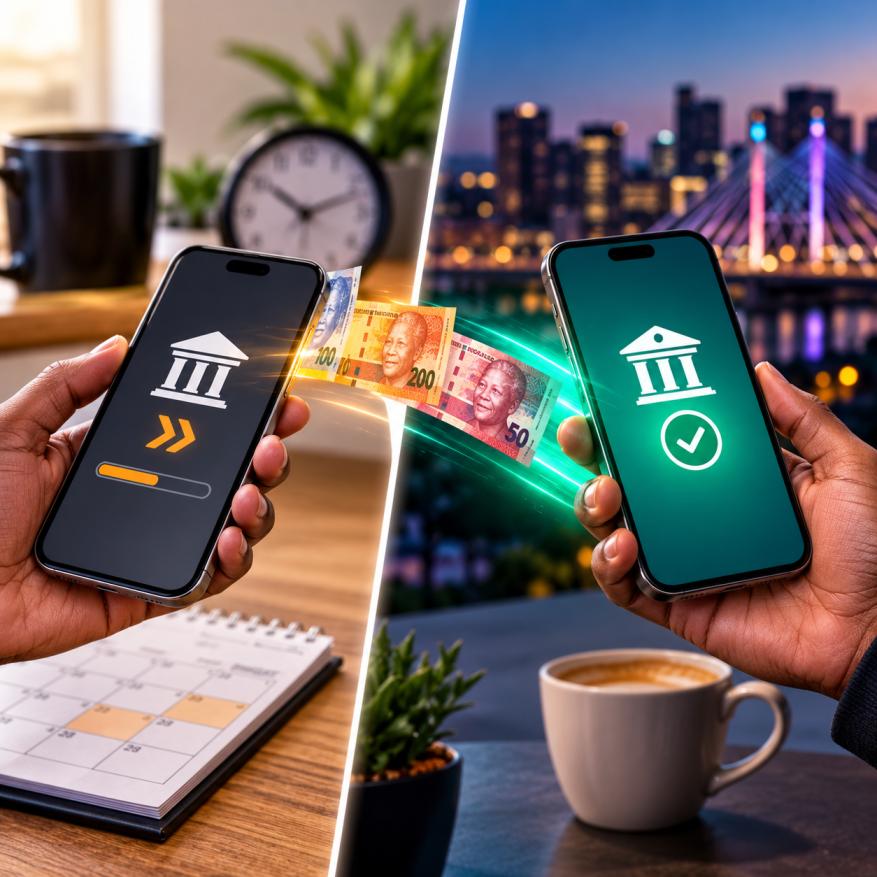
An ordinary EFT and an instant payment can both move money from your bank account to somebody else, but they don’t necessarily move at the same speed, cost the same amount or use the same payment system. Understanding the difference can save you money—and prevent unnecessary panic when a payment doesn’t reflect immediately.
You owe someone R2,000.
They send you their banking details, you add them as a beneficiary and your banking app gives you two choices:
Pay normally or pay immediately.
The instant option looks better. Why would anyone deliberately choose the slower payment?
Then you notice something else.
The immediate option may carry an additional fee.
Now the decision isn’t quite so obvious.
For a landlord who needs proof that you’ve paid rent today, speed may matter. For R250 you’re transferring to a family member who doesn’t need it until tomorrow, paying extra for speed may accomplish very little.
There’s another complication: South Africa’s payment system has changed considerably. Consumers now encounter ordinary EFTs, older real-time payment services and newer options such as PayShap.
They’re all ways of transferring money, but they’re not identical.
This guide explains what happens behind the Pay button.
The Short Answer
An ordinary EFT typically moves money electronically from one bank account to another using batch processing. When different banks are involved, the payment isn’t necessarily reflected immediately.
An instant or real-time payment uses a payment system designed to make funds available much faster—often within seconds.
South Africa also has PayShap, a modern real-time payment system that can allow participating-bank customers to send money rapidly and, where supported, use identifiers such as a cellphone-number-linked ShapID rather than traditional account details.
According to South Africa’s payments-industry information, EFT credits are batch processed and can have same-day, one-day or two-day service levels, while real-time payment systems are designed for immediate interbank transfers. (PASA)
The simplest comparison is:
| Feature | Ordinary EFT | Instant/real-time payment |
|---|---|---|
| Speed | Not necessarily immediate | Usually very fast |
| Processing | Batch-based | Real-time |
| Different banks | May take longer to reflect | Designed for rapid interbank transfer |
| Cost | Often cheaper, depending on bank/account | May cost more, depending on service |
| Best for | Non-urgent payments | Time-sensitive payments |
| Mistake risk | Still serious | Particularly important to verify before sending |
But there’s much more to understand before deciding which one to use.
What Does EFT Actually Mean?
EFT stands for Electronic Funds Transfer.
The term itself is broad, but in everyday South African banking, people commonly use “EFT” to describe an electronic credit payment sent from one bank account to another.
For example:
You bank with Bank A.
Your landlord banks with Bank B.
You instruct Bank A to send R7,500 from your account to your landlord’s account.
That’s an electronic credit transfer.
Traditional EFT Credit in South Africa operates as a batch-based payment system rather than processing every interbank transaction individually in real time.
South African payment-system information describes EFT Credit as supporting both single and bulk payments, with settlement service levels that can be same-day or extend over one or two business days. (PASA)
This explains something South Africans have experienced for years:
“I paid you, but it hasn’t reflected yet.”
Both people may be telling the truth.
The payer may genuinely have sent the money while the recipient’s bank hasn’t yet made the funds available.
What Is an Instant Payment?
An instant payment is designed to eliminate much of that waiting.
Instead of the transaction sitting within a traditional batch-processing cycle, a real-time payment system is designed to process the transaction quickly between participating institutions.
South Africa’s established Real-Time Clearing (RTC) system clears eligible transactions rapidly, while the newer Rapid Payment system—marketed as PayShap—was designed as a modernised real-time payment platform. (PASA)
For the consumer, the difference can feel like this:
Ordinary EFT
08:15: You send R1,000.
08:16: Money leaves your account.
08:20: Recipient checks.
Nothing yet.
Later: Payment reflects.
Real-time payment
08:15: You send R1,000.
Shortly afterwards: Recipient can generally see the funds.
The exact customer experience depends on the bank and service being used.
Why Doesn’t Every EFT Happen Instantly?
This question makes perfect sense in 2026.
If WhatsApp messages cross the world in seconds, why should money between two South African banks sometimes take longer?
Because a bank payment isn’t simply a message saying:
“Shannon sent R500.”
Behind the scenes, financial institutions must exchange payment instructions and ultimately settle financial obligations through regulated payment infrastructure.
Traditional EFT Credit was built around batch processing.
Think of it conceptually as:
Payment instructions collected → processed in groups → cleared → settled → recipient credited
rather than:
Payment sent → individually processed immediately
Modern real-time systems were specifically developed to improve that experience.
How Long Does an Ordinary EFT Take in South Africa?
There isn’t one universal answer.
Timing can depend on:
- Sending bank;
- Receiving bank;
- Payment service;
- Time of day;
- Processing cut-offs;
- Business days;
- Weekends;
- Public holidays; and
- Whether both accounts are at the same institution.
PASA’s published consumer FAQ says interbank transfers are usually processed overnight and funds may take approximately 24 to 48 hours to reflect, while its payment-system information explains that EFT Credit supports same-day, one-day and two-day processing levels. (PASA)
That doesn’t mean every EFT takes 48 hours.
Many payments arrive sooner.
It means you shouldn’t automatically assume fraud simply because an ordinary interbank EFT hasn’t reflected five minutes after the sender made it.
Same Bank vs Different Bank
This distinction is important.
Suppose both you and your friend bank with the same institution.
The bank may be able to update balances within its own systems without relying on the same interbank processing path needed when money travels between separate banks.
That can make an ordinary payment between customers of the same bank appear much faster.
Compare:
Customer A → Bank X → Customer B at Bank X
with:
Customer A → Bank X → interbank payment infrastructure → Bank Y → Customer B
The second payment involves more than one institution.
This is why asking:
“How long does an EFT take?”
isn’t enough.
A better question is:
“How long does this type of payment take from my bank to the recipient’s bank?”
What Is PayShap?
PayShap is one of the biggest changes to South African everyday payments in recent years.
It launched in March 2023 as the market-facing service built on South Africa’s Rapid Payment system.
Unlike traditional EFT Credit, PayShap is a modern real-time payment system built using the ISO 20022 messaging standard. (PASA)
One of its important features is the ability to support proxy-based payments.
Instead of always needing to type:
- Bank name;
- Account number;
- Account type; and
- Branch information,
a person can, where supported and properly registered, receive payment using a ShapID, commonly linked to a cellphone number.
That can make person-to-person payments much easier.
A Simple PayShap Example
Suppose Lerato needs to send Kabelo R450.
With a traditional account-based payment, she may need Kabelo’s banking information.
With a supported PayShap setup, Kabelo could have a registered ShapID associated with his account.
Lerato selects the appropriate PayShap option through her participating bank, identifies Kabelo using the supported payment identifier, verifies the recipient information and sends R450.
The payment travels through the real-time infrastructure.
For everyday person-to-person payments, that can be far more convenient than exchanging full bank-account details.
PayShap Has Grown Quickly
This isn’t merely a niche payment experiment.
PASA’s 2024 integrated report recorded extraordinary growth in PayShap usage during that year.
According to the report:
- PayShap transaction volume grew 1,662.68% during 2024;
- Transaction value grew 1,950.26%;
- Average PayShap transaction size was approximately R798; and
- Monthly PayShap volumes had overtaken RTC volumes by October 2024. (PASA)
Those numbers tell an interesting story.
PayShap was increasingly being used for the kind of smaller, everyday transactions that modern real-time payments were designed to make easier.
Comparing Average Transaction Sizes
The same 2024 industry report provides a useful comparison.
| Payment system | Average transaction size in 2024 |
|---|---|
| EFT Credit | R11,672 |
| RTC | R6,205 |
| PayShap | R798 |
(PASA)
That doesn’t mean EFTs are “for R11,672” or PayShap should only be used for R798.
Those are averages.
But they illustrate how consumers and businesses were using the systems differently.
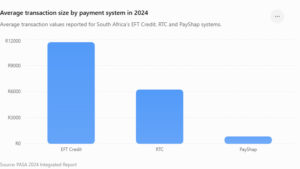
The difference is substantial.
The average EFT Credit transaction was nearly 15 times the average PayShap transaction in that dataset.
That fits PayShap’s role as a convenient option for lower-value, everyday real-time payments.
EFT vs Instant Payment: Full Comparison
Here’s the practical consumer comparison.
| Question | Ordinary EFT | Instant/real-time payment |
|---|---|---|
| Is it electronic? | Yes | Yes |
| Is it necessarily immediate? | No | Designed to be |
| Can it work between banks? | Yes | Yes, where supported |
| Does it use batch processing? | Traditional EFT Credit does | No, real-time systems differ |
| Might it cost extra? | Depends on bank/account | Often possible |
| Good for urgent payment? | Not ideal if timing is critical | Usually better |
| Good for scheduled non-urgent bills? | Often | Possible, but speed may add little value |
| Can mistakes be serious? | Yes | Yes |
| Should recipient details be checked? | Absolutely | Absolutely |
Does Instant Payment Mean “Guaranteed Instantly”?
Be careful with the word instant.
Real-time systems are designed for rapid processing, but consumers should still allow for exceptional circumstances such as:
- Technical outages;
- Bank maintenance;
- Fraud screening;
- Incorrect details;
- Service availability;
- Transaction limits; or
- Other processing exceptions.
South Africa’s RTC system has historically operated with a service level of around 60 seconds, while PayShap is also designed for real-time processing. (PASA)
That’s dramatically faster than traditional batch EFT processing.
But don’t promise someone:
“It is mathematically impossible for this payment to take longer than 60 seconds.”
Payment technology can experience exceptions.
Does Instant Payment Cost More?
It can.
Banks establish their own customer pricing, and prices can change.
Depending on your account and institution:
- Ordinary electronic payments may be included in a monthly bundle;
- EFTs may have a small transaction fee;
- Real-time payments may carry a higher fee;
- PayShap may have different pricing;
- Some accounts may include particular transactions for free; or
- Promotional pricing may apply.
This is why SAWise won’t tell you:
“Instant payments cost R10.”
That would become inaccurate as soon as one bank changed its pricing.
Check your bank’s current pricing guide before choosing a payment method based on cost.
Is Paying for Speed Worth It?
Sometimes.
Sometimes not.
Let’s use a hypothetical example.
Your bank charges:
Ordinary EFT: R1
Immediate payment: R8
The difference is:
R7
Now suppose you make 20 payments every month.
If all 20 are sent immediately:
20 × R8 = R160
If all 20 use ordinary EFT:
20 × R1 = R20
Difference:
R140 per month
Over 12 months:
R140 × 12 = R1,680
This is purely an illustrative calculation—not a representation of a particular bank’s current pricing.
But it demonstrates an important budgeting principle:
Convenience fees that look tiny per transaction can become meaningful when repeated.
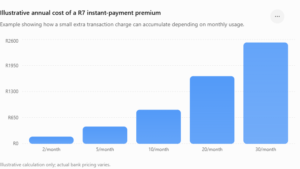
Illustrative Annual Cost of Paying Extra for Speed
Assume an additional R7 per instant payment:
The lesson isn’t “never use instant payments.”
It’s:
Pay for speed when speed has value.
When an Ordinary EFT Makes Sense
An ordinary EFT may be perfectly suitable when the payment isn’t urgent.
For example:
Paying before a deadline
Your rent is due Friday.
You pay on Wednesday and have enough time for an ordinary interbank payment to process.
Moving money between your own accounts
If timing isn’t critical, paying extra for instant processing may be unnecessary.
Paying a supplier early
An invoice is due in seven days.
You’re paying today.
Routine household payments
If the recipient doesn’t require immediate access to the money, ordinary EFT may be enough.
The key is planning.
An ordinary EFT only becomes inconvenient when you treat a non-real-time payment as though it were guaranteed to arrive immediately.
When an Instant Payment Can Be Worth It
There are situations where speed has real value.
Emergency
A family member needs money urgently for transport.
Time-sensitive purchase
A legitimate seller needs cleared payment before releasing goods.
Late payment
You’ve left a bill until the deadline and need funds to reach the recipient quickly.
Business transaction
A supplier won’t release urgent stock until payment reflects.
Person-to-person payment
You’re splitting a restaurant bill and want the other person to receive their share immediately.
In those cases, an extra transaction fee may be worth the convenience.
Proof of Payment Is Not the Same as Money in the Account
This may be the most important section in the entire article.
Someone sends you a screenshot:
PAYMENT SUCCESSFUL — R8,000
Does that mean you should hand over your laptop, phone or car?
No.
A proof of payment shows—or purports to show—that a payment instruction was made.
It isn’t a substitute for independently checking whether the money is actually available in your bank account.
Fake proof-of-payment scams are common enough that consumers and businesses should adopt a simple rule:
If cleared funds matter, check your own account.
Don’t rely solely on:
- SMS;
- Email;
- WhatsApp screenshot;
- PDF proof of payment;
- Buyer’s phone screen; or
- A message claiming “the bank is delayed.”
Example: Selling a Phone Online
You’re selling a smartphone for R9,000.
The buyer arrives.
They say:
“I’ll EFT you now.”
They make a payment and show you a professional-looking proof of payment.
You don’t see the R9,000 in your account.
The buyer says:
“I’m with another bank. It’ll reflect tomorrow.”
Should you hand over the phone?
If your agreement requires cleared funds before releasing the item, wait until you’ve independently confirmed receipt.
A screenshot can be forged.
A real ordinary EFT can also legitimately take time.
You cannot reliably distinguish those two situations simply by staring at the buyer’s screenshot.
Instant Payment Can Reduce Waiting—but Not the Need to Verify
Suppose the buyer uses a legitimate real-time payment service.
That may allow you to verify receipt much faster.
That’s useful.
But you still verify using your own bank account.
The security principle doesn’t change:
Don’t trust the sender’s screen. Trust your verified account information.
Is an Instant Payment Safer Than an EFT?
Not automatically.
Speed is not the same thing as safety.
A real-time payment can actually make a mistake more urgent because money can reach the wrong recipient very quickly.
Suppose you send:
R15,000
to the wrong beneficiary using a fast payment method.
The payment’s greatest advantage—speed—has now become your problem.
That’s why the previous SAWise article about sending money to the wrong bank account is directly relevant here.
Before approving a fast payment, check:
Recipient → Account/identifier → Amount → Reference → Confirm
Once money has been sent, don’t assume an “instant” service includes an instant undo feature.
What Happens If You Send an EFT on Friday?
This is one of the classic South African banking questions.
You send an ordinary interbank EFT late on Friday.
The recipient checks Friday evening.
Nothing.
Saturday morning.
Nothing.
Now everybody is worried.
Whether and when it reflects depends on the specific payment service, processing rules and institutions involved.
Traditional EFT Credit isn’t the same as real-time payment, and business-day processing can matter.
PASA’s consumer guidance has historically advised that interbank EFTs can take 24–48 hours to reflect. (PASA)
The practical solution for a genuinely time-sensitive Friday payment is not to send a normal EFT and then argue about the delay.
Choose an appropriate real-time option before paying, if available and suitable.
What About Public Holidays?
The same planning principle applies.
If a payment deadline falls around:
- Christmas;
- New Year;
- Easter;
- Heritage Day;
- Freedom Day; or
- Another public holiday,
don’t assume an ordinary interbank EFT will behave exactly like a real-time payment.
Pay early or use an appropriate faster service if the payment genuinely needs to arrive quickly.
What Is RTC?
Before PayShap, South Africa already had a real-time retail payment system known as Real-Time Clearing (RTC).
RTC is designed to clear eligible interbank payment instructions rapidly.
Industry reporting describes RTC payments as being cleared within approximately 60 seconds, with funds made available according to that service level. (PASA)
So PayShap didn’t invent the idea of fast bank-to-bank payments in South Africa.
What PayShap represents is a modernised real-time infrastructure, including newer functionality such as proxy-based addressing.
EFT, RTC and PayShap Aren’t Just Three Names for the Same Thing
At infrastructure level, South Africa has distinct credit-transfer systems.
Industry reporting describes them broadly as:
EFT Credit
Legacy batch-based payment system.
RTC
Older real-time payment infrastructure.
Rapid Payment / PayShap
Modern real-time infrastructure built around ISO 20022 and designed to support additional services.
(PASA)
Your banking app may not display those technical names clearly.
You may simply see:
Normal payment
Immediate payment
PayShap
But underneath those buttons can be different payment rails.
What Is ISO 20022 and Why Should You Care?
You don’t need to understand banking message standards to send R500 to your cousin.
But since we’re going in-depth, here’s the simple version.
ISO 20022 is an international financial messaging standard that allows structured information to accompany financial transactions.
PayShap was built using this modern messaging approach, whereas South Africa’s older RTC infrastructure uses the ISO 8583 message standard. (PASA)
For ordinary consumers, the significance isn’t the acronym.
It’s that South Africa’s payments infrastructure is being modernised to support faster, richer and more flexible digital payment services.
South Africa’s Payments System Is Changing
There’s an important current development readers should know.
As of 2 September 2026, functions previously performed through PASA transitioned to the South African Reserve Bank and PayInc as part of restructuring South Africa’s payment-system governance.
The SARB says PayInc now handles payment clearing house functions including EFT credit and debit, PayShap, Registered Mandate and RTC, while the Reserve Bank handles relevant regulatory, authorisation and standards responsibilities. The SARB says the transition was designed to occur without disruption to everyday payments. (South African Reserve Bank)
For consumers, that doesn’t mean your banking app suddenly works differently.
It means the institutional structure behind South Africa’s payment system has changed.
This is a good example of why SAWise checks current official information rather than recycling an article written five years ago.
Payment Limits Matter
Just because a payment system can technically support a certain value doesn’t mean your banking profile lets you send that amount.
There can be several layers of limits:
Payment-system limit
Bank limit
Account/product limit
Your personal digital banking limit
Fraud/security limit
PASA’s current credit-payment information describes low-value payments as transactions up to R5 million, while individual payment systems and banks can impose additional limits. (PASA)
So if your banking app refuses a R200,000 immediate payment, that doesn’t necessarily mean South Africa’s payment system cannot move R200,000.
Your specific bank or profile may have a lower limit.
Don’t Increase Your Banking Limit Carelessly
If you need to make a large payment, don’t permanently increase your digital transfer limit far beyond your normal needs simply for convenience.
Higher transaction limits can increase potential losses if your account is compromised.
If your bank allows temporary limit changes, consider whether that’s more appropriate.
After making a significant payment:
- Confirm the transaction;
- Review your account;
- Restore sensible limits if necessary; and
- Keep proof of the legitimate transaction.
Security should be part of payment planning.
EFT vs Instant Payment for Rent
Suppose rent of R8,500 is due on the first day of the month.
Option A
Pay by ordinary EFT two business days before the deadline.
Potential advantage:
You may avoid an additional instant-payment charge.
Option B
Remember at 21:00 on the due date.
Now speed matters much more.
An immediate payment may be worth the fee.
The financial lesson is subtle:
Planning can save transaction fees.
You don’t always need faster banking technology.
Sometimes you simply need to pay earlier.
EFT vs Instant Payment for Businesses
Businesses face different considerations.
A small company may make 100 or 500 payments per month.
If every payment unnecessarily attracts an additional real-time fee, transaction costs can become material.
Suppose a business makes:
300 payments per month
and instant processing costs an illustrative R6 more than its ordinary alternative.
Extra monthly cost:
300 × R6 = R1,800
Annual:
R1,800 × 12 = R21,600
Again, those are hypothetical fees.
But they show why businesses should have a payment policy rather than automatically choosing the fastest option.
A Practical Business Payment Policy
A small business might use:
Ordinary EFT: supplier payments made well before due date.
Real-time payment: urgent stock, emergency operational expenses or other genuinely time-sensitive transactions.
PayShap: appropriate smaller real-time payments where supported.
Dual verification: high-value or changed-beneficiary payments.
This balances:
speed + cost + security.
When Cheap Is More Important Than Fast
If you’re sending R100 to somebody who only needs it next week, paying a large percentage of the transaction value for speed may make little sense.
Imagine:
Payment: R100
Illustrative ordinary fee: R1
Illustrative instant fee: R8
The additional R7 represents 7% of the money you’re sending.
For a R100,000 payment, R7 is insignificant by comparison.
This is why transaction fees should sometimes be considered relative to payment size.
When Speed Is More Important Than Cost
Now imagine you’re stranded and need to pay R250 for urgent transport.
If an extra few rand makes the money available immediately, the convenience may easily justify the cost.
Personal finance isn’t always about choosing the cheapest possible option.
It’s about understanding what you’re paying for and whether it provides value in that situation.
What If an EFT Doesn’t Reflect?
Don’t immediately send the money again.
First:
- Check your transaction history.
- Confirm the payment status.
- Verify beneficiary details.
- Confirm the payment method used.
- Check when the payment was made.
- Allow for the applicable processing period.
- Contact your bank if the expected period passes without resolution.
Sending a second payment can turn a delayed payment into a duplicate payment.
What If the Money Left Your Account but the Recipient Says Nothing Arrived?
This is exactly where payment type matters.
Ask:
Was it ordinary EFT or real-time?
If ordinary EFT, there may still be legitimate processing time.
If it was a real-time service and substantially exceeds the expected timeframe, investigate.
Save:
- Transaction ID;
- Proof of payment;
- Beneficiary details;
- Amount;
- Date;
- Time; and
- Bank reference.
Then contact your bank through an official channel.
Never Pay Again Just Because Someone Is Pressuring You
A seller says:
“It didn’t reflect. Send another one and I’ll refund the first one tomorrow.”
Stop.
Check.
You don’t want this:
First payment: R5,000
Second payment: R5,000
First payment eventually reflects.
You’ve now paid:
R10,000
for a R5,000 purchase.
Bank delays are frustrating.
Duplicate payments are worse.
What If You Need to Reverse an Instant Payment?
Don’t assume you can.
The precise reversal process depends on the payment type and bank.
Real-time payment systems are designed to move money quickly and with finality.
If you’ve paid the wrong beneficiary, contact your bank immediately.
Don’t wait for the recipient to spend or transfer the funds.
This is exactly why recipient verification matters even more when using fast payments.
A Useful Rule: Fast Money Requires Slow Checking
It sounds contradictory, but it’s one of the best payment habits you can develop.
The faster your payment will move, the slower you should be before pressing Confirm.
For a large payment, take 20 seconds.
Check:
- Recipient;
- Bank/account or ShapID;
- Amount;
- Reference;
- Payment type.
Twenty seconds is nothing compared with spending three weeks trying to recover R20,000.
Five Common EFT Myths
Myth 1: “All electronic payments are instant.”
No. Traditional EFT Credit uses batch processing. (PASA)
Myth 2: “If the money left my account, the other person must already have it.”
Not necessarily. The transaction may still be moving through the applicable payment process.
Myth 3: “A proof of payment means the money is definitely in my account.”
No. Independently verify receipt.
Myth 4: “Instant payments can always be reversed instantly.”
Don’t assume this. Contact your bank immediately after an incorrect payment.
Myth 5: “The fastest payment is always the best payment.”
No. If a payment isn’t urgent, speed may provide little benefit relative to its cost.
The SAWise Payment Decision
Before choosing a payment type, ask three questions:
How urgent is it?
If the recipient needs the money immediately, real-time payment has genuine value.
How much does speed cost?
Check the transaction fee.
How confident am I in the recipient details?
For large or first-time payments, verification matters more than speed.
Think of it as:
Urgency + Cost + Confidence = Payment choice
Frequently Asked Questions
What is the difference between EFT and instant payment in South Africa?
Traditional EFT Credit is processed in batches and isn’t necessarily immediate. Real-time payment systems are designed to process interbank payments much faster. (PASA)
How long does an EFT take between South African banks?
It depends on the service and banks involved. Published industry guidance notes that interbank EFTs can take roughly 24–48 hours to reflect, while EFT Credit supports same-day, one-day and two-day processing levels. (PASA)
Is an instant payment really instant?
Real-time systems are designed for very fast processing. RTC and PayShap have been described as making funds available in real time, with around a 60-second service level, although technical and other exceptions can occur. (PASA)
Is PayShap an EFT?
PayShap is a Rapid Payment system rather than the traditional batch-based EFT Credit system. Both transfer money electronically, but they use different payment infrastructure. (PASA)
What is a ShapID?
A ShapID is a proxy identifier that can be linked to a bank account for supported PayShap payments, commonly using a cellphone number rather than requiring the payer to enter traditional account details.
Is PayShap only for small payments?
PayShap is particularly useful for everyday payments, but limits can change and may differ across banks. Check your bank’s current PayShap limits before sending a larger amount.
Why does an EFT sometimes reflect immediately?
Payments within the same bank can behave differently from interbank transfers, and EFT service levels can vary. A fast previous payment doesn’t guarantee every future EFT will reflect at the same speed.
Why does an EFT take longer over weekends?
Traditional EFT Credit isn’t a real-time system, and processing schedules and business days can affect timing. If timing is critical, investigate an appropriate real-time payment option before sending.
Is instant payment safer?
Not automatically. Faster settlement doesn’t eliminate scams, incorrect beneficiary details or human error.
Can I trust proof of payment?
Use proof of payment as documentation, but where receipt of cleared funds matters, verify the money through your own banking account or official banking channel.
Should I use instant payment for rent?
If you pay early enough for ordinary EFT processing, you may not need to pay extra for speed. If you’re paying close to a deadline, an appropriate real-time option may be useful.
What happens if I send an instant payment to the wrong person?
Contact your bank immediately and ask about the appropriate recovery process. Don’t assume a real-time payment can automatically be undone.
Ordinary EFT Isn’t “Bad” and Instant Payment Isn’t “Better”
It’s tempting to think of payment technology as a simple ladder:
Slow = old and bad
Fast = new and good
That’s not how sensible money management works.
An ordinary EFT can be an excellent payment method when:
- The payment isn’t urgent;
- You’ve planned ahead;
- The cost is lower; and
- The recipient doesn’t require immediate access.
A real-time payment can be excellent when:
- Timing genuinely matters;
- The recipient needs cleared funds quickly; and
- The convenience justifies any additional cost.
PayShap adds another useful option, particularly for modern person-to-person real-time payments.
The best choice isn’t automatically the fastest.
It’s the payment method that fits the transaction.
Before you press Pay, ask:
Does this money actually need to arrive immediately?
If the answer is no, you may not need to pay for speed.
If the answer is yes, choose an appropriate real-time option—but check the recipient details carefully before confirming.
Because once money starts moving in real time, your opportunity to catch a mistake can disappear just as quickly.
A Final Thought
Good money habits aren’t only about saving and investing. They’re also about how you move the money you already have. Paying a little earlier, checking the recipient twice and choosing the right payment method can save fees, prevent mistakes and remove unnecessary financial stress.
Average transaction values reported for South Africa’s EFT Credit, RTC and PayShap systems.
| system | average |
|---|---|
| EFT Credit | 11,672 |
| RTC | 6,205 |
| PayShap | 798 |
Example showing how a small extra transaction charge can accumulate depending on monthly usage.
| payments | annual |
|---|---|
| 2/month | 168 |
| 5/month | 420 |
| 10/month | 840 |
| 20/month | 1,680 |
| 30/month | 2,520 |