
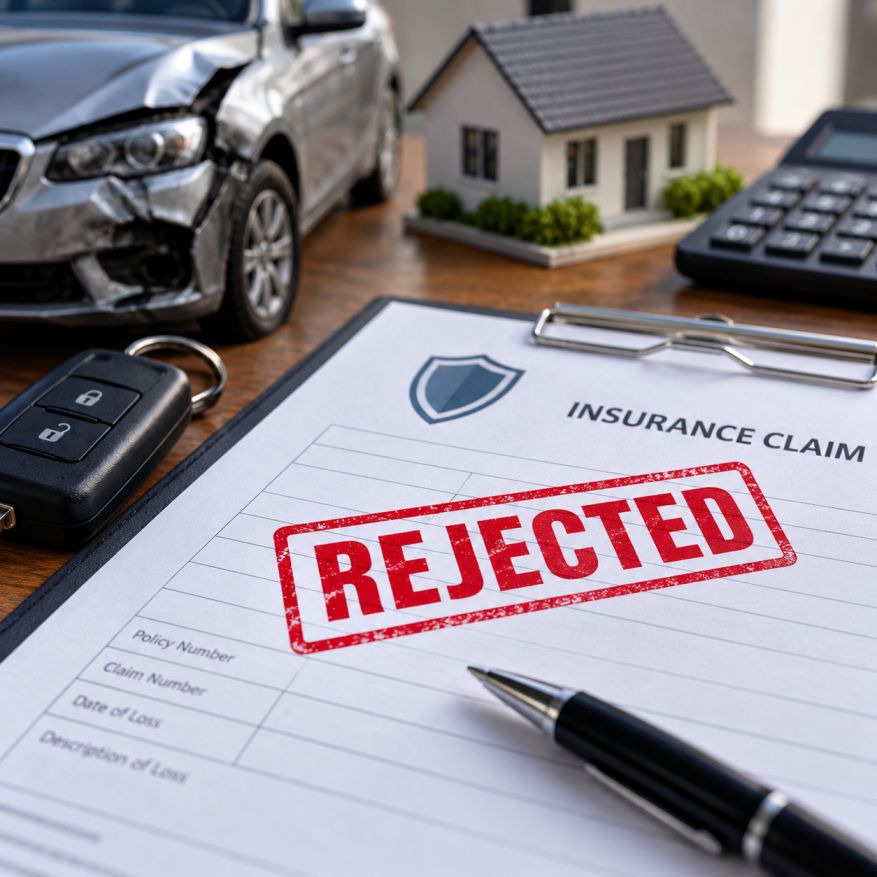
An insurance rejection can leave you facing a damaged car, stolen property, storm damage, medical expenses or even a major family financial loss with no payout. But a rejected claim is not necessarily the end of the road. This guide explains why South African insurers reject claims, when a rejection may be challenged, what evidence matters, how the complaints process works, and what you can do to protect yourself before your next claim.
You Paid Insurance for Years. Then the One Time You Need It, the Answer Is “No.”
Picture this.
You reverse out of your driveway every morning knowing that your car is insured.
The premium comes off your account every month.
R1,300.
R1,300.
R1,300.
Month after month.
Then one evening you have an accident.
Nobody is seriously hurt, but the front of your vehicle is badly damaged.
The repair estimate comes back:
R86,000
You submit your insurance claim.
Photos.
Police details.
Driver’s information.
Everything the insurer requests.
You wait.
Eventually, an email arrives.
You expect to see information about repairs.
Instead, you read:
“We regret to inform you that your claim has been declined.”
That’s the moment insurance stops being an abstract monthly debit order.
Suddenly, the wording inside a policy document you probably haven’t looked at since buying the cover can determine who pays R86,000.
And that is where many South Africans discover an uncomfortable truth:
Having insurance does not mean every loss is insured.
Insurance covers specific events, under specific conditions, subject to specific exclusions and obligations.
However, there’s another side to this.
An insurer rejecting your claim does not automatically mean the insurer is correct.
South African consumers have internal review and external dispute-resolution options, and real cases show that insurer decisions can be changed.
The National Financial Ombud Scheme’s Non-life Insurance Division recorded 10,054 complaints in 2025 and resolved 11,428, while motor insurance represented 35% of complaints and homeowners’ insurance 27%. (NFOSA)
Across the NFO as a whole, approximately R442.9 million was returned to financial consumers during 2025. Of that, roughly R299.6 million related to life insurance and R82.9 million to non-life insurance matters. (NFOSA)
Those numbers tell us something important.
Sometimes consumers are wrong about what their policy covers.
Sometimes insurers are justified in declining claims.
And sometimes:
A rejection deserves to be challenged.
Let’s work out the difference.
🇿🇦 First: What Does “Rejected” or “Repudiated” Actually Mean?
You’ll often hear insurance companies use the word:
Repudiated.
In ordinary language, it means the insurer has refused to pay the claim, or disputes its liability under the policy.
The important question isn’t simply:
“Was my claim rejected?”
It is:
Why was it rejected?
That reason determines your next move.
A claim could be declined because:
- The event isn’t covered;
- A specific exclusion applies;
- A policy condition wasn’t complied with;
- A premium wasn’t paid;
- Material information wasn’t disclosed;
- Information supplied during the claim is disputed;
- The claimed damage resulted from wear and tear rather than an insured event;
- Required security measures weren’t in place;
- The policy had already lapsed;
- The insurer believes the circumstances fall outside the agreed cover.
These are very different problems.
And they require different responses.
📊 Insurance Complaints Are Not Rare
The National Financial Ombud’s 2025 results give us useful real-world context.
In non-life insurance:
Motor vehicle insurance: 35% of complaints.
Homeowners’ insurance: 27%.
Among motor disputes, 70% involved accident claims, while theft and hijacking accounted for 8%.
For homeowners’ insurance, acts of nature accounted for 42% of complaints, followed by burst water apparatus such as geysers at 15%. (NFOSA)
SAWise visual breakdown
Major non-life complaint categories — NFO 2025

Motor vehicle insurance   ████████████████████████████████  35%
Homeowners' insurance     █████████████████████████        27%
Other categories          ███████████████████████████████████ 38%
And what caused many disputes?
For motor claims, the NFO says prominent rejection reasons included exclusions relating to driving under the influence and lack of due care/recklessness.
For homeowners’ claims, major rejection issues included gradual deterioration, lack of maintenance, wear and tear, and defective design, construction or materials. (NFOSA)
These aren’t obscure technicalities.
They’re situations ordinary policyholders encounter every day.
🧠 Why Insurance Claims Get Rejected
Let’s go beyond the usual generic list.
The easiest way to understand insurance rejection is to separate it into six broad questions.
Question 1
Did the insured event actually happen?
Question 2
Does your policy cover that event?
Question 3
Does an exclusion remove that cover?
Question 4
Did you comply with your policy obligations?
Question 5
Was the information supplied to the insurer accurate?
Question 6
Can the insurer prove the reason it is relying on?
That final question is important.
A policy exclusion existing on page 43 doesn’t automatically prove that it applies to what happened to you.
🚗 Reason #1: A Policy Exclusion Applies
Insurance policies don’t only tell you what they cover.
They also tell you what they don’t cover.
Imagine your motor policy contains an exclusion relating to driving more than a specified amount above the speed limit.
You crash.
Your vehicle tracker records you travelling at:
114 km/h
The road limit was:
60 km/h
The insurer may have evidence supporting reliance on that exclusion.
This isn’t theoretical.
The NFO discussed a real dispute in 2026 where a motorist’s tracking information indicated a speed of 114 km/h in a 60 km/h zone. The policy contained an exclusion relating to exceeding the speed limit by more than 20 km/h, and the NFO ultimately found that the insurer had established the relevant rejection reason. (NFOSA)
That’s an important lesson:
Technology can become evidence in an insurance claim.
Your tracker isn’t only useful when your car is stolen.
Its data may potentially help reconstruct what happened before an accident.
🚘 But an Exclusion Isn’t a Magic Word
Now consider another situation.
Your insurer says:
“You failed to take reasonable care.”
Does that automatically end the claim?
No.
The facts matter.
In another real NFO matter, a motorist stopped on the side of a road, left the engine running and later became the victim of an armed hijacking.
The insurer relied on a lack-of-due-care/recklessness exclusion.
The NFO examined how the hijacking actually occurred and concluded that the complainant’s conduct amounted, at most, to negligence rather than recklessness in those circumstances. It recommended that the insurer settle the claim, and the insurer agreed. (NFOSA)
That’s a powerful distinction.
Same general type of exclusion.
Different facts.
Different outcome.
🔍 Materiality Matters
This is one of the most useful concepts a policyholder can understand.
Suppose your policy requires something.
You didn’t comply perfectly.
The question can become:
Did that failure actually matter to the loss?
The NFO has specifically highlighted the importance of materiality when considering exclusions: the facts relied upon to trigger an exclusion need to be relevant to the claim and the loss in question. (NFOSA)
Consider this simplified SAWise example.
Your vehicle is hijacked at gunpoint.
The insurer discovers that one tyre was slightly underinflated.
True?
Yes.
Relevant to the hijacking?
Probably not.
Compare that with:
Your policy requires an active tracking device for theft cover.
The tracker wasn’t working.
The vehicle is stolen and cannot be recovered.
Now the connection may be much more significant.
The exact policy wording and circumstances matter.
📡 Reason #2: You Didn’t Meet a Security Requirement
This is particularly important in South Africa.
Your insurer may require:
An alarm.
A vehicle tracker.
Two tracking devices for certain high-risk vehicles.
Burglar bars.
A security gate.
An immobiliser.
A particular safe.
Other risk-management measures.
The NFO specifically warns consumers that where a policy requires a tracking device, it needs to remain in good working order, and responsibility for compliance rests with the policyholder. It notes that some policies may require two functioning tracking devices for certain vehicles. (NFOSA)
Don’t assume:
“I installed the tracker when I bought the car, so I’m sorted.”
Ask:
Is it active?
Is the subscription paid?
Is it functioning?
Does the insurer require one or two devices?
Did the insurer specify a particular type?
🏠 Reason #3: Maintenance Is Not the Same Thing as Insurance
This is one of the biggest misunderstandings with homeowners’ insurance.
Imagine your ceiling collapses.
You say:
“My house is insured.”
An assessor inspects the roof.
The report finds years of water ingress, deteriorated waterproofing and rotting timber.
The insurer says:
Gradual deterioration and lack of maintenance.
Claim rejected.
The policyholder thinks:
“But the roof is damaged. Isn’t that why I have insurance?”
The issue is how the damage occurred.
Insurance generally exists to cover specified insured events.
It isn’t necessarily a maintenance contract for deterioration that happens gradually over years.
In the NFO’s 2025 complaint analysis, homeowners’ claim disputes frequently involved rejections based on gradual deterioration, lack of maintenance, wear and tear, followed by defective design, construction or materials. (NFOSA)
🌧️ Storm Damage vs Old Roof Damage
This distinction can become complicated.
Suppose heavy rain arrives on Monday.
On Tuesday, your ceiling collapses.
You say:
Storm damage.
The insurer’s assessor says:
Long-term deterioration.
Who’s right?
Potentially either.
This is where evidence becomes critical.
You might need:
- Weather records;
- Photographs from before and after;
- Maintenance invoices;
- Roofing reports;
- Contractor statements;
- Insurer assessment;
- An independent expert report.
The NFO specifically advises that if you’re unhappy with an insurer’s validation report, you can obtain your own report to challenge the findings. (NFOSA)
That can be much stronger than simply writing:
“I disagree.”
🧮 Case Study #1: The R180,000 Storm Claim
This is an original SAWise composite case study created for educational purposes.
Meet fictional homeowner Nadia.
Her home is insured for building damage.
After severe wind and rain, part of the roof fails.
Damage estimate:
R180,000
The insurer appoints an assessor.
The report states:
Long-term roof deterioration and inadequate maintenance.
The claim is declined.
Nadia is furious.
She says:
“There was nothing wrong until the storm.”
At this point, Nadia has two possible approaches.
Approach A
Send angry emails saying:
“I’ve been paying insurance for 12 years!”
Emotionally understandable.
Evidentially weak.
Approach B
Obtain:
Roof maintenance invoices from 18 months earlier.
Before-and-after photographs.
A report from an independent roofing engineer.
Weather information showing unusually severe wind in the area.
Evidence showing which section of the structure failed first.
Now Nadia isn’t arguing:
“This is unfair.”
She’s arguing:
“The evidence does not support your stated reason for repudiation.”
That’s a completely different complaint.
📊 Emotion vs Evidence
Strength of a claim challenge

"I've paid for years!"                  ██
"This isn't fair!"                      ██
"My neighbour's claim was paid."        ███
"Here are dated photos."                ███████
"Here are maintenance invoices."        ████████
"Here is an independent expert report." ██████████
This isn’t a legal ranking.
It’s a practical lesson:
Insurance disputes are won with facts, documents and policy wording—not frustration alone.
📝 Reason #4: Non-Disclosure or Incorrect Information
When you apply for insurance, the insurer asks questions for a reason.
Where is the car parked?
Who regularly drives it?
What is it used for?
Where do you live?
Have you had previous claims?
What security measures exist?
Life insurance can involve questions about:
Health.
Occupation.
Smoking.
Medical history.
Other risk factors.
If information that matters to the insurer’s risk assessment isn’t disclosed accurately, problems can arise later.
The NFO’s Life Insurance Division specifically lists non-disclosure among typical causes of insurance complaints. (NFOSA)
🚗 “But My Son Only Drives It Sometimes”
Here’s a common type of problem.
Policy says:
Regular driver:
Mother, age 48
Reality:
Her 21-year-old son uses the vehicle almost every day.
Then he crashes it.
The insurer investigates.
The issue isn’t necessarily:
“Are children allowed to drive their parents’ cars?”
The issue is:
Was the risk presented accurately when the policy was priced and accepted?
If the insurer asked who the regular driver was, the answer matters.
Don’t try to obtain a cheaper premium by giving the answer that produces the lowest quotation.
Give the accurate answer.
Cheap insurance that doesn’t match the actual risk can become extremely expensive when you claim.
🚬 Life Insurance Makes Disclosure Even More Important
Imagine someone applies for substantial life cover.
The application asks:
“Do you smoke?”
The applicant regularly smokes but answers:
No.
Why?
Because the premium may be lower.
Years later, the insured dies.
The beneficiaries submit a claim.
The insurer investigates the original application.
Now the family is dealing with a dispute at the worst possible time.
The lesson isn’t complicated:
Answer insurance questions truthfully and completely.
If you don’t understand a question, ask the insurer or broker to explain it rather than guessing. The NFO gives the same practical advice to policyholders. (NFOSA)
💳 Reason #5: Your Premium Wasn’t Paid
Insurance only works while cover is in force according to the policy and applicable rules.
Maybe your debit order bounced.
Maybe you changed bank accounts.
Maybe your card expired.
Maybe you stopped the debit order accidentally.
Maybe you thought the insurer would try again.
Then something happens.
This can create a serious dispute.
However, don’t automatically assume:
“Debit order failed = no claim.”
Policyholder Protection Rules contain requirements around premiums and claims, including protections and processes that depend on the type of insurance and circumstances. For example, long-term insurance rules restrict repudiating a claim merely because payment wasn’t made on the due date where payment was made within an applicable grace period. (Government of South Africa)
Your exact policy and the applicable regulatory framework matter.
📱 A Simple Habit That Could Save You Thousands
Once a month:
Open your banking app.
Check:
Did the insurance debit order actually go through?
That’s it.
Thirty seconds.
Especially after:
Changing banks.
Replacing cards.
Salary-date changes.
Account problems.
Debit-order disputes.
Don’t wait for an accident to discover that your policy stopped months ago.
🍺 Reason #6: Alcohol and Driving
This is an area where assumptions can become dangerous.
Some motorists believe:
“Unless the police took blood and proved I was over the limit, my insurer has to pay.”
Not necessarily.
Insurance disputes are civil matters, and the NFO has explained that an insurer may seek to establish on a balance of probabilities that the driver was under the influence.
Evidence can potentially include surrounding circumstances rather than only a blood or breath test. (NFOSA)
The NFO reported a surge during 2025 in complaints involving motor accident claims rejected because insurers alleged that drivers were under the influence of alcohol or another intoxicating substance. (NFOSA)
📲 Your Digital Trail Can Matter
Modern claims investigations can involve more evidence than many drivers expect.
Depending on circumstances, evidence may include:
Vehicle tracking data.
Cellphone information.
Photographs.
Witness statements.
Police information.
CCTV.
Location information.
Damage patterns.
Statements made during the claim.
The NFO has discussed cases where tracking data played an important role in determining vehicle speed before an accident. (NFOSA)
That leads to one of the most important rules in this entire article:
Don’t invent a better story. Tell the truth.
If you don’t remember something, say you don’t remember.
Don’t create details because you think they sound more favourable.
A small inconsistency can turn into a much bigger credibility problem.
💥 Case Study #2: The R320,000 Vehicle Write-Off
Original SAWise composite scenario.
Meet fictional Mandla.
Vehicle value:
R320,000
Late Saturday night, he loses control of the car.
The vehicle is written off.
During the claim interview he says:
“I drove directly from my friend’s house.”
The insurer investigates.
Tracking information indicates that the vehicle had stopped near an entertainment venue earlier.
Now there are two issues.
Issue 1
What actually caused the accident?
Issue 2
Why does Mandla’s version appear inconsistent with available evidence?
Even if the first issue was potentially arguable, Mandla has made his position much harder by giving inaccurate information.
A better response would have been:
“I was at several places earlier. I don’t remember the exact timing, but I’ll provide whatever information I can.”
Truth may not guarantee payment.
But dishonesty can destroy credibility.
🚙 Reason #7: The Insurer Says You Were Reckless
“Recklessness” and “lack of due care” frequently appear in motor insurance disputes.
But ordinary negligence and recklessness are not necessarily identical concepts.
The NFO’s real hijacking matter discussed earlier demonstrates this.
The insurer argued that the motorist had behaved recklessly.
After examining the circumstances, the NFO disagreed and recommended settlement. (NFOSA)
So if your rejection letter simply says:
“You failed to exercise due care.”
Don’t stop reading.
Ask:
What specific conduct?
What policy clause?
What evidence?
How did that conduct cause or contribute to the loss?
That’s how you turn a vague rejection into something you can evaluate.
📑 Reason #8: The Event Simply Wasn’t Covered
Sometimes the insurer isn’t relying on wrongdoing at all.
The loss may simply fall outside the policy.
For example:
You have third-party-only motor cover.
Your own car is damaged in an accident you caused.
You submit a claim for your vehicle.
The policy never promised comprehensive cover.
That’s not necessarily an unfair rejection.
It’s a mismatch between:
What you thought you bought
and:
What you actually bought.
This is why policy schedules matter.
🔎 Your Policy Schedule May Be More Important Than the Brochure
Marketing says:
“Comprehensive protection.”
Your schedule says:
Excess: R8,500.
Specified driver conditions.
Tracker required.
Vehicle use: private only.
Security requirements.
Specified insured value.
Additional exclusions.
Guess which document matters when you claim?
The contract.
Marketing helps sell insurance.
Policy wording defines insurance.
💸 Rejected vs Reduced Claims: They’re Not the Same Thing
Your insurer might not reject your claim completely.
It could say:
“We’ll pay R60,000 of your R100,000 claim.”
Now you have a quantum dispute—a disagreement about how much is payable.
This can happen because of:
Excesses.
Underinsurance.
Valuation.
Depreciation where applicable.
Repair costs.
Replacement basis.
Average clauses.
Limits.
Sub-limits.
Excluded portions of damage.
The NFO’s historical complaint reporting identifies disputes over claim quantum as another significant source of complaints. (NFOSA)
🏠 Underinsurance Can Produce a Painful Surprise
Imagine the replacement value of your household contents is:
R1,000,000
But you insure them for:
R500,000
You’re 50% insured.
Then there’s a burglary causing:
R100,000
of covered loss.
Some policy wordings may apply the principle of average.
A simplified illustration:
R500,000 ÷ R1,000,000
=
50%
Then:
50% × R100,000 loss
=
R50,000
before applicable excesses and other policy considerations.
The NFO specifically warns that underinsurance can result in an average clause being applied and a significantly reduced payout. (NFOSA)
📊 Underinsurance Example
| Replacement value | Sum insured | Insured proportion | R200,000 covered loss — simplified proportional amount* |
|---|---|---|---|
| R1,000,000 | R1,000,000 | 100% | R200,000 |
| R1,000,000 | R800,000 | 80% | R160,000 |
| R1,000,000 | R600,000 | 60% | R120,000 |
| R1,000,000 | R500,000 | 50% | R100,000 |
*Illustrative only. Actual policy wording, limits, excesses and claim circumstances determine payment.
This is why:
“I insured my contents for R500,000 because I’d never lose everything at once”
can be dangerous reasoning.
An average clause can potentially affect a partial loss too.
🛑 Your Claim Has Been Rejected. What Do You Do Now?
This is where the article becomes practical.
Do not immediately:
Cancel your policy.
Threaten the call-centre agent.
Post accusations online.
Hire an attorney.
Give up.
Instead, create a proper dispute file.
STEP 1 — Get the Rejection in Writing
Do not rely on:
“The guy on the phone said they won’t pay.”
You need the insurer’s formal decision.
South Africa’s Policyholder Protection Rules require an insurer to notify a claimant in writing of its claims decision within 10 days after making the decision.
Where the insurer repudiates or disputes a claim or its amount, the notice must explain the reasons in plain language and in enough detail for the claimant to dispute those reasons if desired. (Government of South Africa)
That’s extremely important.
You are entitled to understand:
Why.
STEP 2 — Find the Exact Clause
Take the rejection letter.
Highlight the reason.
Now open your policy wording.
Find the relevant clause.
For example:
Rejection:
Failure to comply with vehicle tracking requirement.
Policy:
Theft/hijack cover requires an active approved tracking device.
Now you know exactly what the dispute is about.
Don’t challenge “the whole insurer.”
Challenge the specific conclusion.
STEP 3 — Build an Evidence Table
Use something like this:
| Insurer says | Policy clause | Their evidence | My evidence |
|---|---|---|---|
| Tracker inactive | Section X | Tracker report | Subscription/payment records |
| Roof poorly maintained | Section Y | Assessor report | Maintenance invoices |
| Excessive speed | Section Z | Tracking data | Independent reconstruction |
| Non-disclosure | Section A | Application | Original correspondence |
This simple table can expose whether you actually have a dispute worth pursuing.
STEP 4 — Ask Yourself an Uncomfortable Question
Could the insurer actually be right?
This matters.
Not every rejection is unfair.
If:
The policy clearly excludes the event,
the condition clearly applies,
the evidence is strong,
and you have nothing contradicting it,
then escalating indefinitely may not change the outcome.
A trustworthy consumer guide shouldn’t tell readers:
Fight every rejected claim.
It should tell them:
Understand every rejected claim. Challenge the ones that deserve challenging.
STEP 5 — Use the Insurer’s Internal Review Process
If you believe the decision is wrong, submit a formal written dispute.
Your letter should be structured.
Not:
“This is disgusting. I’ve paid you for 10 years.”
Instead:
Claim number
123456
Decision challenged
Claim repudiation dated [date].
Insurer’s stated reason
[Exact reason.]Why I disagree
[Specific factual/policy argument.]Evidence
[List attachments.]Requested outcome
Please review the repudiation and reconsider the claim.
Simple.
Professional.
Evidence-driven.
⏰ You Have Important Time Limits
Do not put the rejection letter in a drawer for eight months.
Under the Policyholder Protection Rules for short-term insurance, where a claim is repudiated or disputed, the written notice must tell the claimant that they have a period of not less than 90 days after receiving the notice to make representations to the insurer.
It must also explain the insurer’s internal escalation/review process, the right to approach the relevant ombud, relevant time limits and any applicable time limitation for legal action. (Government of South Africa)
If you make representations through the relevant internal review process, the rules require the insurer to communicate its resulting decision in writing within 45 days of receiving the representation. (Government of South Africa)
Don’t rely on this article alone for your deadline.
Read your rejection letter immediately.
STEP 6 — If Internal Review Fails, Consider the NFO
This part has changed compared with older articles you may find online.
South Africa now has the:
National Financial Ombud Scheme South Africa (NFO)
The NFO deals with consumer complaints involving participating:
- Non-life insurers;
- Life insurers;
- Banks;
- Credit providers.
Its dispute-resolution service is free to consumers. (NFOSA)
If an older article tells you to contact the separate Ombudsman for Short-Term Insurance or Ombudsman for Long-Term Insurance, be careful: those functions have been consolidated into the NFO. (National Government of South Africa)
🧭 The Insurance Dispute Journey
LOSS OCCURS
     │
     ▼
CLAIM SUBMITTED
     │
     ▼
INSURER INVESTIGATES
     │
     ├──────────────► CLAIM PAID
     │
     ▼
CLAIM REJECTED / AMOUNT DISPUTED
     │
     ▼
READ WRITTEN REASONS
     │
     ▼
CHECK POLICY + EVIDENCE
     │
     ▼
INTERNAL INSURER REVIEW
     │
     ├──────────────► DECISION CHANGED
     │
     ▼
NATIONAL FINANCIAL OMBUD
     │
     ▼
FURTHER LEGAL/OTHER OPTIONS
where appropriate
The NFO says you must generally first lodge the complaint with your insurer before it can consider the matter. (NFOSA)
National Financial Ombud Scheme South Africa
💥 Case Study #3: The R420,000 Hijacked Vehicle
Let’s use a scenario inspired by the type of disputes the NFO actually sees, but with fictional people and numbers.
This SAWise case study is illustrative and does not describe an identifiable consumer.
Meet Jerome.
Vehicle insured value:
R420,000
Jerome stops briefly.
His vehicle is later hijacked at gunpoint.
The insurer rejects the claim, arguing that he behaved recklessly and failed to take reasonable precautions.
Jerome has two choices.
Choice 1
Accept the R420,000 loss immediately.
Choice 2
Examine whether the exclusion actually fits the facts.
He gathers:
Police report.
Timeline.
Location photographs.
Witness information.
Tracker records.
Policy wording.
Statement describing exactly how the hijacking occurred.
The key question becomes:
Would the precautions the insurer says he should have taken actually have prevented the loss?
This mirrors the logic in the real NFO hijacking dispute mentioned earlier, where the ombud found the consumer’s actions weren’t reckless in the circumstances and recommended settlement. (NFOSA)
A single word in a rejection letter—”reckless”—doesn’t end the analysis.
Facts do.
📈 Rejections Really Do Get Overturned
This is perhaps the most important statistic for someone staring at a rejection letter.
In 2024, the NFO’s Non-life Insurance Division reported an overturn/resolved ratio of 16.5%.
The NFO describes this as an indicator of complaints where the insurer’s decision or approach changed with an additional benefit to the insured.
Consumers approaching that division received approximately:
R107.4 million
in recorded monetary benefit during 2024. (NFOSA)
And in 2025, the Non-life Insurance Division returned approximately:
R82.9 million
to consumers. (NFOSA)
Don’t interpret that as:
“16.5% of all insurance claims are wrongly rejected.”
It does not mean that.
It relates to complaints handled by the NFO’s Non-life Insurance Division during that reporting period.
But it proves something useful:
Insurer decisions can change after independent scrutiny.
📊 A Rejected Claim Is Not Automatically a Lost Claim
Possible paths after rejection

Rejection justified
        ↓
Decision stands

Insurer overlooked evidence
        ↓
Internal review may change outcome

Interpretation disputed
        ↓
Internal review / NFO

Insurer's exclusion doesn't fit facts
        ↓
Potential reversal

Quantum disputed
        ↓
Further assessment / negotiation / NFO
The correct response depends on the evidence.
📷 What Evidence Should You Keep?
For motor accidents:
- Photos of vehicles;
- Photos of road conditions;
- Dashcam footage;
- Witness details;
- Police information;
- Tow-truck details;
- Tracker information;
- Repair estimates;
- Correspondence;
- Claim forms.
For theft:
- Police case information;
- Proof of ownership;
- Security records;
- Tracker information;
- Receipts;
- CCTV where available.
For property:
- Before-and-after photos;
- Maintenance records;
- Contractor invoices;
- Expert reports;
- Weather evidence;
- Repair quotations;
- Proof of ownership.
For life/funeral/disability:
- Policy documents;
- Application documents;
- Medical information where relevant;
- Premium records;
- Death/medical documentation;
- Beneficiary information;
- Correspondence.
Your future claim begins before the loss occurs.
Good records make good evidence.
🚨 Never Manufacture Evidence
Don’t:
Alter invoices.
Change dates.
Ask someone to create a fake receipt.
Edit photographs deceptively.
Invent a witness.
Lie about where the car was.
Hide information.
A questionable R5,000 detail can potentially put a R500,000 claim at risk.
The NFO has explicitly warned that policyholders should tell the truth when claiming because false information can undermine a claim and potentially create an additional misrepresentation issue. (NFOSA)
🔧 Maintenance Records Are Insurance Evidence
This deserves repeating.
You service your roof.
Keep the invoice.
Repair waterproofing.
Keep the invoice.
Service your alarm.
Keep proof.
Maintain your vehicle.
Keep records.
Replace a faulty tracker.
Keep confirmation.
Why?
Because two years later, somebody might say:
“This damage resulted from poor maintenance.”
And instead of answering:
“No it didn’t.”
you can answer:
“Here are the records.”
📞 What If Your Broker Told You Something Different?
This can complicate matters.
Maybe you told your broker:
“My son drives the car every day.”
But the schedule lists you as the regular driver.
Or you asked:
“Is the solar system covered?”
and were told yes.
Then the claim is rejected.
Preserve:
Emails.
WhatsApps.
Application forms.
Recorded communications where lawfully available.
Advice documentation.
Policy schedules.
Broker correspondence.
The dispute may involve not only the insurer’s interpretation of the policy but potentially the advice or intermediary process.
Depending on the nature of the complaint, different ombud structures or regulatory avenues may be relevant.
Don’t delete correspondence once the policy starts.
💡 Seven Questions to Ask After a Rejection
Write these down:
1. What exact policy clause are you relying on?
2. What evidence supports your conclusion?
3. How does that clause apply to what actually happened?
4. Can I obtain the assessor’s or investigator’s findings where appropriate?
5. What is your internal review process?
6. What deadline applies to my objection?
7. What external complaint route applies if the decision remains unchanged?
Those questions turn:
“Why won’t you pay me?”
into a structured investigation.
❌ Arguments That Usually Don’t Resolve the Real Issue
“I’ve been a customer for 15 years.”
Relevant emotionally.
Not necessarily relevant to whether the event is covered.
“I’ve never claimed before.”
Good claims history doesn’t rewrite an exclusion.
“My neighbour got paid.”
Their policy and circumstances may differ.
“Nobody explained that clause to me.”
Potentially relevant depending on circumstances—but first establish exactly what was provided and disclosed.
“The damage is definitely worth R100,000.”
If the dispute is about coverage, proving the repair cost doesn’t prove the claim is insured.
“I’ll cancel all my policies!”
That doesn’t establish that the rejected claim should be paid.
Focus on the contractual and factual issue.
🛡️ How to Reduce the Chance of Your Next Claim Being Rejected
The best insurance dispute is the one you never have.
Once a year, do an insurance audit.
Check:
Your vehicle
Correct regular driver?
Correct address?
Correct usage?
Tracker working?
Security requirements met?
Finance details correct?
Accessories declared where required?
Your home
Replacement value current?
Building maintained?
Security requirements met?
Renovations disclosed where necessary?
Solar equipment addressed appropriately?
Your contents
Replacement values current?
High-value items specified where required?
Proof of ownership retained?
Your life insurance
Personal details accurate?
Beneficiaries current where applicable?
Premiums paid?
Relevant disclosures accurate?
📅 The 15-Minute Annual Insurance Check
Create one date every year.
Maybe:
1 January
or your birthday.
Open every policy.
Ask:
Has anything changed?
New car?
Moved house?
New driver?
Working from home?
Business use?
New expensive electronics?
Solar installation?
Renovations?
Security change?
Marriage?
Divorce?
New child?
New beneficiary needs?
Insurance purchased five years ago may not perfectly reflect your life today.
🧮 The Cost of Checking vs the Cost of Discovering
Annual policy review:
15–60 minutes
Potential rejected vehicle claim:
R300,000
Potential property claim:
R500,000+
Potential life cover:
R1 million+
A boring hour reading insurance documents can have an extraordinary financial return.
❓ Frequently Asked Questions
Can an insurer legally reject my claim in South Africa?
Yes. A claim can legitimately be rejected where it falls outside the policy or an applicable exclusion or condition permits rejection. However, the insurer must follow applicable rules, and you can challenge a decision you believe is incorrect.
Does the insurer have to explain why my claim was rejected?
For claims governed by the relevant Policyholder Protection Rules, a repudiation/dispute notice must give reasons in plain language and sufficient detail to allow the claimant to dispute them. (Government of South Africa)
How long does an insurer have to tell me about its claims decision?
The short-term Policyholder Protection Rules state that the insurer must notify the claimant in writing within 10 days after taking the decision. (Government of South Africa)
Can I appeal a rejected insurance claim?
Yes. Insurers must have claims escalation/review processes under the applicable rules, and rejection communications should explain the process and relevant time limits. (Government of South Africa)
How long do I have to challenge the decision?
Don’t assume one universal deadline. Read the rejection letter. Under the short-term PPR framework discussed above, the insurer must provide at least 90 days from receipt of the repudiation/dispute notice for representations to the insurer, and the notice must explain other relevant time limits. (Government of South Africa)
What happens after I ask the insurer to reconsider?
Under those rules, where representations are made through the internal review process, the insurer must notify the claimant in writing of its resulting decision within 45 days of receiving the representation. (Government of South Africa)
Who handles insurance complaints in South Africa now?
The National Financial Ombud Scheme South Africa handles complaints involving participating life and non-life insurers, as well as banks and credit providers. (NFOSA)
Does it cost money to complain to the NFO?
The NFO describes its consumer dispute-resolution service as free. (NFOSA)
Can I go directly to the NFO?
The NFO says consumers should first lodge their complaint with the relevant insurer, bank or credit provider before opening a case with the NFO. (NFOSA)
Can my car insurance claim be rejected because I was speeding?
Potentially, depending on the policy wording and evidence. The NFO has dealt with cases involving specific speed-related exclusions and tracking evidence. (NFOSA)
Can insurance reject my claim because my tracker wasn’t working?
Potentially. The NFO warns that if a policy requires a functioning tracking device, compliance is the policyholder’s responsibility. (NFOSA)
Can my house insurance claim be rejected because of poor maintenance?
Potentially. Gradual deterioration, lack of maintenance and wear and tear are prominent reasons behind homeowners’ insurance disputes reported by the NFO. (NFOSA)
Should I get my own assessor?
If you disagree with an insurer’s technical report, an appropriate independent report can be valuable. The NFO specifically advises consumers that they can obtain their own report to challenge an insurer’s findings. (NFOSA)
Can I challenge the amount instead of the whole rejection?
Yes. Insurance disputes aren’t limited to total repudiation. Consumers can also dispute the quantum—the amount offered or payable.
Does a rejected claim mean I’ve wasted all my premiums?
Not necessarily. Insurance premiums pay for cover during the insured period; they don’t operate like a savings account. A particular rejected claim doesn’t automatically mean the policy never provided protection.
Can the NFO force an insurer to reconsider?
The NFO provides independent dispute resolution, and its published statistics demonstrate that complaints can result in changed outcomes and financial benefits to consumers. (NFOSA)
📊 Three Rejected Claims, Three Different Outcomes
Let’s put our examples side by side.
| Scenario | Claim | Rejection issue | Strongest response | Possible lesson |
|---|---|---|---|---|
| Nadia’s roof | R180,000 | Maintenance/deterioration | Independent report + maintenance evidence | Prove cause |
| Mandla’s vehicle | R320,000 | Driving circumstances/inconsistent account | Accurate evidence and timeline | Never invent details |
| Jerome’s hijacking | R420,000 | Recklessness/due care | Examine materiality and actual sequence | An exclusion must fit the facts |
Notice something?
There isn’t one magic appeal letter.
The strongest response depends on:
Why the insurer said no.
🔥 The SAWise Rejected-Claim Checklist
If you receive a rejection today:
☑ Don’t panic
☑ Get the decision in writing
☑ Note every deadline immediately
☑ Identify the exact rejection reason
☑ Find the exact policy clause
☑ Read your policy schedule as well as the wording
☑ Request clarity about the insurer’s evidence where necessary
☑ Gather your own evidence
☑ Obtain an independent expert opinion where worthwhile
☑ Keep every email and document
☑ Submit a structured internal review
☑ Stick to facts
☑ Never manufacture evidence
☑ Ask for the final internal decision in writing
☑ Consider the NFO if the dispute remains unresolved and falls within its jurisdiction
☑ Get appropriate professional/legal advice where the value or complexity justifies it
💚 Conclusion: A Rejection Letter Is a Decision—Not Something You Should Accept Without Understanding
Insurance is built on trust from both sides.
You trust the insurer to honour the policy when a covered event occurs.
The insurer relies on you to provide accurate information and comply with the agreed conditions.
Sometimes the system works exactly as intended.
A policyholder claims for something that was never insured.
The insurer explains why.
The rejection is correct.
But sometimes things aren’t so simple.
An assessor may interpret damage as long-term deterioration.
Another expert may conclude that a storm caused the failure.
An insurer may describe someone’s behaviour as reckless.
The evidence may show ordinary negligence rather than recklessness.
A tracking record may prove that an exclusion applies.
Or the insurer’s evidence may fail to establish the connection it claims.
That’s why your first reaction to a rejected claim shouldn’t automatically be:
“The insurer is stealing my money.”
And it shouldn’t automatically be:
“There’s nothing I can do.”
It should be:
“Show me why.”
Read the rejection.
Read the policy.
Find the clause.
Look at the evidence.
Understand the timeline.
Then decide whether the decision makes sense.
If it does, you’ve learned exactly what your policy does and doesn’t cover.
If it doesn’t, South Africa has mechanisms for challenging it.
The NFO’s own figures show why those mechanisms matter. During 2025, the scheme returned approximately R442.9 million to financial consumers, including around R82.9 million through its Non-life Insurance Division and R299.6 million through Life Insurance. (NFOSA)
That does not mean every unhappy policyholder will win.
It means:
Independent review matters.
The strongest insurance consumer isn’t the person who knows every clause by heart.
It’s the person who keeps accurate information, maintains what needs maintaining, understands the important conditions, tells the truth when claiming, keeps evidence and knows what questions to ask when something doesn’t add up.
Insurance is bought before disaster.
But its real value is tested after disaster.
And when a claim is rejected, don’t judge your position from one sentence saying:
DECLINED.
Understand the reason behind it.
Because sometimes “no” is correct.
And sometimes:
“No” deserves another look.
SAWise Methodology & Trust Note
This article distinguishes between official statistics, real NFO decisions and original SAWise examples. The three named case studies are fictional composite scenarios created to explain common insurance disputes and should not be interpreted as testimonials or personal experiences. Real-world examples specifically identified as NFO cases are based on published NFO material.
The regulatory sections were checked against South African Policyholder Protection Rules and current National Financial Ombud information. Insurance contracts differ, regulations can change, and individual disputes depend heavily on policy wording and evidence. (Government of South Africa)
SAWise Disclaimer
SAWise.co.za provides independent educational information and does not provide personalised insurance, financial or legal advice. A rejected claim should be assessed against your own policy wording, schedule, correspondence and circumstances. Where substantial money or complex legal issues are involved, consider obtaining appropriately qualified professional advice.