

Losing your salary can change your financial life overnight. This practical South African guide explains what happens after job loss, how UIF and retrenchment pay work, which bills to prioritise, what to do about debt and insurance, and how to build a 90-day survival plan while you search for your next income.
Yesterday You Had a Salary. Today You Have a Bank Balance.
Imagine this.
It’s a normal Tuesday morning.
You arrive at work expecting the usual routine.
Coffee. Emails. Meetings. Complaints. Deadlines.
Then you’re called into a meeting.
There are two people waiting.
Your manager and someone from HR.
You already know something isn’t right.
The conversation eventually reaches the words:
“Unfortunately, your position has been affected.”
Maybe the company is restructuring.
Maybe the branch is closing.
Maybe sales have fallen.
Maybe technology has changed the business.
Maybe your contract has ended.
Whatever the reason, one thought eventually becomes louder than everything else:
How am I going to pay my bills?
Your home loan doesn’t know you’ve been retrenched.
Your landlord doesn’t know.
The bank still expects the vehicle instalment.
Your insurance debit order is still scheduled.
Your children’s school still needs payment.
You still need food.
You still need electricity.
And on the 25th, the salary that normally resets your financial life may not arrive.
Losing a job therefore creates two separate problems.
The first is obvious:
You need another source of income.
The second receives much less attention:
You need to make the money you currently have survive long enough to reach that next income.
Those are different jobs.
And in South Africa’s difficult labour market, the second can be just as important as the first.
🇿🇦 Job Loss Is Not a Small Risk in South Africa
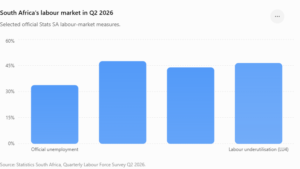
South Africa’s official unemployment rate reached 33.6% in the second quarter of 2026, according to Statistics South Africa.
There were approximately 8.5 million unemployed people, up by 345,000 from the previous quarter, while employment stood at approximately 16.7 million.
Among people aged 15–34, the unemployment rate was even higher:
47.4%
Around 5 million young people were unemployed during the quarter. (Statistics South Africa)
These numbers don’t mean that one-third of currently employed people are about to lose their jobs.
But they do show something important:
Finding replacement employment after losing a job cannot be assumed to happen immediately.
That’s why job-loss planning matters even while you’re happily employed.
📊 South Africa’s Official Unemployment Rate
The official rate increased from 32.7% in Q1 2026 to 33.6% in Q2 2026. Stats SA also reported a broader measure combining unemployment and the potential labour force of 43.8%. (Statistics South Africa)
This is why a sensible financial plan shouldn’t be built around:
“If I lose my job, I’ll probably find another one next month.”
Maybe you will.
Hopefully you will.
But your financial plan needs to survive the possibility that you don’t.
🧠 The First Financial Mistake: Pretending Nothing Has Changed
You’ve been earning R30,000 per month.
Then the salary stops.
But for the first month, you continue living like someone earning R30,000.
Same subscriptions.
Same takeaways.
Same entertainment.
Same shopping.
Same transfers.
Same weekend spending.
Why?
Because emotionally, your old lifestyle still feels normal.
Financially, however, the situation has completely changed.
Yesterday:
Income → expenses → next salary
Today:
Existing cash → expenses → ???
That question mark changes everything.
After an income shock, the objective temporarily changes from:
Living normally
to:
Protecting financial runway.
🛬 What Is Financial Runway?
Your financial runway is approximately how long your available resources can keep essential household expenses going without your normal income.
Suppose you have:
Cash savings: R45,000
Your normal monthly spending:
R30,000
At first glance:
R45,000 ÷ R30,000
=
1.5 months
That’s frightening.
But perhaps your true survival expenses are only:
R18,000 per month.
Now:
R45,000 ÷ R18,000
=
2.5 months
Nothing about your bank balance changed.
What changed was your spending plan.
You’ve effectively bought yourself another month.
That’s why one of your first actions after losing income should be calculating your survival budget.
🧮 The SAWise Job-Loss Runway Formula
Use:
Accessible cash
+
Confirmed money still due to you
+
Other reliable household income
−
Immediate unavoidable obligations
=
Available survival resources
Then:
Available survival resources ÷ essential monthly expenses
=
Approximate financial runway
Let’s use a realistic fictional example.
👨👩👧 Meet the Daniels Family
Michael loses his job.
His household has:
Savings: R35,000
Final salary expected: R24,000
Estimated net amount available from other confirmed employer payments: R18,000
Spouse’s monthly income: R12,000
We won’t include UIF yet because it hasn’t been approved or received.
Michael and his spouse therefore shouldn’t mentally spend money that hasn’t actually arrived.
Their normal household spending was:
R42,000 per month.
But after reviewing everything, they identify essential survival spending of:
R27,000.
The spouse still earns R12,000.
So the monthly gap is:
R27,000 − R12,000
=
R15,000
Their immediately identified one-off resources are:
R35,000 + R24,000 + R18,000
=
R77,000
Ignoring timing, tax and other complications purely for illustration:
R77,000 ÷ R15,000
=
Just over five months of gap coverage.
Had they continued spending R42,000 while receiving only R12,000:
Monthly gap:
R30,000
R77,000 ÷ R30,000
=
About 2.6 months.
One budget decision nearly doubles their runway.
📊 How Cutting Expenses Can Buy You Time
Using the same R77,000 pool:
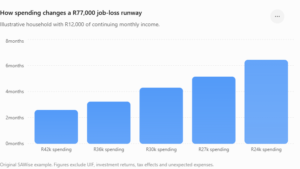
This doesn’t mean you can cut your way out of every income crisis.
Some households are already operating on essentials.
But where discretionary spending exists, reducing it quickly can buy something incredibly valuable:
Time.
⏱️ The First 24 Hours: Don’t Make Big Emotional Money Decisions
Losing a job can trigger panic.
Panic creates terrible financial decisions.
You might immediately think:
Cash out everything.
Cancel every insurance policy.
Stop every debit order.
Take a loan before the bank realises I’m unemployed.
Use my credit card to keep everything normal.
Don’t automatically do any of these.
Your first job is information gathering.
Before deciding what you can afford, establish what you actually have.
📂 Step 1: Build Your Job-Loss File
Create one folder—digital, physical or both.
Put in:
- Termination/retrenchment letter;
- Employment contract;
- Recent payslips;
- Employer correspondence;
- Leave records if relevant;
- Pension/provident fund information;
- UIF-related information;
- Bank details;
- Insurance policies;
- Credit agreements;
- Current account balances;
- List of debit orders;
- Tax documents;
- Certificate of service when received.
You are moving from employment into a period where documentation matters.
Don’t leave everything buried across WhatsApp messages, email inboxes and old drawers.
💼 Step 2: Work Out Why Your Employment Ended
This matters because:
Retrenchment isn’t resignation.
Dismissal isn’t retirement.
A fixed-term contract expiring isn’t necessarily the same as voluntarily quitting.
The reason employment ended can affect UIF eligibility, severance and other rights.
The UIF states that unemployment benefits are generally payable where an employer terminates the contributor’s services or a contract expires. It says benefits aren’t normally payable after resignation or abscondment unless constructive dismissal is proven through the CCMA. (UIF)
So don’t describe every job loss simply as:
“I’m unemployed.”
Find out the formal reason.
⚖️ Retrenchment Is Not Just “You’re Fired”
In South African labour law, retrenchment relates to an employer’s operational requirements—economic, technological, structural or similar needs of the employer.
The Basic Conditions of Employment Act provides that an employee dismissed for operational requirements is entitled to severance pay of at least:
One week’s remuneration for each completed year of continuous service
subject to the law’s conditions. (Department of Labour)
That word minimum matters.
An employment contract, collective agreement or negotiated retrenchment arrangement may produce a different entitlement.
🧮 What Could Statutory Minimum Severance Look Like?
Let’s create simplified illustrations.
Assume weekly remuneration for the purpose of our example is:
R6,000
| Completed service | Illustrative minimum severance |
|---|---|
| 1 year | R6,000 |
| 3 years | R18,000 |
| 5 years | R30,000 |
| 10 years | R60,000 |
| 15 years | R90,000 |
The principle comes from the BCEA’s minimum of one week’s remuneration for each completed year of continuous service in qualifying operational-requirements dismissals. (Department of Labour)
But don’t take:
Monthly salary ÷ 4 × years
and assume you’ve perfectly calculated your legal entitlement.
The BCEA contains rules for calculating remuneration, and individual circumstances matter.
Use your employer’s calculation and supporting documents, and query anything you don’t understand.
⚠️ Severance Pay Is Not Automatically “Free Spending Money”
Imagine you receive:
Final salary: R25,000
Leave payout: R12,000
Severance: R60,000
Total gross-looking amount:
R97,000
Seeing almost R100,000 hit—or being due to hit—can create a dangerous feeling:
“I’m okay.”
But R97,000 isn’t a replacement for a permanent R25,000 monthly salary.
If your essential expenses are R20,000 per month:
R97,000 represents less than five months before considering tax effects, other deductions and unexpected expenses.
That money has a new job:
Buying time until income returns.
🧾 What Else Might Your Employer Owe You?
Depending on your circumstances and the employment arrangement, termination may involve amounts such as:
- Salary already earned;
- Notice pay where applicable;
- Accrued leave payable under applicable rules;
- Severance in qualifying retrenchments;
- Contractual amounts;
- Other agreed benefits.
The Department’s BCEA guidance states, for example, that notice periods can range from one to four weeks depending on length/type of employment, and an employee is entitled to a certificate of service when employment terminates. (Department of Labour)
Don’t just look at the final amount.
Ask for a breakdown.
You want to know:
What is each rand for?
🏦 Then There Is UIF
For many formally employed South Africans, UIF can provide temporary financial support after qualifying unemployment.
But UIF should be understood correctly.
It is:
Temporary income protection
not:
A replacement salary guaranteed to equal what you earned.
UIF contributions generally involve 1% deducted from the employee and 1% contributed by the employer, making a total 2% contribution subject to the applicable rules and earnings ceiling. (Department of Labour)
🇿🇦 Who Can Claim UIF Unemployment Benefits?
The UIF’s current unemployment-benefit guidance says, among other requirements:
- The application must be made within 12 months after termination of service;
- Benefits are payable from the day after termination;
- The employer must generally have terminated the contributor’s services or the employment contract must have expired;
- Ordinary benefits aren’t payable where someone resigned or absconded, unless constructive dismissal can be proven through the CCMA;
- The contributor must register as a work-seeker with Employment Services South Africa (ESSA);
- The contributor must be capable of and available for work. (UIF)
Don’t unnecessarily delay an application simply because the maximum filing window is 12 months.
When your income has disappeared, getting the administrative process moving is part of your financial plan.
💻 UIF’s Claims System Has Changed
This is important if you’re reading older articles online.
The Department of Employment and Labour says the UIF launched UIF Online on 1 April 2025 to replace the legacy uFiling employee-claims portal.
The newer platform supports direct claim submission and claim tracking.
By April 2026, the UIF said it had processed and paid 4,558,971 claims through the newer environment during the reported period. (Department of Labour)
So always use current official UIF instructions rather than following a five-year-old tutorial.
Official UIF benefits information
💰 How Much UIF Will You Receive?
This is where misinformation spreads quickly.
UIF isn’t simply:
“60% of your salary.”
Normal unemployment benefits are calculated using an income-replacement formula and available credit days.
Department guidance describes an Income Replacement Rate (IRR) sliding scale from 38% to 60% for the applicable first portion of benefits, with lower-income contributors receiving the higher replacement percentage.
Benefit calculations are based on daily income subject to the prescribed remuneration ceiling, and credits accumulate at approximately:
1 benefit day for every 4 days worked as a contributor
up to the applicable maximum.
The UIF says normal unemployment benefits can be paid for a maximum of 365 credit days within a four-year period, depending on contributions and previous claims. (Department of Labour)
That means two people who lose jobs on the same day may not receive identical benefits.
📉 UIF Is Why You Shouldn’t Build a Budget Around Your Old Salary
Imagine someone earns R30,000 per month.
Their household costs:
R26,000.
They think:
“I’ll claim UIF, so I’ll carry on.”
That’s dangerous.
UIF normal unemployment benefits are subject to the statutory calculation and earnings ceiling; they are not designed to reproduce a high earner’s full salary. Department calculation guidance currently uses a remuneration ceiling of R17,712 per month for normal-benefit calculations and explains the sliding replacement formula. (Department of Labour)
So the moment your employment ends, you should assume:
Household income has materially fallen
and restructure spending accordingly.
📅 Your UIF Credits Matter
The Department’s guidance says contributors accumulate:
1 credit day for every 4 days worked
which is approximately:
91.25 credit days per year
subject to a maximum of 365 credit days in a four-year cycle, less applicable benefits already received. (Department of Labour)
Illustratively:
| Contribution history | Approximate credits accumulated* |
|---|---|
| 6 months | ~46 days |
| 1 year | ~91 days |
| 2 years | ~183 days |
| 3 years | ~274 days |
| 4 years | ~365 days |
Simplified illustration. Actual entitlement depends on UIF records, contribution periods, previous benefit usage and applicable rules.
This is why someone who worked for four months cannot assume they have the same benefit duration as someone who contributed continuously for four years.
🚨 What If Your Employer Didn’t Pay Your UIF Properly?
Don’t simply assume:
“Nothing can be done.”
Keep your payslips.
If UIF deductions appear on them, preserve that evidence.
The Department has previously warned that employer declaration problems can delay claims, and employers are required to make the relevant monthly contributions and declarations. (Department of Labour)
If your UIF employment history appears wrong, raise it with the UIF and your former employer rather than abandoning the claim.
🧮 Now Build Your Survival Budget
Forget your normal budget temporarily.
A job-loss budget has three levels.
🔴 Level 1 — Must Pay
Expenses that keep the household functioning or protect critical assets.
Examples:
Housing.
Basic food.
Essential electricity/water.
Essential transport.
Necessary medication/healthcare.
Critical insurance.
Minimum contractual debt obligations while you engage creditors.
Basic communication/data for job searching.
🟠 Level 2 — Important but Adjustable
Things that matter but may be reduced.
Examples:
Mobile plan.
Internet package.
Groceries above the basic level.
Fuel usage.
Certain subscriptions.
Children’s activities.
Clothing.
Domestic services.
🟢 Level 3 — Pause or Cut
Examples might include:
Frequent takeaways.
Entertainment subscriptions you barely use.
Non-essential shopping.
Holiday saving.
Luxury upgrades.
Expensive social activities.
Impulse purchases.
This isn’t forever.
You’re temporarily redirecting money toward survival.
📊 A R32,000 Lifestyle Can Become a R21,000 Survival Budget
Consider this fictional household:
| Expense | Before job loss | Survival mode |
|---|---|---|
| Housing | R8,500 | R8,500 |
| Food | R5,500 | R4,000 |
| Transport | R4,000 | R2,500 |
| Insurance | R2,000 | R1,800 |
| Utilities | R2,000 | R1,700 |
| Debt payments | R3,500 | R3,500* |
| Entertainment | R2,000 | R300 |
| Takeaways | R1,500 | R0 |
| Subscriptions | R800 | R300 |
| Clothing/shopping | R1,200 | R0 |
| Miscellaneous | R1,000 | R400 |
| Total | R32,000 | R23,000 |
Do not arbitrarily reduce contractual debt repayments. Contact the relevant credit provider if you cannot pay.
Monthly reduction:
R9,000
Over three months:
R27,000
Over six months:
R54,000
That can be the difference between needing expensive credit in month three and still having cash in month five.
🏠 Should You Pay Your Home Loan or Rent First?
Housing is generally one of the highest-priority expenses.
But if you know you cannot pay the full amount, don’t disappear.
Contact the lender or landlord early.
For a home loan, ask the bank what formal assistance may be available.
For rent, communicate before arrears grow.
Don’t make promises you know you can’t keep.
The worst strategy is often:
Ignore → miss payments → ignore calls → hope the problem disappears.
Financial problems rarely become cheaper through silence.
🚗 What About the Car?
A car may be essential for:
Work searching.
Children.
Family.
Transport.
But a financed vehicle can also be one of the household’s largest monthly costs.
Suppose:
Instalment: R6,500
Insurance: R1,500
Fuel: R2,500
Maintenance/licence/tyres averaged: R1,000
Actual monthly transport burden:
R11,500
The “R6,500 car” isn’t really costing R6,500.
If unemployment becomes prolonged, major fixed expenses like vehicles deserve serious review.
But don’t impulsively surrender or sell a financed vehicle without first understanding:
- Settlement balance;
- Market value;
- Shortfall;
- Contractual implications;
- Alternative transport costs.
A desperate decision can create another debt.
💳 What Happens to Your Debt When You Lose Your Job?
This surprises some people:
Losing your job does not automatically cancel your debt.
Your personal loan still exists.
Credit-card balance still exists.
Vehicle finance still exists.
Bond still exists.
Store accounts still exist.
But before panicking, check something important:
Do any of your credit agreements have credit-life insurance?
🛡️ Credit-Life Insurance Could Matter After Retrenchment
South African credit-life regulations prescribe minimum benefits for certain credit agreements.
The National Credit Regulator explains that qualifying credit-life cover may include benefits where a consumer loses employment; under the prescribed framework, instalments under a qualifying credit agreement can be covered for up to 12 months, subject to the policy, regulations, qualifying event, exclusions and limitations. (NCR)
This does not mean:
“Everyone who loses a job gets 12 months of every debt paid.”
You need to establish:
- Whether you have credit-life insurance;
- Whether your job-loss circumstances qualify;
- Which agreement is covered;
- What exclusions or waiting periods apply;
- How and when to submit a claim.
But don’t overlook it.
You may have been paying for protection you now actually need.
🔍 Check Every Credit Agreement
Create this table:
| Debt | Balance | Monthly payment | Credit life? | Job-loss cover? | Contacted? |
|---|---|---|---|---|---|
| Home loan | R___ | R___ | ? | ? | ☐ |
| Vehicle | R___ | R___ | ? | ? | ☐ |
| Personal loan | R___ | R___ | ? | ? | ☐ |
| Credit card | R___ | R___ | ? | ? | ☐ |
| Store account | R___ | R___ | ? | ? | ☐ |
Don’t assume.
Check.
An hour spent examining your agreements could materially change your survival budget.
📞 Contact Creditors Before You Fall Deeply Behind
If your income shock is going to make payments impossible, early communication matters.
Tell the credit provider that your employment has ended.
Ask what formal options exist.
Ask whether credit-life cover applies.
Ask what documentation is needed.
Ask how any arrangement will affect:
- Interest;
- Fees;
- Repayment term;
- Credit reporting;
- Future instalments.
And get important arrangements in writing.
A call-centre promise isn’t something you want to reconstruct six months later.
⚠️ Don’t Solve Unemployment With a Huge New Loan Unless You Understand the Consequences
This temptation is understandable.
You have:
R20,000 savings.
Then a bank offers:
R100,000 personal loan.
Suddenly you think:
“Great. I’ve got R120,000 to survive.”
No.
You have:
R20,000 of your money
plus
R100,000 of debt.
If you spend the loan surviving for five months and still don’t have employment, you’ve created a second problem:
No salary + large new monthly repayment.
Borrowing can sometimes have a legitimate place in financial planning.
But debt should not be mistaken for income.
💳 Your Credit Card Is Not an Emergency Fund
Available credit:
R40,000
Savings:
R5,000
Your emergency resources are not automatically:
R45,000.
You have R5,000 in cash and the ability to borrow up to an additional amount subject to the credit agreement.
That distinction matters.
Once borrowed, the money needs to be repaid, generally with applicable interest and fees.
🛡️ Should You Cancel Insurance After Losing Your Job?
Not automatically.
This is one of those cuts that can save R1,000 today and cost R300,000 tomorrow.
Suppose you cancel comprehensive insurance on a financed vehicle to save R1,400 per month.
Three weeks later the car is stolen.
You could potentially be left with a major financial problem involving an asset you no longer possess and finance obligations that haven’t magically disappeared.
Before cancelling insurance:
Ask whether the risk still exists.
Check finance requirements.
Consider whether cover can be adjusted.
Get alternative quotations.
Review unnecessary add-ons.
But don’t blindly remove protection from risks you cannot afford to absorb.
❤️ Life Cover Deserves Similar Thought
If you’re unemployed, life-insurance premiums can feel optional.
But ask:
“Did losing my job remove my family’s financial dependence on me?”
Maybe.
Maybe not.
Cancelling long-held life or disability cover can also have consequences if you later try to obtain new cover after your health or age changes.
Review.
Don’t panic-cancel.
🏦 What About Your Pension or Provident Fund?
Job loss can result in access to retirement-fund decisions depending on your fund and circumstances.
The dangerous thought is:
“There’s R300,000. Problem solved.”
Retirement savings may look like emergency money because they’re attached to your name.
But they were accumulated for decades of future life.
Before withdrawing retirement savings, understand:
- Preservation options;
- Applicable tax consequences;
- Fund rules;
- The long-term compound-growth cost;
- Whether you actually need the money.
Don’t make a 30-year decision because of a three-week panic.
📈 The Hidden Cost of Cashing Out R100,000 at Age 30
Suppose R100,000 remained invested for 35 years.
At a purely hypothetical average return of 8% annually, before fees and tax, it could grow to roughly:
R1.48 million
That doesn’t mean you’ll earn 8%.
It demonstrates opportunity cost.
When you withdraw retirement money, you aren’t only spending today’s balance.
You may also be giving up decades of potential compounding.
🧮 Job-Loss Money Has an Order
When cash is limited, create a hierarchy.
A practical example:
1. Food and basic household survival
You need to live.
2. Housing
Protect where you live and engage the lender/landlord early if trouble is coming.
3. Essential utilities
Electricity, water and essential communications.
4. Essential transport
Especially where required for job searching and household needs.
5. Critical insurance and healthcare
Don’t accidentally create catastrophic exposure.
6. Debt obligations
Pay according to agreements where possible; if impossible, engage creditors early and investigate insurance/relief.
7. Everything else
Review aggressively.
This isn’t a universal legal ranking of debts.
It’s a practical household triage framework.
📆 Your First Seven Days After Losing Your Job
Job hunting matters.
But don’t spend seven days sending CVs while ignoring your finances.
Your first week should have two parallel projects.
Project A: Replace income
Update CV.
Contact your network.
Register as a work-seeker.
Apply strategically.
Look for temporary income.
Explore contract/freelance opportunities where appropriate.
Project B: Extend runway
Calculate cash.
Apply for qualifying benefits.
Check employer payments.
Check credit life.
Reduce spending.
Contact creditors.
Review insurance.
Stop unnecessary debit orders.
Both matter.
A new job solves the problem eventually.
Runway keeps you alive financially until it does.
📅 The SAWise 30-Day Job-Loss Plan
Days 1–3: Establish Reality
Write down every available rand.
List every debit order.
Calculate essential spending.
Obtain employer documents.
Confirm termination reason.
Start the UIF process if eligible.
Don’t guess.
Days 4–7: Protect Cash
Pause unnecessary spending.
Cancel unused subscriptions.
Review automatic transfers.
Check credit-life policies.
Contact creditors if needed.
Review major household expenses.
Week 2: Build the Income Pipeline
Apply for jobs—but don’t simply fire the same CV at 100 vacancies.
Prioritise roles that actually match your skills.
Tell trusted professional contacts you’re available.
Update online profiles.
Register with relevant recruiters.
Explore temporary/contract work.
Week 3: Create Alternative Income
Can you:
Freelance?
Tutor?
Repair something?
Consult?
Sell a legitimate service?
Do contract work?
Take temporary shifts?
Monetise an existing skill?
Sell unused possessions?
The goal isn’t necessarily replacing your entire salary immediately.
Even R3,000 per month changes your runway.
Week 4: Recalculate
How much cash remains?
What UIF progress has been made?
Which applications are moving?
Which expenses can be reduced further?
Do you need a more aggressive plan?
Job-loss budgets should be reviewed weekly, not once every six months.
📊 Even Small Temporary Income Extends Runway
Suppose you have:
Savings/resources:
R60,000
Essential expenses:
R20,000/month
No income:
60,000 ÷ 20,000
=
3 months
Now suppose you earn R5,000 monthly doing temporary work.
Monthly shortfall:
R15,000.
Runway:
4 months
Earn R10,000:
Monthly shortfall:
R10,000.
Runway:
6 months
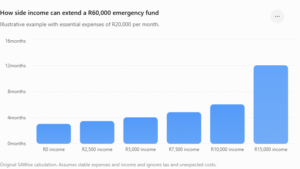
Notice the lesson.
You don’t necessarily need to immediately replace 100% of your old salary to improve your position.
Reducing the monthly gap matters enormously.
💡 Think in Terms of “Burn Rate”
Businesses use this concept.
Households should too.
If you have no income and spend R25,000 per month:
Your burn rate is:
R25,000/month.
If you cut expenses to R20,000 and earn R5,000 temporarily:
Net burn:
R15,000/month.
You haven’t solved unemployment.
But you’ve slowed the financial damage by 40%.
That’s meaningful.
🛒 What Should You Sell?
Selling possessions can help.
But don’t panic-sell productive assets.
Selling a R15,000 laptop for R6,000 may be a terrible decision if that laptop could help you earn income.
Ask:
Does this item cost me money or help me make money?
Potential candidates:
Unused electronics.
Second television.
Old equipment.
Clothes with genuine resale value.
Furniture you don’t need.
Hobby items you no longer use.
But be careful with:
Work tools.
Computer.
Reliable transport.
Anything central to generating your next income.
Survival shouldn’t destroy your ability to recover.
🧠 Unemployment Changes the Value of R1,000
When you’re earning R40,000 per month, R1,000 might feel small.
When you’re unemployed with R30,000 left, R1,000 represents:
3.3% of all your remaining cash.
Five unnecessary R1,000 purchases:
R5,000
That’s 16.7% of R30,000.
Your relationship with money needs to temporarily change when replenishment is uncertain.
🍞 But Don’t Starve Yourself Financially
There’s another extreme.
Some people become so frightened that they cut everything.
They stop eating properly.
Stop using transport to attend opportunities.
Cancel internet needed for applications.
Avoid necessary medication.
This can damage the recovery process.
The goal is not:
Spend nothing.
It’s:
Spend deliberately.
Money required to get back into employment may be productive spending.
Data for interviews?
Useful.
Transport to an interview?
Useful.
Printing/certification where genuinely required?
Potentially useful.
A course that clearly improves employability?
Possibly useful.
R3,000 of random shopping because you’re stressed?
Probably not.
📉 Beware of “Job Search Businesses” That Want Your Last Money
Unemployment creates vulnerability.
Someone promises:
“Pay R2,500 and we’ll guarantee you a job.”
Be careful.
Legitimate job searching may involve certain costs, but guaranteed-job claims and suspicious upfront-payment demands deserve scrutiny.
Don’t let desperation remove your normal scepticism.
The same applies to:
“investment opportunities”
“easy online income”
“double your money”
“guaranteed trading profits”
and questionable business schemes.
When income disappears, protecting your remaining capital becomes more important—not less.
🧑💼 Your Network Is a Financial Asset
Imagine two unemployed people with identical savings.
Person A tells nobody.
Person B contacts:
Former colleagues.
Suppliers.
Customers they legitimately know professionally.
Friends.
Recruiters.
Industry contacts.
Professional groups.
Person B may shorten the unemployment period.
And shortening unemployment by even one month can have enormous financial value.
If your survival expenses are R20,000:
Finding work one month sooner is economically similar to protecting another:
R20,000 of runway.
Job searching is therefore not only a career activity.
It’s a financial strategy.
📝 Keep a Job-Search Dashboard
Track:
| Date | Company | Position | Contact | Stage | Follow-up |
|---|---|---|---|---|---|
| 4 Sep | Company A | Admin | Recruiter | Applied | 11 Sep |
| 5 Sep | Company B | Operations | HR | Interview | 9 Sep |
| 6 Sep | Company C | Sales | Manager | Contacted | 10 Sep |
Why?
Because unemployment can make days blend together.
Activity feels like progress.
But:
50 random applications
may be less valuable than:
10 highly relevant applications + 5 direct professional conversations + 3 follow-ups.
Measure outcomes.
💼 Should You Accept a Lower-Paying Job?
Maybe.
Suppose your previous salary was:
R35,000
New offer:
R27,000
You think:
“I’m worth R35,000. I’m not taking it.”
But your savings are falling by:
R20,000 per month.
Waiting another four months costs:
R80,000 of runway.
Accepting R27,000 doesn’t necessarily mean you must stay forever.
You can potentially stabilise income and continue building your career.
Of course, job quality, transport, childcare, contractual restrictions, working conditions and long-term prospects matter.
But don’t compare an offer only against your old salary.
Also compare it against:
R0 current salary.
🧮 The “Wait or Work” Calculation
Previous salary:
R35,000.
Current income:
R0.
Monthly survival cost:
R20,000.
Offer:
R27,000.
If accepted, the household moves from:
−R20,000 monthly cash flow
to approximately:
+R7,000 before considering work-related cost changes and tax differences.
That’s a swing of:
R27,000 per month.
Pride can be expensive.
Evaluate the entire situation.
🏠 What If Your Partner Still Works?
This changes the mathematics but not the need for a plan.
Suppose household income was:
You: R30,000.
Partner: R20,000.
Total:
R50,000
Household spending:
R45,000
After job loss:
Income becomes:
R20,000
Monthly deficit:
R25,000
If the household can reduce expenses to:
R32,000
Deficit becomes:
R12,000
That’s why job loss must be treated as a household event, not only the unemployed person’s problem.
Everyone who spends from the household budget needs to understand the temporary reality.
👨👩👧 Talk to the Family Before the Money Runs Out
Don’t pretend everything is normal for three months and then suddenly announce:
“We have no money.”
Age-appropriate conversations can help.
Maybe the family temporarily reduces:
Takeaways.
Entertainment.
Trips.
Subscriptions.
Non-essential shopping.
Expensive celebrations.
The message doesn’t need to be:
“We’re doomed.”
It can simply be:
“Our income has changed, so we’re being careful until work is sorted out.”
That’s financial leadership.
🧮 The Emergency Fund You Wish You Had
Job loss is where the phrase:
“Three to six months of essential expenses”
suddenly stops sounding boring.
Suppose essentials:
R20,000/month
Emergency fund:
| Savings | Survival coverage |
|---|---|
| R10,000 | 0.5 month |
| R20,000 | 1 month |
| R40,000 | 2 months |
| R60,000 | 3 months |
| R80,000 | 4 months |
| R120,000 | 6 months |
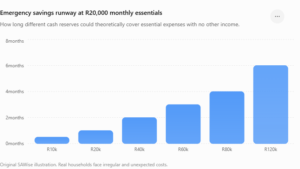
This isn’t designed to make somebody without savings feel bad.
If you’re already unemployed, the emergency-fund lecture is too late.
Work with what you have.
But when employment returns, remember how this period felt.
That’s when you build the fund for next time.
🔄 Recovery Starts Before the New Job Arrives
Financial recovery doesn’t begin on the first payday at your next job.
It begins when:
You stop unnecessary cash leakage.
You claim benefits you’re entitled to.
You investigate insurance.
You communicate with creditors.
You protect productive assets.
You seek income actively.
You make deliberate decisions.
Every R1,000 you preserve today is R1,000 your future salary doesn’t need to repair.
🎉 Then You Get the Call: “You Got the Job”
Fantastic.
But there’s one final trap.
First salary arrives.
You feel relief.
So you immediately:
Upgrade your phone.
Book a weekend away.
Buy clothes.
Take everyone out.
Restart every subscription.
Spend the whole first salary celebrating survival.
Enjoy the moment—but remember:
Your finances may still be injured.
Maybe savings were depleted.
Maybe credit-card debt increased.
Maybe bills were delayed.
Maybe retirement savings were touched.
Maybe family lent you money.
Your income has recovered.
Your balance sheet hasn’t necessarily recovered yet.
🔧 The First Six Months Back at Work
Once employed again, consider this order:
Month 1
Catch up critical obligations.
Month 2
Start rebuilding emergency savings.
Month 3
Review debt accumulated during unemployment.
Month 4
Restore appropriate long-term contributions.
Month 5
Review insurance and benefits.
Month 6
Calculate your new job-loss runway.
Don’t simply return to the financial system that failed you.
Build a stronger one.
🧠 What Job Loss Teaches You About Your Salary
Before unemployment, your salary may feel like:
Money.
After unemployment, you realise it was actually performing many jobs:
Housing.
Food.
Transport.
Insurance.
Debt.
Education.
Savings.
Entertainment.
Future security.
When the salary disappears, all those obligations remain standing in line.
That’s why a job-loss plan isn’t pessimistic.
It’s responsible.
🛡️ Build Your “Lose My Job Tomorrow” Folder While You’re Employed
You don’t need to expect retrenchment.
Just prepare.
Keep:
Three to six months of essential expenses as a long-term target appropriate to your circumstances.
Updated CV.
Copies of qualifications.
Recent payslips.
Employment contract.
UIF records where appropriate.
Retirement information.
Insurance policies.
Debt agreements.
List of monthly debit orders.
Professional contacts.
This is financial fire equipment.
You hope you never need it.
📋 SAWise Job-Loss Checklist
If you lost your job today, work through this:
☑ Get the reason for termination in writing
☑ Collect your employment documents
☑ Request a breakdown of final employer payments
☑ Check whether severance applies
☑ Check outstanding leave/notice amounts where applicable
☑ Obtain your certificate of service
☑ Check UIF eligibility
☑ Start your UIF application promptly if eligible
☑ Register as a work-seeker as required
☑ Calculate accessible cash
☑ Create a survival budget
☑ List every debit order
☑ Check every credit agreement for credit-life insurance
☑ Contact creditors before arrears become serious
☑ Review—not blindly cancel—insurance
☑ Protect retirement savings where possible
☑ Update your CV
☑ Contact your professional network
☑ Look for temporary income
☑ Review your financial runway every week
❓ Frequently Asked Questions About Losing Your Job in South Africa
Can I claim UIF if I lose my job?
Potentially, if you were a qualifying contributor and your employment ended under circumstances covered by UIF. The UIF says unemployment benefits generally apply where an employer terminates employment or a contract expires, subject to its requirements. (UIF)
Can I claim UIF if I resign?
Ordinarily, UIF says unemployment benefits aren’t paid for resignation or abscondment. It identifies constructive dismissal proven through the CCMA as an exception. (UIF)
How long do I have to apply for UIF after losing my job?
The UIF currently states that an unemployment-benefit application must be made within 12 months of termination of service. (UIF)
Does UIF pay your full salary?
No. Normal benefits use an income-replacement calculation subject to the applicable earnings ceiling, percentage scale and accumulated credit days. Department guidance describes the normal IRR as ranging from 38% to 60% for the applicable portion of benefits. (Department of Labour)
How long can UIF pay unemployment benefits?
The UIF says benefits may be payable for up to 365 credit days within a four-year period, depending on accumulated credits and previous benefits used. (UIF)
Do I get severance pay if I’m retrenched?
For a qualifying dismissal based on operational requirements, the BCEA provides for at least one week’s remuneration for each completed year of continuous service, subject to the law’s provisions. (Department of Labour)
If I worked for ten years, do I automatically get ten months’ salary?
No. Don’t confuse weeks with months. The statutory minimum described above is one week’s remuneration for each completed year, not one month’s salary for each year. Other contractual or negotiated arrangements may differ.
What happens to my loans if I’m retrenched?
The debts don’t automatically disappear. Check whether your credit agreements have credit-life insurance covering qualifying loss of employment, and contact credit providers early if you anticipate difficulty.
Can credit-life insurance pay my instalments?
Certain qualifying credit-life policies can provide job-loss benefits subject to the regulations and policy conditions. NCR guidance describes prescribed cover that can pay instalments for up to 12 months in qualifying circumstances. (NCR)
Should I use my credit card while unemployed?
Using credit for essential costs may sometimes become unavoidable, but remember that credit is debt, not replacement income. Borrowing to preserve your previous lifestyle can create a serious repayment problem if unemployment lasts longer than expected.
Should I withdraw my retirement fund?
Don’t make this decision casually. Consider preservation, tax and the long-term cost of losing future compounded growth. Get appropriate advice where necessary.
Should I cancel my car insurance to save money?
Don’t automatically cancel important insurance, especially where an asset is financed. Consider the financial consequence if the insured event happens while you’re unemployed.
How much emergency savings should I have before losing a job?
There isn’t a universal amount. Several months of essential expenses is a useful planning framework, but the appropriate target depends on income stability, dependants, debt, insurance and other household income.
What if I have no savings when I lose my job?
Focus on immediate cash preservation rather than regretting the past. Calculate essential expenses, investigate UIF and other entitlements, check credit-life cover, communicate with creditors and aggressively pursue replacement or temporary income.
What is South Africa’s unemployment rate?
Stats SA reported an official unemployment rate of 33.6% in Q2 2026, with approximately 8.5 million people unemployed. (Statistics South Africa)
🇿🇦 A Complete 90-Day Example
Let’s put the entire strategy into one household.
Thando earns:
R32,000 take-home per month.
His partner earns:
R10,000.
Household income:
R42,000
Their normal spending is:
R39,000.
Thando is retrenched.
At termination, the household has:
Savings:
R30,000
Expected final net employment-related cash after deductions, for this fictional example:
R35,000
Total identified immediate resources:
R65,000
Partner’s salary continues:
R10,000/month
They cut household spending from:
R39,000
to:
R24,000
Monthly gap:
R24,000 − R10,000
=
R14,000
Without UIF or any additional income:
R65,000 ÷ R14,000
=
Approximately 4.6 months of runway.
Now Thando finds temporary work earning:
R5,000/month
Household income becomes:
R15,000.
Monthly gap:
R24,000 − R15,000
=
R9,000
R65,000 ÷ R9,000
=
Approximately 7.2 months.
UIF, if approved, could extend that further.
The household has transformed the problem.
At first:
“Thando lost a R32,000 salary.”
After planning:
“We need to cover a R9,000 monthly gap while he searches for permanent work.”
That second problem is far less frightening.
📊 Before and After the Job-Loss Plan
| Position | Before action | After action |
|---|---|---|
| Monthly spending | R39,000 | R24,000 |
| Remaining salary | R10,000 | R10,000 |
| Temporary income | R0 | R5,000 |
| Monthly shortfall | R29,000 | R9,000 |
| Cash resources | R65,000 | R65,000 |
| Approx. runway | 2.2 months | 7.2 months |
One household.
Same R65,000.
Completely different survival prospects.
That’s what financial planning does.
It doesn’t create money out of thin air.
It makes the money you have work harder and last longer.
🌟 The Biggest Mistake Is Waiting Until the Money Is Gone
If your salary stops today and you have R60,000 saved, you still have choices.
At R40,000, you still have choices.
At R20,000, fewer.
At R5,000, your choices become much narrower.
At R0 with overdue bills and maxed-out credit, the decisions start being made for you.
That’s why speed matters.
Not panic.
Speed.
There is a difference.
Panic says:
“Cancel everything! Borrow! Sell! Do something!”
A plan says:
“What do I have? What do I owe? What is protected? What can I cut? What benefits can I claim? How long can I survive? How do I replace income?”
That is how you regain control.
💚 Final Thought: Your Job Is an Income Source, Not Your Entire Financial Identity
Losing a job hurts.
For many people, it isn’t only about money.
It’s routine.
Status.
Confidence.
People you saw every day.
Plans you thought were secure.
And then there is the fear:
“What if I don’t find something?”
Financial planning cannot remove that uncertainty.
But it can reduce the pressure.
A R60,000 emergency fund doesn’t guarantee another job.
It gives you time to look.
A survival budget doesn’t replace your salary.
It makes existing money last longer.
UIF doesn’t recreate your old income.
It may provide temporary support.
Credit-life insurance doesn’t erase every debt.
It may protect certain qualifying obligations.
Temporary work may not match your old salary.
It can reduce the amount you’re burning every month.
Each piece does something.
And together, those pieces create runway.
If you’re employed today, build that runway before you need it.
If you’ve already lost your job, forget the perfect financial plan.
Start with today’s numbers.
How much cash do you have?
What income remains?
What does the household absolutely need?
What benefits might you qualify for?
What expenses can stop?
What debts need attention?
What skills can produce money?
How many weeks can you buy?
Then protect each one.
Because after job loss, your most valuable financial asset isn’t necessarily the biggest payout, your credit limit or even your savings balance.
It’s:
Time.
Time to apply.
Time to interview.
Time to learn.
Time to negotiate.
Time to find temporary income.
Time to reject a terrible financial decision.
And ultimately:
Time to earn again. 🇿🇦
South Africa’s labour market in Q2 2026
| measure | rate |
|---|---|
| Official unemployment | 33.6 |
| Youth unemployment (15–34) | 47.4 |
| Unemployment + potential labour force | 43.8 |
| Labour underutilisation (LU4) | 46.3 |
Illustrative household with R12,000 of continuing monthly income.
| monthlySpending | months |
|---|---|
| R42k spending | 2.57 |
| R36k spending | 3.21 |
| R30k spending | 4.28 |
| R27k spending | 5.13 |
| R24k spending | 6.42 |
Illustrative example with essential expenses of R20,000 per month.
| temporaryIncome | runway |
|---|---|
| R0 income | 3 |
| R2,500 income | 3.43 |
| R5,000 income | 4 |
| R7,500 income | 4.8 |
| R10,000 income | 6 |
| R15,000 income | 12 |
How long different cash reserves could theoretically cover essential expenses with no other income.
| savings | months |
|---|---|
| R10k | 0.5 |
| R20k | 1 |
| R40k | 2 |
| R60k | 3 |
| R80k | 4 |
| R120k | 6 |
SAWise Note
SAWise.co.za provides general educational information and not personalised financial, legal, credit, tax or labour-law advice. UIF eligibility and benefit calculations, retrenchment rights, tax treatment, retirement-fund rules, insurance coverage and credit agreements depend on individual circumstances and may change. Confirm current requirements with the relevant official institution or appropriately qualified professional before making significant decisions.