
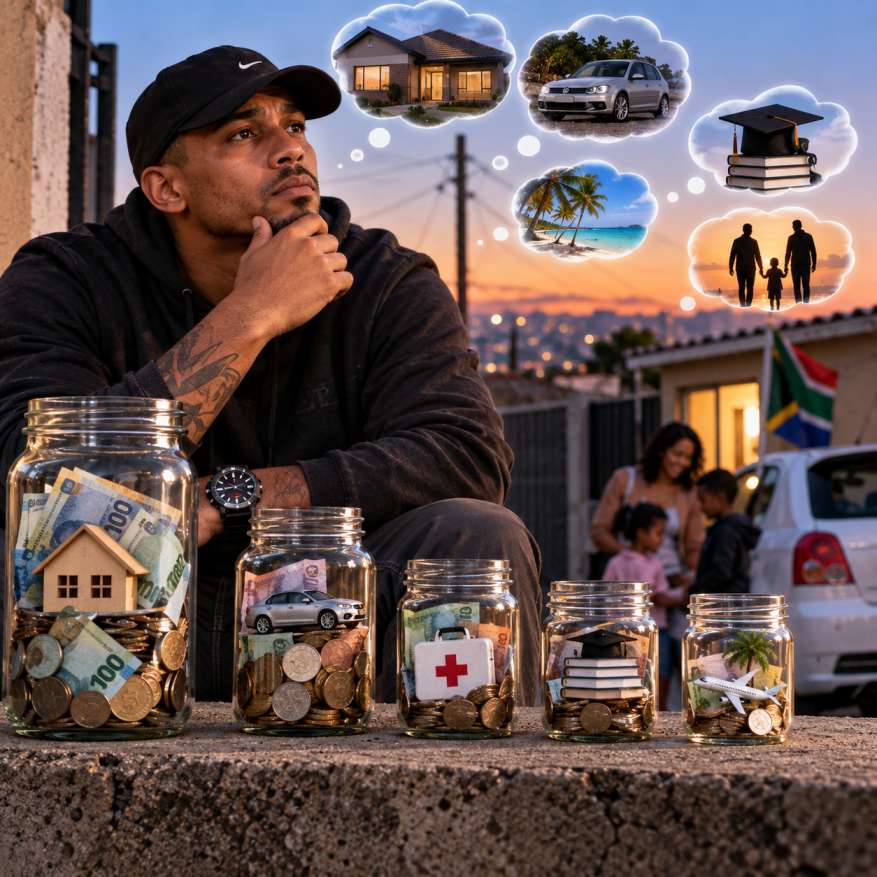
There is such a thing as having too little money in your bank account—but also having too much sitting there without a purpose. This guide shows South Africans how to decide what belongs in a transactional account, what should be reserved for emergencies, what can be saved for upcoming expenses, and when excess cash may deserve a different job.
R42,000 in the Bank. But How Much of It Is Actually Yours to Spend?
It’s payday.
You open your banking app and see:
R42,380
For a moment, everything feels good.
There is money in the account.
A lot more than there was yesterday.
Then you remember:
Rent is coming off.
The car instalment hasn’t gone through yet.
Insurance is due.
There’s a debit order for fibre.
You need groceries.
Electricity is running low.
Your child’s school needs money.
Your credit card payment is due.
And R5,000 of that balance is money you’ve been trying not to touch because it’s supposed to be your emergency savings.
So are you really sitting with R42,380?
Technically, yes.
But financially?
Not really.
Perhaps only R6,000 of that balance is genuinely available after everything else has been accounted for.
This is one of the most important distinctions in personal finance:
Your bank balance tells you how much money is in the account. It doesn’t tell you how much you can safely spend.
Those are two completely different numbers.
And if you’ve ever reached the 20th of the month wondering how R25,000, R40,000 or even R60,000 disappeared so quickly, understanding this difference can change the way you manage money.
🇿🇦 South African Households Are Carrying Significant Debt
Before building our system, let’s look at the wider picture.
The South African Reserve Bank reported that household debt was equivalent to 62.2% of nominal household disposable income in the first quarter of 2026, up from 61.8% in the previous quarter.
The household debt-service-cost ratio—the portion of disposable income represented by the cost of servicing debt—was 8.4%. (South African Reserve Bank)
That doesn’t mean every South African owes 62.2% of their salary.
It’s an economy-wide household ratio.
But it does tell us something important:
Debt occupies a substantial place in South African household finances.
Meanwhile, Stats SA reported headline consumer inflation of 4.3% in July 2026, down from 5.0% in June. (Statistics South Africa)
So the question:
“How much money should I leave in my bank account?”
isn’t trivial.
For many households, every rand has competition.
Debt wants some.
Food wants some.
Transport wants some.
Housing wants some.
Children want some.
Emergencies eventually want some.
And your future needs some too.
🧠 There Is No Perfect Bank Balance
Let’s get rid of one myth immediately.
There isn’t a universal number such as:
“Everyone should always have R20,000 in their bank account.”
R20,000 could be enormous for one household and dangerously inadequate for another.
Consider these three people.
Person A
Lives with parents.
No children.
No debt.
Monthly essential expenses: R4,000.
Person B
Married with two children.
Home loan.
Two vehicles.
Monthly essential expenses: R35,000.
Person C
Self-employed.
Income fluctuates between R15,000 and R70,000.
Supports family members.
Monthly essentials: R22,000.
Would R20,000 mean the same thing to all three?
Obviously not.
So instead of asking:
“What bank balance should everybody have?”
ask:
“How much cash does my life require?”
That question produces a much more useful answer.
💰 SAWise’s Four-Layer Cash System
Let’s create a framework specifically for this article.
Instead of thinking about all your money as one balance, divide your accessible cash into four layers:
🟢 Layer 1 — Spending Cash
Money needed between today and your next income date.
🔵 Layer 2 — Bills Money
Money already committed to debit orders and known expenses.
🟠 Layer 3 — Emergency Cash
Money reserved for genuinely unexpected financial shocks.
🟣 Layer 4 — Goal Cash
Money being accumulated for known future expenses.
There may eventually be a fifth layer:
🌱 Long-Term Wealth
Money you don’t expect to need soon and that may be suitable for longer-term saving or investing according to your circumstances.
The mistake many people make is keeping all five categories in one pile.
Then the banking app says:
R30,000
and your brain hears:
R30,000 AVAILABLE.
That’s how money reserved for December tyres somehow becomes Saturday-night takeaway money.
📊 What R30,000 in the Bank Might Really Mean
Imagine your account balance is:
R30,000
But:
| Purpose | Amount |
|---|---|
| Rent/home loan | R9,000 |
| Vehicle instalment | R4,500 |
| Insurance | R1,500 |
| Utilities/fibre/mobile | R2,000 |
| Groceries until payday | R4,000 |
| Transport | R2,000 |
| Emergency savings | R5,000 |
| Truly unallocated | R2,000 |
Your bank says:
R30,000
Your actual freely available money says:
R2,000
That’s a massive difference.
And this is exactly why people sometimes overspend without feeling as though they’re overspending.
They aren’t deliberately spending the rent.
They’re spending from a balance that contains the rent.
📉 The Payday Balance Illusion
Let’s follow that R30,000 across a month.
Payday: R30,000
After housing: R21,000
After vehicle: R16,500
After insurance: R15,000
After utilities: R13,000
After groceries: R9,000
After transport: R7,000
Emergency reserve: R5,000
Actual remaining discretionary money:
R2,000
The R30,000 was real.
But most of it already had somewhere to go.
This leads to one of the most useful personal-finance rules in this entire article:
Don’t spend according to your balance. Spend according to your available balance after commitments.
🏦 So How Much Should Stay in Your Everyday Bank Account?
Your everyday transactional account should generally contain enough to handle:
Upcoming debit orders + normal spending + a sensible buffer.
The exact buffer depends on you.
Someone with extremely predictable income and expenses may need less.
Someone whose income varies dramatically may want more.
Let’s build an example.
Naledi gets paid on the 25th.
Between the 25th and her next payday, she expects:
Housing: R8,500
Car: R3,800
Insurance: R1,200
Groceries: R3,500
Fuel: R2,000
Utilities: R1,500
Other debit orders: R1,000
Planned discretionary spending: R1,500
Total:
R23,000
She could then add, for example, a R2,000 transactional buffer.
Her practical operating balance becomes:
R25,000
That doesn’t mean she needs to maintain R25,000 every day.
It means that at the beginning of her monthly cycle, approximately R25,000 has jobs to perform.
Anything beyond that deserves another question:
What is this extra money for?
🛟 Your Emergency Fund Should Not Feel Like Spending Money
This is where account structure becomes psychologically powerful.
Suppose you have:
Current account: R8,000
Emergency savings: R30,000
Your financial position includes R38,000 of cash.
But when you’re deciding whether to buy a R7,000 television, your brain should not say:
“I’ve got R38,000.”
You don’t have R38,000 for a television.
You have:
R8,000 operating cash
and
R30,000 reserved for emergencies.
Purpose changes the meaning of money.
🚨 What Actually Counts as an Emergency?
An emergency is generally:
Unexpected
You couldn’t reasonably schedule it.
Necessary
You genuinely need to deal with it.
Financially significant
Normal monthly cash flow may not comfortably absorb it.
Examples could include:
🚗 An urgent vehicle repair needed to get to work.
🏠 An essential home repair.
💼 Sudden loss of income.
✈️ Necessary emergency travel involving close family.
🩺 An unavoidable health-related cost not otherwise covered.
⚰️ Certain unexpected family expenses.
But:
Black Friday isn’t an emergency.
A holiday isn’t an emergency.
Christmas isn’t an emergency.
School uniforms next January aren’t an emergency.
Your annual car service isn’t an emergency.
Those may all be legitimate expenses.
But they’re predictable.
Predictable expenses need a different bucket.
🎯 That’s Where Sinking Funds Come In
The term sounds complicated.
The idea isn’t.
A sinking fund is simply money you save gradually for a known future expense.
Suppose your tyres will probably need replacing in eight months.
Expected cost:
R8,000
Instead of waiting eight months and putting R8,000 on a credit card:
R8,000 ÷ 8
=
R1,000 per month
Now the expense becomes part of the plan.
🎄 Christmas Doesn’t Arrive Unexpectedly
Let’s say you usually spend R12,000 in December on:
Food.
Gifts.
Travel.
Family events.
Entertainment.
Clothes.
If you start saving in January:
R12,000 ÷ 12
=
R1,000 per month
If you wait until November:
R12,000 ÷ 2
=
R6,000 per month
Same December.
Completely different financial pressure.
This is one reason personal finance can improve without earning a cent more.
You change when the expense is funded.
📊 Turning Financial Shocks Into Monthly Expenses
Consider four predictable annual costs:
| Future expense | Annual cost | Monthly amount |
|---|---|---|
| December spending | R12,000 | R1,000 |
| Vehicle maintenance | R6,000 | R500 |
| School expenses | R9,600 | R800 |
| Annual household repairs | R4,800 | R400 |
| Total | R32,400 | R2,700 |
Without planning, you experience four “emergencies.”
With planning:
R2,700 per month gradually funds them.
That’s a major shift.
You haven’t made life cheaper.
You’ve made it less financially violent.
🧮 How Big Should an Emergency Fund Be?
You’ve probably heard:
“Save three to six months of expenses.”
It’s a useful benchmark.
It is not a law.
A better question is:
How vulnerable is my income and household?
Let’s create four fictional South Africans.
🟢 Scenario A — Stable Dual-Income Household
Two permanent incomes.
Relatively low debt.
Good medical cover.
Strong family support.
Essential monthly expenses:
R25,000
Three months:
R75,000
Six months:
R150,000
They may decide that somewhere within their chosen range provides sufficient comfort.
🟡 Scenario B — Single-Income Parent
One salary.
Two children.
No second household income.
Essentials:
R20,000
Income disruption could be more serious.
A larger emergency buffer may therefore be particularly valuable.
🔴 Scenario C — Freelancer
Income:
January: R45,000
February: R17,000
March: R61,000
April: R12,000
May: R38,000.
Essentials:
R18,000.
Three months:
R54,000
Six months:
R108,000
Because income is volatile, this person may value a larger cash reserve than someone with a predictable salary.
🔵 Scenario D — Living With Parents
Essentials:
R5,000.
No dependants.
Low fixed commitments.
Six months:
R30,000
The same six-month concept produces a completely different rand amount.
That’s why emergency funds should be built from your expenses, not somebody else’s salary.
📈 Emergency-Fund Targets Based on R20,000 of Essentials
If your essential monthly costs are R20,000:
| Reserve | Target |
|---|---|
| 1 month | R20,000 |
| 2 months | R40,000 |
| 3 months | R60,000 |
| 4 months | R80,000 |
| 5 months | R100,000 |
| 6 months | R120,000 |
Don’t look at R120,000 and think:
“Impossible. Forget it.”
Your first target could be:
R5,000
Then:
R10,000
Then:
One month of essentials.
Then:
Two months.
Financial security doesn’t suddenly appear at R120,000.
Every layer helps.
🪜 The SAWise Emergency-Fund Ladder
Instead of one giant intimidating goal, build it in stages.
Level 1 — R1,000
A tiny shock absorber.
Level 2 — R5,000
Can handle some everyday surprises.
Level 3 — R10,000
More meaningful protection.
Level 4 — One month of essential expenses
Now you’re building genuine income-loss protection.
Level 5 — Three months
Stronger resilience.
Level 6 — Six months or another amount appropriate to your risk
Much more breathing room.
The important part is movement.
R0 → R1,000 matters.
R1,000 → R5,000 matters.
Don’t wait until you can save R50,000 before starting.
💡 What If You Can Only Save R100?
Then save R100.
Seriously.
R100 per month:
After 1 year = R1,200
After 3 years = R3,600, before interest.
R250 per month:
After 1 year = R3,000
After 3 years = R9,000, before interest.
R500 per month:
After 1 year = R6,000
After 3 years = R18,000, before interest.
R1,000 per month:
After 1 year = R12,000
After 3 years = R36,000, before interest.
The person saving R250 isn’t failing because somebody on YouTube saves R10,000.
They’re R250 stronger than they were before.
📊 Small Monthly Savings Become Real Money
| Monthly saving | 12 months | 24 months | 36 months |
|---|---|---|---|
| R100 | R1,200 | R2,400 | R3,600 |
| R250 | R3,000 | R6,000 | R9,000 |
| R500 | R6,000 | R12,000 | R18,000 |
| R1,000 | R12,000 | R24,000 | R36,000 |
| R2,000 | R24,000 | R48,000 | R72,000 |
Figures exclude interest and assume uninterrupted contributions.
Notice something interesting.
People often search for:
“How can I make R50,000 quickly?”
But someone who quietly saves R2,000 every month has R48,000 in contributions after two years.
Boring?
Maybe.
Effective?
Absolutely.
🏧 Should Your Emergency Money Be in Your Normal Bank Account?
Usually, there is value in separating it.
Not necessarily because of some sophisticated financial reason.
Because you’re human.
If your transactional account says:
R2,300
you’re likely to behave differently than if it says:
R42,300
even if R40,000 of the second balance is supposedly “untouchable.”
Separating emergency money can create friction.
That’s useful.
You want emergency cash to be:
Accessible enough
You can get it when a genuine emergency happens.
Separate enough
You’re not spending it casually.
Low risk
You don’t want your emergency fund depending on a speculative investment being up on the exact day you lose your job.
Productive where practical
If suitable savings products can earn interest while keeping the money appropriately accessible, that’s worth comparing.
📱 The “Invisible Money” Trick
Imagine you get paid R25,000.
You decide to save R1,500.
Method A
Leave R25,000 in your everyday account and promise:
“I’ll save whatever is left.”
At month-end:
R217 left.
Method B
Payday arrives.
Immediately transfer:
R1,500
into your designated savings account.
Now your spending system starts with:
R23,500
You’ve turned saving from:
Whatever survives
into:
A planned expense.
That psychological change can be enormous.
🔄 Pay Yourself First—But Don’t Misunderstand It
“Pay yourself first” doesn’t mean:
“Ignore your rent and stop feeding your children so you can invest.”
It means treating saving as an intentional part of your budget rather than hoping there is money left at month-end.
If money is extremely tight, your first savings amount may be tiny.
That’s fine.
A sustainable R200 habit is more useful than an unrealistic R3,000 target you abandon after one month.
🧾 The Problem Might Not Be Your Spending
Personal-finance advice can become insulting when it assumes everybody struggling financially buys too many coffees.
Sometimes the maths genuinely doesn’t work.
Income:
R12,000
Essential expenses:
Housing: R4,500
Transport: R2,500
Food: R3,000
Electricity/data/basic services: R1,500
Debt minimums: R1,200
Total:
R12,700
You have a:
R700 monthly deficit
No amount of budgeting changes:
R12,000 − R12,700 = −R700
The problem is structural.
The household needs some combination of:
- Higher income;
- Lower fixed costs;
- Debt restructuring where appropriate;
- Different transport/housing arrangements;
- Additional work;
- Assistance;
- Other meaningful changes.
A budget is a diagnostic tool.
It can’t manufacture money.
❤️ You Are Allowed to Enjoy Some of Your Money
This matters.
A budget that says:
Food.
Rent.
Debt.
Save.
Work.
Sleep.
Repeat for 40 years.
isn’t particularly human.
Entertainment belongs in a realistic budget.
Takeaway can belong.
A birthday can belong.
Clothes can belong.
A weekend activity can belong.
The question is whether those expenses fit within your finances—not whether enjoyment is morally wrong.
A sustainable financial system needs room for life.
🍔 The R80 Problem Isn’t Really R80
Suppose you spend R80 on lunch.
One R80 lunch isn’t destroying your finances.
But if you spend R80 on lunch five working days per week:
R80 × 5 = R400/week.
Across roughly four weeks:
R1,600/month.
Across 12 months:
R19,200
Now you have information.
Maybe you decide:
“It’s worth R19,200 to me.”
Fine.
That’s a decision.
Or:
“I’d rather buy lunch twice a week and take food from home three days.”
Also fine.
Good personal finance isn’t about never spending.
It’s about understanding what repeated spending becomes.
☕ Tiny Expenses Are Not Always the Villain
Suppose you cut a R30 coffee five times per week.
Approximately:
R150/week.
R600 over a simplified four-week month.
R7,200 per year.
Useful.
But now compare that with:
An unnecessarily expensive vehicle: additional R4,000/month.
That is:
R48,000/year.
Or rent that is R3,000 above what your finances comfortably support:
R36,000/year.
Small spending matters.
But big fixed expenses can matter much more.
Don’t spend three hours optimising toothpaste while ignoring a car payment that’s suffocating your budget.
🏠 Your Big Four Deserve Attention First
For many households, large recurring costs cluster around:
Housing
Rent/home loan.
Transport
Vehicle instalment, petrol, insurance, maintenance, public transport.
Food
Groceries and eating out.
Debt
Credit cards, personal loans, store accounts and other repayments.
If you’re trying to free up R3,000 per month, investigate these before obsessing over R10 transactions.
💳 Should You Save While You Have Debt?
This question needs nuance.
Some people say:
“Never save until every debt is gone.”
Others say:
“Always save 20% no matter what.”
Real life is messier.
Suppose you have R0 emergency savings and R30,000 of expensive credit-card debt.
You use every spare rand to attack the card.
Then your tyre blows.
Cost:
R2,500
How do you pay?
The credit card.
You’re back in debt.
A small emergency buffer can therefore be useful even while tackling debt.
After establishing some protection, you can weigh the guaranteed cost of expensive debt against the benefits of additional saving.
🔥 High-Interest Debt Changes the Calculation
Imagine:
Savings account earns an illustrative:
7% annually
Credit debt costs an illustrative:
20% annually
Holding a large pile of cash purely to earn 7% while carrying debt costing 20% may not be economically efficient, although liquidity, early-settlement terms, tax, emergency needs and individual circumstances still matter.
This is why financial decisions should not be made in isolation.
The question isn’t:
“Should I save?”
It’s:
“What is the best next job for my next R1,000?”
That could be:
Emergency savings.
Debt repayment.
Insurance.
Retirement.
A known upcoming expense.
Investment.
Education.
Or simply keeping enough cash to survive the rest of the month.
🧠 The Next-R1,000 Test
Whenever you have an extra R1,000, ask these questions in order:
1. Do I need it for essential expenses before my next income?
If yes, keep it accessible.
2. Do I have overdue essential obligations?
Deal with those.
3. Do I have any emergency buffer?
If not, consider building one.
4. Do I have expensive debt?
Consider whether reducing it gives you a stronger financial return.
5. Do I have predictable expenses coming?
Fund them.
6. Is this genuinely long-term money?
Now longer-term saving/investment becomes more relevant.
This prevents every extra R1,000 from mysteriously becoming:
“Spending money.”
📉 Inflation Quietly Changes the Value of Cash
Cash feels stable.
R10,000 today still looks like R10,000 next year.
But what it can buy changes.
Stats SA reported annual consumer inflation of 4.3% in July 2026. (Statistics South Africa)
If prices hypothetically increased by 4.3% across the things you personally buy, something costing:
R10,000 today
would cost approximately:
R10,430
after a year.
Five years of compounding at exactly 4.3%—purely as an illustration—would take a R10,000 basket to roughly:
R12,345
That’s why holding enormous amounts of long-term money in non-interest-bearing cash can reduce purchasing power over time.
But that does not mean:
“Invest your emergency fund aggressively.”
Different money has different jobs.
🏃 Short-Term Money and Long-Term Money Should Behave Differently
Imagine you’re saving for a house deposit you need in six months.
Would you want the money in something that could fall 25% immediately before you need it?
Probably not.
Now imagine money you won’t need for 30 years.
Would leaving every rand in a zero-interest transactional account necessarily be ideal?
Probably not.
Time horizon matters.
A simple framework:
| When you need the money | Main priority |
|---|---|
| This month | Accessibility |
| Emergency | Accessibility + stability |
| Within 1 year | Capital preservation/liquidity |
| Several years | Balance of growth and risk |
| Decades | Long-term growth becomes more important |
This is intentionally broad.
Specific financial products require more careful consideration.
📈 The Cost of Leaving Long-Term Money Completely Idle
Let’s compare two hypothetical scenarios.
You have:
R50,000
Scenario A earns 0%.
After 10 years:
R50,000
Scenario B hypothetically compounds at 7% per year before fees and tax.
After 10 years:
Approximately:
R98,358
Difference:
R48,358
This isn’t a promise of investment returns.
It demonstrates the power of compounding.
And it explains why your emergency money and 20-year money may not belong in exactly the same place.
🌱 Compound Growth Becomes More Powerful With Time
Suppose you invest R1,000 monthly and hypothetically achieve an average 8% annual return, compounded monthly.
Ignoring fees and tax, approximately:
After 5 years:
R73,500
After 10 years:
R183,000
After 20 years:
R589,000
After 30 years:
R1.49 million
Your contributions over 30 years would be:
R1,000 × 360
=
R360,000
The rest of the hypothetical balance would come from growth.
Again:
8% isn’t guaranteed.
Real returns fluctuate.
Fees and taxes can reduce outcomes.
But the maths illustrates why time matters.
⏰ Starting Earlier Can Matter More Than Starting Bigger
Person A starts at 25.
Invests R1,000 monthly for 40 years.
Person B starts at 35.
Invests R1,000 monthly for 30 years.
At the same hypothetical 8% annual return before fees and tax:
Person A could end with roughly:
R3.49 million
Person B:
R1.49 million
Person A contributed only R120,000 more:
R480,000 versus R360,000.
Yet the hypothetical final difference is about:
R2 million.
Why?
Time.
Money needs time to compound.
⚠️ But Don’t Invest Money You Need for Rent
This is where people sometimes get carried away.
They discover investing.
Suddenly every rand must be invested.
Then the car breaks.
They need cash.
Their investment happens to be down.
They sell at a bad time.
A financial system needs liquidity.
Your emergency fund may not produce spectacular returns.
That’s okay.
Its job isn’t to make you rich.
Its job is to prevent an emergency from forcing you into a terrible financial decision.
🛡️ Emergency Savings Are Financial Insurance You Own Yourself
Imagine you have R40,000 in emergency savings.
Your employer unexpectedly retrenches you.
Your essential monthly expenses are:
R13,000
Your R40,000 reserve represents roughly:
3 months of essential expenses
Suddenly that R40,000 isn’t boring cash.
It’s time.
Time to search for work.
Time to avoid immediately borrowing.
Time to pay rent.
Time to keep food in the house.
Time to think.
That’s what emergency savings actually buy:
Breathing room.
📊 South African Household Debt: Why Cash Buffers Matter
SARB reported household debt equal to 62.2% of nominal disposable income in Q1 2026. (South African Reserve Bank)
For context, the annual ratio was 61.9% in 2025, down from 62.7% in 2024. Household debt grew by 4.3% during 2025, while debt-servicing costs relative to disposable income averaged 8.6%. (South African Reserve Bank)
This doesn’t tell us whether you personally have too much debt.
But it reinforces why emergency cash matters.
When a household has no savings, an unexpected R5,000 expense often becomes:
Credit-card debt.
Personal loan.
Store credit.
Borrowing from family.
Missed debit order.
One financial shock creates another financial obligation.
Savings interrupt that cycle.
🚗 The Car Repair That Costs More Than R8,000
Let’s say your gearbox repair costs:
R8,000
Person A — No emergency savings
Pays R8,000 using credit.
Now they owe:
R8,000 + interest/fees according to the credit agreement.
And future monthly cash flow is reduced by repayments.
Person B — R15,000 emergency fund
Pays R8,000.
Emergency balance becomes:
R7,000.
They then rebuild it.
Both people experienced an R8,000 repair.
But Person A’s problem continues into future months.
Person B’s problem is largely contained.
That’s the real power of liquidity.
💵 Cash Gives You Negotiating Power
Cash reserves do more than protect against emergencies.
They can improve decisions.
Without savings:
“I hate this job, but if I miss one salary I’m finished.”
With several months of expenses:
“I still need another job, but I have time to make a sensible move.”
Without savings:
“The car needs repairs, so I’ll take whatever loan I’m offered.”
With savings:
“I’ll get three quotes.”
Without savings:
“The fridge broke. Swipe the card.”
With savings:
“Let’s compare prices first.”
Money doesn’t solve every problem.
But financial breathing room gives you options.
And options are valuable.
🧮 Calculate Your Personal “Survival Number”
Here’s an exercise worth doing today.
Forget your normal lifestyle for a moment.
What is the minimum amount required to keep your household functioning for one month?
Include:
Housing.
Basic food.
Electricity/water.
Essential transport.
Insurance you need to maintain.
Medical necessities.
Minimum debt obligations.
Essential communications.
Dependants.
Suppose:
| Essential expense | Monthly |
|---|---|
| Housing | R8,000 |
| Food | R4,000 |
| Transport | R2,500 |
| Utilities | R1,500 |
| Insurance | R1,200 |
| Debt minimums | R1,500 |
| Phone/data | R600 |
| Other essentials | R700 |
| Survival number | R20,000 |
Now you know something powerful.
Your one-month emergency target:
R20,000
Three months:
R60,000
Six months:
R120,000
Your emergency goal is no longer random.
It is connected to your life.
🔥 Your Normal Budget and Survival Budget Are Different
Normal month:
R30,000.
Survival month:
R20,000.
Why?
In an emergency you might temporarily reduce:
Takeaways.
Entertainment.
Subscriptions.
Clothing.
Non-essential shopping.
Holiday savings.
Certain discretionary spending.
That means a R60,000 emergency fund could represent:
2 months of normal spending
but:
3 months of survival spending.
That’s why emergency funds should generally be calculated around essential expenses rather than your most expensive lifestyle month.
📆 The 30-Day Cash Audit
For the next 30 days, don’t try to become perfect.
Just observe.
Record every rand.
At month-end divide spending into:
Essential
Needed.
Important but adjustable
Useful, but could be reduced.
Lifestyle
Chosen for enjoyment/convenience.
Waste
You genuinely regret it.
Don’t shame yourself.
Analyse.
Maybe you discover:
Essential: R18,000
Adjustable: R4,000
Lifestyle: R5,000
Waste: R3,000
Your problem isn’t the R5,000 lifestyle spending if you consciously value it.
The interesting number might be the R3,000 you don’t even remember enjoying.
That’s where easy improvement lives.
🕳️ The Subscription Graveyard
R99.
R149.
R79.
R199.
R59.
Individually they look harmless.
Together:
R585/month.
Per year:
R7,020
If you actively use and value them, great.
If three haven’t been opened in six months, that’s different.
Audit:
Streaming.
Cloud storage.
Apps.
Gaming.
Gym memberships.
Software.
Memberships.
Insurance add-ons.
Banking extras.
You don’t need to cancel everything.
Cancel what you don’t value.
💳 Don’t Let Available Credit Pretend to Be Savings
Credit-card available balance:
R30,000
Emergency savings:
R0
You do not have a R30,000 emergency fund.
You have the ability to potentially borrow up to R30,000, subject to your credit agreement.
That’s not the same thing.
A credit facility can be useful.
But borrowing creates an obligation.
Savings don’t send you a repayment bill next month.
🏦 What About an Overdraft?
Same principle.
An overdraft can provide liquidity.
It is still credit.
If your emergency strategy is:
“I’ll just use the overdraft,”
you’re assuming the facility will remain available and that future income will comfortably service the resulting debt and costs.
A cash reserve gives you something credit cannot:
money that already belongs to you.
🧠 Why People With Good Salaries Can Still Have No Money
Income and financial resilience aren’t identical.
Person A earns:
R20,000
Spends:
R16,000
Surplus:
R4,000
Person B earns:
R60,000
Spends:
R63,000
Deficit:
R3,000
Who is financially stronger?
Income alone doesn’t answer the question.
The person earning R60,000 looks richer.
But if lifestyle costs consume everything and debt fills the gap, the household can still be fragile.
The key number isn’t merely:
What do you earn?
It’s:
What do you keep?
📈 Lifestyle Inflation Is Sneaky
You earn R20,000.
Then get promoted to R25,000.
Great.
You upgrade your car.
Now you’re spending R25,000.
Another promotion:
R32,000.
You move to a more expensive place.
Spending becomes R32,000.
Income rises to R45,000.
New phone.
More expensive restaurants.
More subscriptions.
More travel.
Spending becomes R45,000.
Ten years later your salary has more than doubled.
Your savings rate is still:
0%.
That’s lifestyle inflation.
Increasing income should ideally create at least some increase in financial margin—not only larger expenses.
💡 The Raise Split
Suppose your take-home pay increases by:
R4,000 per month.
Instead of immediately spending all R4,000, you could deliberately split it.
Example:
R1,500 → better lifestyle.
R1,500 → savings/investing.
R1,000 → debt reduction.
Now your life improves and your finances improve.
This is merely an example, not a prescribed ratio.
The principle is powerful:
Don’t let every future raise become permanently committed before you even receive it.
🧒 What About Saving for Children?
Separate this from your emergency fund.
Suppose you save R1,000 monthly for education.
After five years, ignoring returns:
R60,000
That’s goal money.
If your car breaks and you repeatedly take from it, the education fund isn’t really an education fund.
Again:
Purpose matters.
Consider separate pots/accounts or clear tracking for major goals.
🏖️ Holidays Need Sinking Funds Too
Holiday target:
R24,000
Travel date:
12 months away.
Monthly saving:
R2,000
Then when the holiday arrives, you’ve already paid for much of it financially.
Compare that with:
Holiday now.
Credit card now.
Repay for the next 12 months.
The holiday lasts seven days.
The debt lasts a year.
One is delayed gratification.
The other can become delayed pain.
🛒 “Buy Now, Pay Later” Doesn’t Make Something Cheaper
R6,000 item.
Six payments of R1,000.
Your brain may see:
R1,000
The price is still:
R6,000
And depending on the arrangement, fees or other charges may apply.
Instalments change timing.
They don’t magically reduce cost.
Always ask:
Would I still buy this if I had to pay the full R6,000 today?
That’s a powerful filter.
🚨 Five Signs You’re Running Your Life Too Close to Zero
1. Payday is required to cover yesterday’s expenses.
You’re permanently catching up.
2. One failed debit order creates chaos.
There’s no buffer.
3. A R1,000 surprise needs credit.
No emergency liquidity.
4. Your balance determines your mood.
High on payday.
Panic two weeks later.
5. You regularly borrow before payday.
Your monthly structure may need attention.
These don’t mean you’re irresponsible.
They mean the system needs more breathing room.
🧱 Build a One-Pay-Cycle Buffer
A powerful long-term goal is to stop living exactly from salary date to salary date.
If you get paid on the 25th, ideally you don’t want the 24th to look like:
R3.17
You want some separation between:
“Salary hasn’t arrived yet”
and
“I can’t function.”
Start small.
R500.
R1,000.
R2,000.
Eventually, perhaps a full month of essential expenses.
The larger the buffer becomes, the less power payday has over you.
🧮 The Real Meaning of “I Can Afford It”
You see a R15,000 television.
You have R18,000 in your account.
Can you afford it?
Mathematically:
Yes.
Financially:
Maybe not.
If R10,000 is for rent and debit orders and R5,000 is your emergency fund, your genuinely available amount is:
R3,000.
So:
Having enough money to complete a transaction is not the same as being able to afford the purchase.
That sentence is worth remembering.
🏷️ Give Every Rand a Name
Instead of:
Savings: R50,000
try:
Emergency: R25,000.
Car maintenance: R6,000.
December: R7,000.
Holiday: R5,000.
School: R4,000.
Home repairs: R3,000.
Total:
R50,000
Same amount.
Much more clarity.
Now if you spend R10,000, you can see which goal you’re sacrificing.
🧮 The SAWise “Safe-to-Spend” Formula
Here’s an original formula you can use:
Current accessible balance
minus
Bills due before next income
minus
Essential living costs until next income
minus
Money reserved for known goals
minus
Emergency money you have decided not to touch
=
Safe-to-Spend Amount
Example:
Balance:
R28,000
Bills due:
−R12,000
Living costs:
−R6,000
Goal savings:
−R3,000
Emergency reserve:
−R5,000
Safe-to-spend:
R2,000
Your banking app says R28,000.
Your financial system says R2,000.
Believe the system.
📱 Could You Automate This?
Yes.
A simple payday structure could be:
Salary arrives.
↓
Emergency savings transfer.
↓
Goal/sinking-fund transfers.
↓
Bills allocation.
↓
Essential spending allocation.
↓
Discretionary amount remains.
The fewer decisions you need to make during the month, the easier consistency becomes.
Automation doesn’t make you disciplined.
It reduces how often discipline is required.
💰 What If You Receive a Bonus?
A bonus creates an unusual psychological effect.
Salary feels like:
“Money for responsibilities.”
Bonus feels like:
“FREE MONEY!”
But it’s still your money.
Suppose bonus:
R20,000
You could choose:
R5,000 enjoyment.
R5,000 emergency savings.
R5,000 debt.
R5,000 long-term goal.
Or another split entirely.
The important thing is to decide before the money disappears.
🤑 What About a Tax Refund?
Same principle.
Don’t treat every unexpected inflow as permission for unexpected spending.
Ask:
Which part of my financial system is weakest?
Emergency fund empty?
Debt expensive?
Car service coming?
School fees coming?
Investment neglected?
Then allocate deliberately.
📉 A Bad Month Doesn’t Mean the Plan Failed
You save R10,000.
Then:
Car repair: R6,000.
Emergency savings fall to R4,000.
Some people feel:
“I saved all that money for nothing.”
No.
The system worked perfectly.
The emergency happened.
You paid without creating R6,000 of new debt.
That’s exactly why the fund existed.
Now rebuild.
Emergency savings aren’t a trophy.
They’re a tool.
🧯 Your Emergency Fund Is Supposed to Be Used
People sometimes become so protective of savings that they’ll take expensive debt rather than touch them.
That’s backwards if the expense genuinely meets the purpose of the fund.
If you have:
Emergency savings: R30,000.
Genuine emergency: R10,000.
And you take expensive credit solely because you don’t want your savings balance to decrease, you may be paying interest to protect a number on a screen.
Use the fund for its intended purpose.
Then replenish it.
🧭 A Practical Order for Building Your Financial Base
There is no universal sequence appropriate for every household, but a sensible starting framework could look like:
1. Stabilise essential bills.
↓
2. Stop persistent monthly deficits.
↓
3. Build a starter emergency buffer.
↓
4. Address expensive/problem debt.
↓
5. Expand emergency savings.
↓
6. Fund predictable future expenses.
↓
7. Build longer-term savings/investments appropriate to your goals.
These stages can overlap.
Life isn’t a spreadsheet.
But the framework helps prevent you from investing for 2046 while borrowing for groceries in 2026.
❓ Frequently Asked Questions
How much money should I keep in my bank account in South Africa?
There is no universal rand amount. A useful starting point is enough to cover upcoming bills, essential spending until your next income and an appropriate transactional buffer. Emergency and longer-term savings can then be separated according to their purpose.
Is R10,000 a good emergency fund?
R10,000 is significantly better than R0, but whether it is sufficient depends on your essential monthly expenses and household risks. If your essentials are R5,000, it represents two months. If they’re R30,000, it represents about one-third of a month.
How many months of expenses should I save?
Three to six months is a common benchmark, but the right amount varies. Income stability, dependants, debt, insurance, health-related financial exposure and access to other resources can all affect your target.
Should I keep emergency savings in my current account?
You can, but separating emergency savings from everyday spending may reduce the temptation to use them. Accessibility and capital stability are important considerations for emergency money.
Should I save or pay off debt first?
It depends on the debt, interest rate, emergency reserves and circumstances. A small emergency buffer can prevent new borrowing, while high-cost debt can make aggressive repayment financially attractive. Consider the whole picture.
Does a credit card count as an emergency fund?
No. Available credit is borrowing capacity, not savings.
Should I invest my emergency fund?
Emergency money usually prioritises accessibility and stability rather than maximum return. High-volatility investments can be unsuitable if you may need to sell during a market decline.
How much should I save each month?
The amount needs to be sustainable within your income and expenses. Even small amounts matter. A percentage rule can be a starting point, but it shouldn’t override the reality of your household budget.
Is keeping too much cash bad?
Cash is useful for short-term needs and emergencies, but long-term money held in low- or non-interest-bearing accounts can lose purchasing power to inflation. Different goals may require different financial products.
What is South Africa’s current inflation rate?
Stats SA reported headline CPI inflation of 4.3% in July 2026, down from 5.0% in June. (Statistics South Africa) Because inflation changes regularly, always check the latest Stats SA release when making decisions that depend on the current rate.
How indebted are South African households?
The SARB reported household debt equal to 62.2% of nominal disposable income in the first quarter of 2026, with debt-servicing costs at 8.4% of disposable income. These are economy-wide ratios and should not be interpreted as the debt position of every individual household. (South African Reserve Bank)
Should I save for Christmas separately from emergencies?
Ideally, yes. Christmas is predictable. A sinking fund allows you to save gradually without draining emergency reserves.
What if I can’t save anything?
Start by calculating whether your monthly income actually exceeds essential expenses. If it doesn’t, the immediate problem isn’t a lack of saving discipline—it’s a structural deficit that requires changes to income, costs, debt or some combination.
🇿🇦 A South African Household From Payday to Financial Stability
Let’s finish with one complete example.
Meet the fictional Jacobs household.
Combined take-home income:
R38,000
Monthly essentials:
Housing: R9,000
Food: R5,500
Transport: R4,500
Insurance: R1,800
Utilities: R2,000
Debt minimums: R3,000
Phone/data: R1,000
Children: R2,500
Total essentials:
R29,300
Remaining:
R8,700
They decide:
Emergency savings: R2,000.
Future car/house expenses: R1,000.
Long-term saving: R1,000.
Entertainment/eating out: R2,000.
Extra debt repayment: R1,500.
Monthly buffer: R1,200.
Total:
R8,700.
Nothing magical happened.
They didn’t become millionaires.
They didn’t stop enjoying life.
They simply made the entire R38,000 visible.
Now imagine they maintain the R2,000 emergency contribution for two years without withdrawals.
Contributions:
R48,000
If they need R15,000 for a genuine emergency after that, they don’t immediately need a R15,000 personal loan.
That’s what financial progress often looks like.
Not Lamborghinis.
Not screenshots of trading accounts.
Not “get rich in 30 days.”
It’s an ordinary household gradually becoming harder to financially knock over.
🌟 The Goal Isn’t to Have the Biggest Bank Balance
A huge balance can feel reassuring.
But the real goal is not:
MORE MONEY IN ONE ACCOUNT.
It’s:
THE RIGHT MONEY IN THE RIGHT PLACE FOR THE RIGHT PURPOSE.
R5,000 for spending.
R20,000 for bills.
R50,000 for emergencies.
R15,000 for upcoming expenses.
Long-term money invested appropriately elsewhere.
That is far more informative than:
“I’ve got R90,000 in the bank.”
Because now every rand has a job.
💚 Final Thought: Financial Freedom Starts With Breathing Room
People sometimes imagine financial freedom as:
A mansion.
A supercar.
Millions in investments.
Retiring at 35.
But there is a quieter version of financial freedom that matters long before any of that.
The fridge breaks.
You can replace it.
The car needs repairs.
You don’t panic.
Payday is three days late.
Your debit orders don’t bounce.
December arrives.
Christmas was already funded.
Your employer announces retrenchments.
You’re scared—but you have several months of essential expenses saved.
Your child needs something important.
You don’t immediately reach for a credit card.
That is financial freedom too.
Maybe not the Instagram version.
But the version you can actually feel.
It begins when you stop asking:
“How much money is in my account?”
and start asking:
“What does each part of my money need to do?”
Build the first R1,000.
Then R5,000.
Then one month.
Then the next.
Separate emergencies from spending.
Turn predictable expenses into monthly savings.
Give your long-term money enough time to grow.
And don’t compare your R500 contribution with somebody else’s R10,000 contribution.
You’re not trying to beat them.
You’re trying to make your own household stronger than it was last month.
That’s a financial goal worth chasing. 🇿🇦💚
SAWise Note
SAWise.co.za publishes general educational information for South African readers. This article does not constitute personalised financial, investment, tax, credit or legal advice. Savings products, interest rates, fees, investment risks and individual financial circumstances differ. Consider your own circumstances and, where appropriate, obtain advice from a suitably authorised professional.