

A rejected insurance claim can turn a bad day into a financial disaster. Yet many disputes are not caused by insurance being “a scam”; they begin months or even years earlier—with an exclusion that was never understood, incorrect information, unpaid premiums, poor maintenance, underinsurance or a policy condition that was overlooked. This in-depth South African guide explains what happens between buying insurance and receiving a payout, using real complaint data, original examples and practical checks you can perform before you ever need to claim.
Your House Is Damaged. You Have Insurance. So You’re Covered… Right?
It’s 02:17 in the morning.
Heavy rain has been falling for hours.
You hear water.
Not rain hitting the roof.
Water inside the house.
You switch on the light and find part of the ceiling wet. Water has reached a cupboard, damaged furniture and soaked the floor.
Your first thought might be:
“Thank goodness I have insurance.”
You take photographs.
You call the insurer the next morning.
An assessor eventually visits.
Then comes the email you weren’t expecting:
Claim declined.
The insurer says the damage resulted from gradual deterioration or inadequate maintenance rather than an insured event covered by the policy.
You are furious.
You have been paying premiums for years.
So you ask the question thousands of South Africans eventually ask:
What exactly have I been paying insurance for?
That’s a fair question.
But there’s another question that should ideally have been asked much earlier:
What exactly did I buy?
Those two questions are the heart of this article.
Insurance is one of those products we often buy hoping never to use.
You don’t insure your car because you hope to crash it.
You don’t buy life cover because you want your family to claim.
You don’t insure your home because you’re expecting a fire next Tuesday.
You pay for the transfer of specific defined risks, subject to the policy’s terms, limits, exclusions and conditions.
And that last sentence explains an enormous amount about insurance disputes.
Insurance does not mean:
“Anything bad happens = insurer pays.”
It generally means:
“A defined insured event occurs, and the circumstances satisfy the applicable policy terms = a valid claim may be payable.”
That difference is everything.
🇿🇦 South Africans Claim Billions From Insurance Every Year
Before discussing rejected claims, we need some perspective.
There is a popular belief that:
“Insurance companies never pay.”
The data doesn’t support such a sweeping statement.
For 2025, life insurers belonging to the Association for Savings and Investment South Africa (ASISA) processed 1,080,930 death claims across individual life, credit-life, funeral and universal-life policies.
They paid 1,016,794 of those claims.
That’s an overall payout rate of:
94.1%
The value paid to beneficiaries was approximately:
R44.2 billion
ASISA says the average claims payout rate for life and funeral policies has remained between approximately 94% and 96% over the past five years.
Here’s the 2025 breakdown:
| Insurance type | Claims paid | Payout rate | Amount paid |
|---|---|---|---|
| Life insurance | 254,377 | 96.0% | R29.3 billion |
| Credit life | 149,958* | 93.1% | R2.9 billion |
| Funeral policies | 579,296 | 93.2% | R9.6 billion |
| Universal life | 33,163 | 99.9% | R2.3 billion |
| Combined | 1,016,794 | 94.1% | R44.2 billion |
*ASISA notes a reporting change affecting the credit-life claim count. (Asisa)
That’s important context.
Insurance claims are paid in huge numbers.
But claims are also rejected.
And when you’re the person whose R300,000, R800,000 or R2 million claim has been declined, the industry’s overall payout percentage isn’t going to make you feel better.
You need to understand why yours wasn’t paid.
📊 Life Insurance Claims: Paid vs Declined
Using ASISA’s published 2025 numbers:
Total death claims processed: 1,080,930
Paid: 1,016,794
That means roughly:
64,136 were not paid.
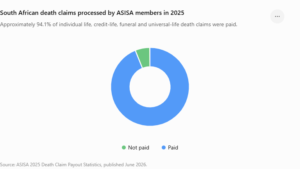
ASISA identifies reasons for declined death claims including dishonesty, fraud and contractual exclusions—for example, a suicide exclusion applicable within an initial policy period. (Asisa)
That gives us our first major insurance lesson:
Buying insurance is only half the job. Understanding what you bought is the other half.
🧠 Insurance Makes More Sense When You Stop Thinking of It as a Savings Account
Suppose you’ve insured your car for five years.
Premium:
R1,500 per month
Over five years:
R1,500 × 60
= R90,000
You never claim.
You sell the vehicle.
Some people look at that R90,000 and think:
“I wasted R90,000.”
Not necessarily.
You purchased five years of protection against certain insured risks.
During those five years, you could potentially have suffered a R250,000 theft or accident loss, depending on the cover and policy.
The insurer carried defined financial risks during that period.
Insurance is therefore generally better understood as:
Risk transfer
rather than:
Money stored for later.
You pay a comparatively predictable premium to reduce your exposure to certain potentially devastating losses.
💥 The R500,000 Question
Imagine two homeowners.
Both own homes containing approximately R500,000 worth of household contents.
Homeowner A
Has contents insurance.
A covered fire destroys R300,000 worth of possessions.
Subject to the policy terms, excess and valuation provisions, insurance may absorb much of the covered financial loss.
Homeowner B
Has no contents insurance.
The same R300,000 loss occurs.
Who pays?
Homeowner B.
That is what you’re really purchasing with insurance:
Protection against a loss you may not comfortably be able to absorb yourself.
🚫 So Why Are Claims Rejected?
There isn’t one answer.
Different insurance products have different contracts.
A rejected motor claim can involve completely different issues from a rejected funeral claim.
A homeowner’s claim involving deteriorated waterproofing has little in common with a life-insurance non-disclosure dispute.
But several themes repeatedly appear.
We’ll examine them one by one.
1️⃣ The Event Simply Wasn’t Covered
This sounds obvious until it happens.
Imagine you have building insurance.
Your ceiling collapses.
You think:
“My building is insured. Therefore the ceiling is covered.”
But insurance doesn’t necessarily cover every cause of damage to the building.
The question becomes:
What caused the ceiling to collapse?
Storm damage?
Sudden burst pipe?
Long-term water leakage?
Termite damage?
Poor construction?
Lack of maintenance?
Wear and tear?
Those aren’t necessarily treated identically.
This distinction appears clearly in actual South African complaint data.
The National Financial Ombud Scheme South Africa (NFO) reported that among homeowners’ insurance complaints finalised in 2024, 40% involved loss or damage associated with acts of nature, while burst water apparatus accounted for 16% and theft/burglary 8%.
But the leading reason behind disputes in the homeowners category involved claims rejected because of:
gradual deterioration, lack of maintenance or wear and tear. (NFOSA)
That distinction deserves attention.
🏠 Insurance Is Not a Maintenance Plan
Imagine your roof has slowly deteriorated for seven years.
Small cracks develop.
Waterproofing fails.
Every winter, a little water gets through.
You never repair it.
Eventually, during heavy rain, the ceiling collapses.
From your perspective:
“The rain destroyed my ceiling.”
From the insurer’s perspective, the argument may be:
“The rain exposed a long-standing maintenance problem.”
Those are very different interpretations.
This is why homeowners need to understand the difference between:
Sudden insured damage
and
Gradual deterioration
Insurance is generally designed around defined uncertain events.
It isn’t intended to replace ordinary property maintenance.
📊 What South Africans Dispute in Home Insurance
According to the NFO’s 2024 report, finalised homeowners’ complaints were concentrated around several types of loss:
| Type of homeowners complaint | Share |
|---|---|
| Acts of nature | 40% |
| Burst water apparatus | 16% |
| Theft/burglary | 8% |
| Other | 36% |
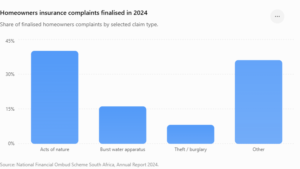
(NFOSA)
The point isn’t that storms aren’t covered.
The point is that cause matters.
2️⃣ Wear and Tear Is Different From Accidental Damage
Let’s use a car.
Your vehicle’s engine eventually fails after years of use.
That doesn’t automatically make it an insurance claim.
Now imagine another vehicle crashes into your car and causes substantial damage.
Those are fundamentally different events.
One is deterioration/mechanical failure.
The other is an accident.
The same principle can apply around your home.
A geyser pipe suddenly bursts.
That’s different from a pipe slowly corroding for years while leaking unnoticed.
A storm tears roof tiles away.
That’s different from an old roof slowly deteriorating until it can no longer keep water out.
Always ask:
What risk does my policy actually insure?
not:
Is the damaged thing insured?
Those questions sound similar.
They aren’t.
3️⃣ Non-Disclosure Can Become Extremely Expensive
This is especially important for life insurance.
Suppose an insurer asks:
“Do you smoke?”
You smoke regularly.
You answer:
No.
Why?
Because you’re worried the premium will increase.
Years later, a claim occurs.
The insurer investigates the application information.
Now you’ve created a serious problem.
The insurer priced the risk based partly on information you supplied.
ASISA specifically stresses the importance of honesty during life-insurance applications and says declined claims can arise from dishonesty and fraud. (Asisa)
The cheaper premium obtained through inaccurate information may ultimately be very expensive.
🩺 “But It Had Nothing to Do With the Claim”
This is where insurance disputes can become legally and contractually complicated.
Consumers sometimes argue:
“Yes, I didn’t mention that condition, but it had nothing to do with how I died/became disabled.”
Whether a non-disclosure permits an insurer to decline or adjust a particular claim depends on the facts, applicable law and policy terms.
Don’t assume either extreme:
“Any mistake means automatic rejection.”
or:
“It doesn’t matter unless it directly caused the claim.”
If an insurer asks a material question during underwriting, answer it accurately.
If you genuinely don’t know, don’t invent an answer.
If you don’t understand the question, ask.
4️⃣ The Premium Wasn’t Paid
This is one of the saddest ways to lose cover.
You’ve paid premiums for years.
Then financial pressure hits.
The debit order fails.
You tell yourself:
“I’ll sort it out next month.”
Another premium fails.
Then the insured event happens.
Whether cover remains in force will depend on the policy terms and applicable rules, including any relevant grace provisions.
But allowing premiums to lapse can eventually leave you uninsured.
This isn’t a theoretical concern.
ASISA reported that almost 4.5 million recurring-premium risk policies lapsed during the first half of 2025.
It noted that while some lapses may result from people switching providers, many occur because financially stretched consumers stop paying premiums. (Asisa)
That number is enormous.
📉 Why a Lapsed Policy Can Hurt More Than You Think
Suppose you’re 32 when you buy life cover.
You’re healthy.
Ten years later, you stop paying.
The policy lapses.
At 43, you decide you want the cover again.
But your health has changed.
You may:
- Pay a different premium;
- Face different underwriting;
- Receive exclusions;
- Receive different terms; or
- Potentially struggle to obtain equivalent cover.
Insurance isn’t always something you can simply switch off today and restore under identical conditions later.
5️⃣ You Didn’t Follow a Policy Condition
Policies contain obligations.
Depending on the type of insurance, conditions might concern:
- Vehicle security;
- Driver licensing;
- Tracking devices;
- Alarm systems;
- Property security;
- Business use;
- Storage;
- Regular maintenance;
- Reporting a loss;
- Supplying documentation;
- Keeping insured information accurate.
Let’s create a fictional example.
Your vehicle policy requires an approved tracking device.
You cancel the tracking subscription six months later because you want to save R200 per month.
The car is subsequently stolen.
You may have created a serious claim problem if the policy made the tracking requirement relevant to theft cover.
The lesson:
Don’t treat policy conditions as decorative fine print.
They are part of the agreement.
🚗 Motor Insurance Produces a Huge Share of Disputes
Motor insurance deserves special attention because it represented the largest single category of non-life insurance complaints finalised by the NFO in 2024.
The breakdown was:
Motor vehicle: 42%
Homeowners: 27%
Commercial: 14%
Household contents: 6%
Other/non-claim matters: 11%
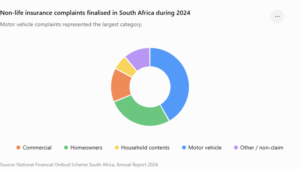
(NFOSA)
Within motor disputes, accidents accounted for 62%, warranty/mechanical breakdown matters 18%, and theft/hijacking 9%. (NFOSA)
That means understanding your motor policy deserves more than five minutes when you buy it.
🚘 The Cheapest Car Insurance Quote Isn’t Necessarily the Cheapest Insurance
Suppose you compare two comprehensive motor policies.
Policy A
Premium:
R1,050/month
Basic excess:
R5,000
Policy B
Premium:
R850/month
Basic excess:
R12,500
Policy B saves:
R200 per month
Over 12 months:
R2,400
Then you have a covered accident.
You discover you need to contribute an excess of R12,500 under the applicable claim circumstances.
That doesn’t automatically mean Policy B was bad.
Maybe the higher excess was clearly disclosed and appropriate for your finances.
But if you selected it only because:
R850 is cheaper than R1,050
then you didn’t actually compare the products properly.
🧮 The Real Cost of an Excess
Imagine your insured vehicle suffers R35,000 of covered accident damage.
Assume, purely for illustration, that the policy responds fully other than a basic excess.
Scenario A
Damage: R35,000
Excess: R5,000
Illustrative insurer contribution:
R30,000
Scenario B
Damage: R35,000
Excess: R12,500
Illustrative insurer contribution:
R22,500
Scenario C
Damage: R35,000
Excess: R20,000
Illustrative insurer contribution:
R15,000
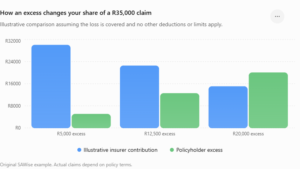
Before choosing a higher voluntary excess to reduce your premium, ask:
Could I comfortably pay this excess tomorrow?
If the answer is no, your cheap monthly premium may have created an expensive problem.
6️⃣ You Insured the Car for the Wrong Use
This is a classic example of why disclosure matters.
Suppose your vehicle is insured for ordinary private use.
Six months later, you begin using it intensively for commercial deliveries.
You don’t tell the insurer.
Then you have an accident during a delivery.
Whether this affects the claim depends on your specific contract and circumstances.
But your risk has clearly changed.
Insurance pricing isn’t random.
How a vehicle is used can affect:
- Mileage;
- Road exposure;
- Driver exposure;
- Location;
- Accident probability;
- Theft risk.
If your circumstances materially change, contact your insurer or broker and ask whether the policy needs updating.
Don’t wait until claim day.
7️⃣ The Regular Driver Information Was Wrong
Another common motor-insurance trap:
A parent owns the vehicle.
Their 20-year-old child drives it every day.
But the policy lists the parent as the regular driver.
Why?
Maybe the quote was cheaper.
Again, that’s dangerous thinking.
If the insurer asks who the regular driver is, answer according to reality.
Don’t engineer answers around the premium you want.
A policy built on inaccurate information can become a very expensive piece of paper.
🍺 What About Drinking and Driving?
Motor policies can contain exclusions and conditions relating to driving under the influence of alcohol or drugs.
More importantly, South African road law itself imposes restrictions on driving under the influence.
Don’t build your insurance strategy around:
“How much can I drink and still claim?”
Build it around:
Don’t drive after drinking.
Insurance is supposed to protect against accidents.
It is not a licence to create avoidable risk.
8️⃣ Your Claim Amount and the Insurer’s Amount Don’t Match
Not every dispute is:
PAY
versus
DON’T PAY.
Sometimes the insurer accepts that a claim exists, but the disagreement concerns:
How much should be paid?
The NFO’s 2024 report identifies disputed claim quantum as one of the recurring reasons for non-life insurance complaints. (NFOSA)
Imagine your damaged household items include:
Television.
Laptop.
Couch.
Fridge.
Sound system.
You calculate:
R95,000
The insurer assesses the payable amount as:
R68,000
Now the dispute is about valuation, limits, proof, depreciation/replacement provisions or another policy mechanism—not necessarily whether the event happened.
Keep evidence of significant possessions.
Receipts help.
Photographs help.
Serial numbers help.
Invoices help.
An updated household inventory can help enormously after a burglary or fire.
📸 The 10-Minute Home Insurance Habit
Do this today.
Take your phone.
Walk through every room.
Record a slow video.
Capture:
- Television;
- Appliances;
- Furniture;
- Computers;
- Electronics;
- Jewellery;
- Tools;
- Expensive clothing;
- Collectibles;
- Other valuable possessions.
Then store the video securely somewhere other than only on that phone.
If your home burns down next month, remembering every possession from memory can be extremely difficult.
Imagine trying to list every item in your kitchen while emotionally dealing with a destroyed home.
Evidence created before a loss can make life easier afterwards.
9️⃣ Underinsurance Can Be Brutal
This is one of the most important concepts in property insurance.
Imagine the replacement value of your household contents is:
R1,000,000
But you’ve insured them for:
R500,000
You might think:
“That’s fine. If R200,000 worth of things are stolen, I’m below my R500,000 cover.”
Not necessarily.
Depending on the policy, an average clause or underinsurance provision may apply.
A simplified calculation can look like:
Amount insured ÷ actual replacement value × loss
Using our example:
R500,000 ÷ R1,000,000 × R200,000
= R100,000
So on a R200,000 covered loss, the proportional amount before other applicable deductions could be:
R100,000
Why?
Because you insured only 50% of the total value.
Effectively, you retained the other 50% of the risk yourself.
📊 Underinsurance in Action
Let’s hold the loss constant at R200,000 while changing the insured amount.
Actual replacement value:
R1,000,000
| Sum insured | Insurance ratio | Illustrative proportional claim |
|---|---|---|
| R1,000,000 | 100% | R200,000 |
| R800,000 | 80% | R160,000 |
| R600,000 | 60% | R120,000 |
| R500,000 | 50% | R100,000 |
| R300,000 | 30% | R60,000 |
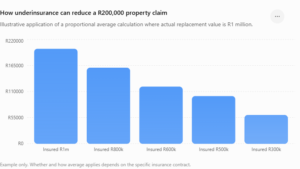
This is why artificially reducing your insured value just to lower the premium can backfire.
🏗️ Your House’s Market Value Isn’t Necessarily Its Rebuilding Cost
This is another major misunderstanding.
You bought a house for:
R1.8 million.
Does that mean the building should be insured for R1.8 million?
Not automatically.
A property’s market price can include:
- Land;
- Location;
- Neighbourhood demand;
- Scarcity;
- View;
- Local property market conditions.
Building insurance generally focuses on the cost associated with rebuilding the insured structure according to the policy basis.
Land doesn’t burn down.
But rebuilding can involve:
- Demolition;
- Rubble removal;
- Labour;
- Materials;
- Professional fees;
- Compliance costs;
- Construction inflation;
- Other expenses.
So don’t simply copy your purchase price into the building sum insured.
Determine what the policy requires and how the insurer recommends calculating appropriate cover.
💍 Some Valuable Items May Need Special Treatment
Suppose you have:
A R70,000 engagement ring.
A R35,000 camera.
A R45,000 laptop.
A R60,000 watch.
You assume:
“My contents are insured, so everything is covered everywhere.”
That may not be true.
Policies can have item limits and special provisions for valuables, especially when property is taken outside the home.
Certain belongings may need to be specified under an all-risks or portable-possessions section, depending on the insurer.
Check.
Don’t discover the limitation after losing the item.
📱 The R30,000 Phone Example
Your expensive smartphone is stolen at a shopping centre.
You have household contents insurance.
But your phone wasn’t specified for cover away from home.
You submit a claim.
Now you discover your household policy doesn’t provide the off-premises cover you assumed.
The mistake was thinking:
“I own insurance.”
instead of asking:
“Where, when and against what is this item insured?”
Those questions are much more useful.
1️⃣0️⃣ Life Insurance: The Claim Your Family Has to Understand
Life insurance is different because you may never personally submit the claim.
Your family will.
That means your policy shouldn’t be a secret.
At minimum, an appropriate trusted person should know:
- That the policy exists;
- Which insurer issued it;
- Where policy information is stored;
- Who the relevant beneficiaries are;
- How the insurer can be contacted.
A R2 million policy nobody knows exists is far less useful than it should be.
❤️ How Much Life Insurance Do You Actually Need?
There is no universal:
“Everyone needs R5 million.”
Your need depends on what financial problem your death would create.
A useful framework is:
Debt
Mortgage.
Vehicle finance.
Personal loans.
Other obligations.
Income replacement
How much financial support would dependants lose?
Children
Schooling.
University.
Daily living costs.
Funeral and immediate costs
What cash would the family need quickly?
Existing assets
Savings.
Investments.
Existing insurance.
Partner’s income
What can the household continue to support without you?
🧮 The Family Gap Calculation
Let’s create an original example.
Sipho has:
Home-loan balance: R1,100,000
Other debt: R150,000
Desired education provision: R500,000
Additional family income/support need: R1,500,000
Immediate expenses: R100,000
Total financial need:
R3,350,000
Existing savings/investments earmarked for family:
R400,000
Existing employer life cover:
R600,000
Simplified gap:
R3,350,000 − R1,000,000
=
R2,350,000
This does not mean Sipho automatically needs exactly R2.35 million of additional life insurance.
Inflation, tax, investment returns, duration of support, employer-cover conditions and family circumstances all matter.
But this is far more intelligent than randomly choosing:
“R1 million sounds like a lot.”
⚰️ Funeral Cover and Life Cover Are Not Identical
These products can overlap in purpose, but they aren’t necessarily substitutes.
Funeral insurance is typically designed to provide a benefit following death to assist with funeral-related and immediate financial needs.
Life insurance can be structured around larger, longer-term financial risks such as:
- Income replacement;
- Mortgage debt;
- Dependants;
- Estate liquidity;
- Education;
- Long-term family support.
ASISA’s 2025 statistics illustrate the scale of both markets.
Its members paid:
579,296 funeral claims worth R9.6 billion
and
254,377 individual life-insurance claims worth R29.3 billion. (Asisa)
One household may legitimately need both, depending on circumstances.
🏦 Credit Life: The Insurance You May Already Have
Credit-life insurance can be attached to certain credit agreements and may cover specified obligations after events such as death, disability, retrenchment or another defined event, depending on the product.
Consumers sometimes forget it exists.
Imagine someone loses their job and immediately thinks:
“How am I going to pay this loan?”
Before panicking, check whether the credit agreement includes credit-life insurance and what events it covers.
Don’t assume you’re covered.
But don’t assume you’re not.
Read the contract.
Ask the credit provider.
🧑🦽 Disability and Income Protection: Protecting the Machine That Produces the Money
Think about your biggest asset.
Your house?
Car?
Retirement fund?
For many working-age people, it may actually be:
Their future ability to earn income.
Suppose you’re 35 and earn R30,000 per month.
If you could otherwise continue earning for another 30 years, your gross future earnings—ignoring raises, inflation, tax and investment effects—would be:
R30,000 × 12 × 30
=
R10.8 million
Your income-producing ability is economically significant.
If illness or disability prevents you from working, the financial effect can be enormous.
That’s why disability and income-protection insurance deserve serious consideration alongside life insurance.
🧠 Insure the Disaster, Not Every Irritation
Insurance is most powerful when protecting you from losses that would seriously damage your finances.
Ask:
“Could I comfortably absorb this loss myself?”
A R500 broken appliance?
Maybe.
A R3,000 phone repair?
Possibly.
A R900,000 house fire?
Probably not.
A R500,000 vehicle theft?
Potentially devastating.
The death of the household’s primary earner?
Potentially life-changing.
This is why insurance planning should start with financial consequences, not with buying every product somebody offers.
💸 The Insurance Budget Problem
Suppose a household pays monthly:
Car insurance: R1,600
Building/contents: R900
Life cover: R1,200
Funeral cover: R500
Income protection: R850
Other policies: R600
Total:
R5,650 per month
That’s R67,800 per year.
The correct reaction isn’t automatically:
“Cancel insurance.”
It is:
Review what each policy protects.
Maybe you’re duplicated.
Maybe you’re underinsured.
Maybe you have policies you no longer need.
Maybe essential cover is missing.
Maybe your excess structure is inappropriate.
Insurance should be reviewed, not simply accumulated.
🔁 Duplicate Cover Isn’t Always Double Money
Suppose you have two policies that appear to cover the same property.
Don’t automatically assume:
“If something happens, I’ll get paid twice.”
Indemnity-based insurance generally aims to restore you financially following the insured loss according to policy terms, not create a profit from the event.
Life insurance and certain fixed-benefit products operate differently.
This is another reason to understand what kind of insurance you’re buying.
Insurance isn’t one homogeneous product.
📃 Read the Policy Schedule Before the 40-Page Wording
Long insurance documents intimidate people.
Start strategically.
When a policy is issued, look first at your schedule.
Check:
- Your name;
- Address;
- Insured property;
- Vehicle details;
- Regular driver;
- Sum insured;
- Cover type;
- Excess;
- Specified items;
- Security requirements;
- Premium;
- Important endorsements.
If something is wrong, contact the insurer immediately.
Then work through the policy wording, especially exclusions and claim conditions.
Don’t wait until the accident.
🔍 The SAWise 15-Minute Insurance Audit
Take every policy you have.
For each one, answer these ten questions:
| Question | Your answer |
|---|---|
| What exactly is insured? | ___ |
| What events are covered? | ___ |
| What are the main exclusions? | ___ |
| What is my excess? | R___ |
| Is there an additional excess? | ___ |
| Is my sum insured still accurate? | ___ |
| Are my personal details correct? | ___ |
| Are there security conditions? | ___ |
| Are my premiums up to date? | ___ |
| Who knows this policy exists? | ___ |
If you can’t answer half of these without calling your insurer, that’s useful information.
Call them.
📞 Record Important Changes Properly
You move house.
Change driver.
Install/remove tracking.
Start working from home.
Buy expensive equipment.
Renovate.
Change occupation.
Begin business use of a vehicle.
Get married.
Have a child.
Acquire a valuable item.
Some life changes can affect insurance needs or policy information.
Don’t rely on:
“I think I told the call-centre guy two years ago.”
Where practical, keep written confirmation of material policy changes.
Save updated schedules.
Store important correspondence.
🧾 Claim Day: What Should You Do?
A loss happens.
You’re stressed.
This is when good preparation matters.
Protect people first
If there is danger, prioritise safety and emergency assistance.
Prevent further loss where reasonable and safe
For example, take reasonable steps to prevent additional damage—but don’t put yourself in danger.
Document the scene
Take photos and video where appropriate.
Don’t destroy evidence unnecessarily
The insurer may need to inspect damaged property.
Report promptly
Follow your policy’s notification requirements.
Get the claim number
Keep it.
Write down what happened
Memories become fuzzy quickly.
Save every document
Invoices.
Police case information where relevant.
Repair quotations.
Emails.
Photos.
Assessor reports supplied to you.
Correspondence.
Be truthful
Never exaggerate the loss.
A legitimate R40,000 claim does not become better because you invent another R20,000 of missing items.
Fraud can jeopardise a claim and create much bigger problems.
🚨 Never Stage or Inflate an Insurance Claim
Suppose a television worth R15,000 is stolen.
You tell the insurer:
“It was R30,000.”
Then add a gaming console you never owned.
You’ve transformed yourself from somebody who suffered a genuine loss into somebody supplying false information.
Don’t do it.
ASISA identifies fraud and dishonesty among reasons death claims can be declined. (Asisa)
Insurance works partly because risk is pooled across policyholders.
Fraud ultimately damages that system.
Claim for what actually happened.
Nothing more.
Nothing less.
❌ What If Your Claim Is Rejected?
This is where people often make one of two mistakes.
Mistake 1
Immediately accept the rejection even though they don’t understand it.
Mistake 2
Immediately scream:
“SCAM!”
without reading the reason.
Do neither.
Ask for the rejection in writing.
Identify:
- The specific reason;
- The policy clause relied upon;
- The evidence supporting the decision;
- The insurer’s internal dispute process;
- Applicable deadlines.
Then compare the insurer’s position with:
- Your policy wording;
- Schedule;
- Application information;
- Photographs;
- Maintenance records;
- Expert evidence;
- Correspondence.
You need to understand the dispute before you can challenge it effectively.
⚖️ A Rejection Is Not Necessarily the Final Word
South Africa has an external dispute-resolution mechanism.
The National Financial Ombud Scheme South Africa (NFO) began operating in March 2024 following the amalgamation of several previous financial ombud schemes, including the former short-term and long-term insurance ombuds. (NFOSA)
And external complaints do sometimes produce different outcomes.
In 2024, the NFO’s Non-life Insurance Division recorded an overturn/resolved ratio of 16.5%.
The additional monetary benefit obtained for consumers through the division was approximately:
R107.4 million
for 2024. (NFOSA)
That is worth thinking about.
It doesn’t mean 16.5% of all insurance claims in South Africa were wrongly declined.
It concerns complaints handled by the NFO division.
But it does demonstrate that insurer decisions can be challenged and, in some cases, changed.
📊 What Happened to NFO Non-Life Complaints in 2024?
The NFO reported:
12,806 complaints registered
11,089 complaints resolved
16.5% overturn/resolved ratio
Approximately R107.4 million additional monetary benefit to consumers (NFOSA)
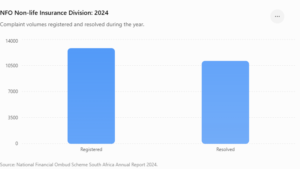
This is exactly why consumers should understand their rights.
A declined claim may be correct.
But if you genuinely believe the insurer has incorrectly applied the policy, there is a dispute process.
National Financial Ombud Scheme South Africa
🛡️ The Regulator Matters Too
South Africa’s financial-sector conduct regulator is the Financial Sector Conduct Authority (FSCA).
Policyholder Protection Rules include requirements around insurer communications and disclosures. FSCA material notes, among other things, that insurer communications to policyholders must be in plain language, not misleading and appropriately presented. (FSCA)
That’s important.
Consumers have responsibilities.
But insurers do too.
This article isn’t saying:
“Every rejection is the customer’s fault.”
Far from it.
Insurance is a contractual relationship with obligations on both sides.
Financial Sector Conduct Authority
🧭 The Claim Rejection Decision Tree
If your claim is rejected, work through this sequence:
Step 1 — Why?
Get the exact written reason.
↓
Step 2 — Where?
Find the relevant policy clause.
↓
Step 3 — Is the information correct?
Check the insurer’s factual assumptions.
↓
Step 4 — What evidence do you have?
Photos, reports, invoices, maintenance records, witnesses, communications.
↓
Step 5 — Internal complaint
Use the insurer’s formal dispute procedure.
↓
Step 6 — Still unresolved?
Investigate whether the NFO or another appropriate formal dispute channel can assist.
This is far more effective than posting:
“Insurance company X stole my money!”
before you’ve even obtained the rejection letter.
🧠 The Most Expensive Insurance Mistakes Often Happen Before the Claim
This is the central lesson of this entire article.
People think insurance problems begin here:
ACCIDENT → CLAIM → REJECTION
But many begin here:
APPLICATION
You give inaccurate information.
Or here:
POLICY ISSUED
You don’t read the schedule.
Or here:
YEAR 2
Your circumstances change.
You don’t update the insurer.
Or here:
YEAR 3
Your roof deteriorates.
You don’t maintain it.
Or here:
YEAR 4
You reduce your sum insured to save money.
Or here:
YEAR 5
A debit order fails.
You ignore it.
Then:
CLAIM DAY
The earlier decisions suddenly matter.
Insurance is maintained before the disaster.
🧮 The “Can I Survive This?” Test
Here’s an original SAWise method for deciding which risks deserve attention.
Write down five financial disasters.
Example:
| Event | Potential financial loss | Could I absorb it? |
|---|---|---|
| Phone stolen | R15,000 | Maybe |
| Car stolen | R300,000 | No |
| House burns | R1.5m+ | No |
| Can’t work for a year | R360,000 income | No |
| Primary earner dies | Multi-year impact | No |
Now ask:
Which losses would seriously damage my family’s finances?
Those are the risks that deserve priority.
Insurance planning should begin with catastrophe.
Not sales pitches.
💡 Cheap Insurance vs Valuable Insurance
The goal isn’t necessarily:
Lowest premium
The goal is:
Appropriate protection at a sustainable cost
A R600 policy that won’t respond to the risk you’re worried about is expensive.
A R1,000 policy that properly covers a financially devastating risk may provide better value.
Price matters.
But compare:
- Cover;
- Exclusions;
- Excesses;
- Limits;
- Conditions;
- Service;
- Claims process;
- Optional benefits;
- Policy wording.
Don’t compare only:
R899 vs R1,099.
📆 Your Annual Insurance Review
Pick one date every year.
Maybe your birthday.
Review everything.
Vehicle
Current use?
Regular driver correct?
Vehicle details correct?
Security requirements met?
Appropriate cover?
Home
Rebuilding amount still realistic?
Renovations?
New solar system?
New structures?
Contents
Have you bought expensive furniture/electronics?
Replacement values changed?
Portable possessions
New phone?
Laptop?
Jewellery?
Camera?
Life
New child?
Marriage?
Divorce?
New mortgage?
Income changed?
Income protection
Income changed?
Occupation changed?
Beneficiaries
Still appropriate?
A 30-minute annual review can prevent years of unnoticed insurance drift.
📈 Insurance Needs Change as Your Life Changes
At 21:
You rent a room.
Own a R40,000 car.
No children.
At 31:
Married.
Two children.
R1.5 million mortgage.
R300,000 vehicle.
At 41:
Higher income.
Larger house.
More debt.
Substantial assets.
At 61:
Mortgage possibly settled.
Children independent.
Retirement approaching.
Would exactly the same insurance portfolio make sense at all four ages?
Probably not.
Insurance isn’t:
Buy once → forget forever.
It should evolve with your financial life.
🇿🇦 South Africa’s Insurance Industry Is Enormous
ASISA reported that its long-term insurance members ended 2025 with approximately:
R5.2 trillion in assets under management
and tens of millions of in-force policies.
During 2025, life insurers paid approximately:
R626 billion
in claims and benefits across death, disability, critical illness, income protection, retirement-related benefits and other covered events. (Asisa)
Those numbers demonstrate how deeply insurance and long-term financial products are embedded in South African household finances.
But scale doesn’t remove personal responsibility.
Your insurer manages millions of policies.
You only need to understand yours.
🧩 Five Fictional Households, Five Different Insurance Problems
Let’s put everything together.
Household 1 — The Mokoenas
They have comprehensive vehicle insurance.
Their car is stolen.
Tracking requirements were maintained.
Premiums are current.
Information is accurate.
The theft is promptly reported.
Their documentation is available.
Subject to all policy terms, they’ve done a lot right.
Household 2 — The Williams Family
Their roof leaks badly during a storm.
The insurer’s assessor says the roof has suffered years of deterioration and inadequate maintenance.
Their dispute isn’t simply:
“Did it rain?”
It’s:
What caused the loss the policyholder is claiming for?
Household 3 — Lebo
She has R800,000 worth of household contents but insured them for R400,000.
A covered R200,000 loss occurs.
If the applicable policy contains an average clause, underinsurance could materially reduce the claim.
Household 4 — Yusuf
He buys life insurance but omits important health information when answering underwriting questions.
A claim occurs years later.
The application information becomes part of the investigation.
The money he thought he saved on premiums now looks irrelevant.
Household 5 — Nomsa
She receives a rejected motor claim.
Instead of giving up, she asks for:
The written rejection.
Policy clause.
Evidence.
Internal review.
She believes the insurer has applied the exclusion incorrectly.
After exhausting the insurer’s process, she takes the matter through the appropriate external dispute channel.
She may still lose.
But now she is challenging the decision intelligently.
❓Insurance Questions South Africans Often Ask
Can an insurance company reject my claim?
Yes. A claim can be declined where the event isn’t covered or where an applicable exclusion, condition or other contractual issue justifies rejection. The facts and policy wording matter.
Does paying premiums guarantee every claim will be paid?
No. Paying the premium keeps applicable cover in force subject to the contract; it doesn’t turn excluded events into covered events.
Can an insurer reject a claim for wear and tear?
Policies commonly distinguish insured events from gradual deterioration and maintenance issues. The NFO reported that gradual deterioration, lack of maintenance and wear and tear were the leading rejection reasons in homeowners’ complaints during 2024. (NFOSA)
What happens if my insurance debit order bounces?
Check immediately with your insurer. Policies can contain provisions dealing with missed premiums and lapses. Don’t assume you’re still covered—or automatically assume you’ve immediately lost cover. Confirm your status.
What is an insurance excess?
It is the portion of an insured claim that the policyholder may need to bear under the applicable policy terms. Different excesses can apply in different circumstances.
Is a lower excess always better?
Not necessarily. Lower excess structures may affect premiums. The right balance depends on what you can afford monthly and what you could afford at claim time.
Can I insure my house for what I paid for it?
Don’t automatically use the purchase price. Building insurance can be based on rebuilding costs rather than property market value. Ask the insurer how the sum insured should be calculated.
What is underinsurance?
Broadly, it occurs when the insured amount is lower than the value that should have been insured. Where an average clause applies, this can reduce a partial claim proportionally.
Will insurance cover poor maintenance?
Don’t assume it will. Maintenance and gradual deterioration are frequent areas of dispute in property insurance. (NFOSA)
Can I dispute a rejected claim?
Yes. Start with the insurer’s internal complaints process. Depending on the dispute, the National Financial Ombud Scheme may be an appropriate external channel.
Does insurance really pay claims?
Yes—large numbers of valid claims are paid. ASISA members paid 1,016,794 individual death claims in 2025 worth R44.2 billion, representing 94.1% of claims processed in the categories reported. (Asisa)
Why would a life claim be rejected?
Reasons can include dishonesty, fraud and contractual exclusions, depending on the circumstances. ASISA specifically identified these among reasons for declined death claims in its 2025 statistics. (Asisa)
Do I need both funeral and life insurance?
They can serve different financial purposes. Whether you need either or both depends on your family’s circumstances and financial needs.
Should I insure everything I own?
Not necessarily. Consider the financial consequences of losing an asset and the cost of transferring that risk. Insurance is particularly valuable for losses you cannot comfortably absorb yourself.
📋 SAWise Insurance Checklist: Before You Click “Accept”
Before buying or renewing insurance, ask:
☑ What exactly am I insuring?
☑ What events are covered?
☑ What are the major exclusions?
☑ What is my basic excess?
☑ Are there additional excesses?
☑ What security requirements apply?
☑ Is the insured amount accurate?
☑ Did I answer every application question honestly?
☑ What changes must I report?
☑ What happens if a premium isn’t paid?
☑ What documents will be needed at claim time?
☑ Who should know this policy exists?
If the salesperson can’t explain something you don’t understand, don’t pretend you understand it.
Ask again.
It’s your money.
It’s your risk.
And it may eventually be your family’s claim.
🌟 The Best Insurance Claim Is Prepared Years Before It Happens
Nobody knows which ordinary morning might become extraordinary.
You leave home at 07:00.
At 07:40, another vehicle runs a red light.
You go to work.
At 13:00, somebody breaks into your house.
You go to sleep.
At 02:17, water starts coming through the ceiling.
You feel perfectly healthy.
Six months later, a doctor tells you something you never expected to hear.
Insurance exists because life doesn’t ask permission before changing.
But buying a policy and forgetting about it isn’t enough.
You need to know:
What is covered.
What isn’t.
What you promised the insurer.
What the insurer promised you.
What conditions apply.
How much you’re insured for.
What excess you’ll pay.
What evidence you should keep.
And what to do when something goes wrong.
That’s how insurance becomes something more useful than another debit order.
It becomes part of your financial defence system.
💚 Final Thought
A good insurance policy should allow you to answer one simple question:
“If the thing I’m afraid of happens tomorrow, what happens financially the day after?”
If you don’t know the answer, don’t wait for the accident.
Find out now.
Check your schedule.
Read the exclusions.
Photograph your possessions.
Update your insured values.
Confirm your regular driver.
Maintain your property.
Keep premiums current.
Tell the truth when applying.
Store your documents.
Tell your family where important life policies are.
Because the worst time to discover what your insurance doesn’t cover is after you’ve already suffered the loss.
Insurance cannot prevent the storm.
It cannot stop a thief.
It cannot reverse an accident.
It cannot bring somebody back.
What it can do—when the right cover is in place and a valid claim meets the policy terms—is prevent one terrible event from becoming a second disaster:
a financial one. 🇿🇦🛡️
| outcome | claims |
|---|---|
| Paid | 1,016,794 |
| Not paid | 64,136 |
| category | percentage |
|---|---|
| Acts of nature | 40 |
| Burst water apparatus | 16 |
| Theft / burglary | 8 |
| Other | 36 |
| type | percentage |
|---|---|
| Motor vehicle | 42 |
| Homeowners | 27 |
| Commercial | 14 |
| Household contents | 6 |
| Other / non-claim | 11 |
| excess | insurer | customer |
|---|---|---|
| R5,000 excess | 30,000 | 5,000 |
| R12,500 excess | 22,500 | 12,500 |
| R20,000 excess | 15,000 | 20,000 |
| insured | claim |
|---|---|
| Insured R1m | 200,000 |
| Insured R800k | 160,000 |
| Insured R600k | 120,000 |
| Insured R500k | 100,000 |
| Insured R300k | 60,000 |
| measure | count |
|---|---|
| Registered | 12,806 |
| Resolved | 11,089 |
SAWise Note
SAWise.co.za provides independent educational information and does not provide personalised insurance, legal or financial advice. Insurance products, underwriting requirements, exclusions, excesses and claims processes differ between providers and policies. Always read your own policy schedule and wording, obtain clarification from your insurer or appropriately authorised financial adviser where necessary, and use official dispute-resolution channels if you believe a claim has been handled incorrectly.