


Running a small business from your phone, spare room, garage or laptop can make the line between “my money” and “business money” almost invisible. A customer pays R8,000, groceries need to be bought, a supplier is waiting and suddenly everything comes from the same account. This guide explains how South African entrepreneurs can build a practical financial wall between themselves and their businesses—and why doing so can make a business easier to understand, manage and grow.
There is a strange moment that happens in many small businesses.
Your phone vibrates.
Payment received: R12,500.
For a few seconds, you feel rich.
The business had a good week. Customers paid. There is finally money in the account.
Then reality starts arriving.
R3,600 must go to a supplier.
R1,400 is needed for delivery costs.
R750 is for software and internet.
A customer paid a R2,000 deposit for work you haven’t completed yet.
Your car needs petrol.
There is almost no food at home.
Your child needs R600 for something at school.
And you remember that some of the business income may eventually have tax consequences.
Suddenly that R12,500 isn’t really R12,500 available for you to spend.
This is where many otherwise promising businesses become financially confusing.
The problem isn’t necessarily that the business isn’t making money.
The owner simply can’t tell which money belongs where.
A customer pays into the owner’s everyday account. The owner buys groceries from it. Business stock goes onto a personal credit card. A family member transfers money into the same account. Netflix debits from it. Another customer pays. The owner buys petrol. A supplier gets paid.
At month-end, the bank statement contains 200 transactions and nobody can confidently answer a basic question:
Did the business actually make money this month?
For a South African entrepreneur, separating personal and business finances isn’t merely about looking professional.
It’s about being able to see the truth about your business.
Let’s build a system that does that.
💰 The R40,000 Illusion
Let’s begin with a fictional Cape Town business owner named Jerome.
Jerome repairs and resells electronics.
In one month, customers pay him:
R40,000
He proudly tells his friend:
“Business made forty grand this month.”
But did it?
Let’s look underneath the number.
| Item | Amount |
|---|---|
| Customer payments | R40,000 |
| Replacement parts | -R11,500 |
| Devices bought for resale | -R6,000 |
| Courier/delivery costs | -R2,100 |
| Advertising | -R1,800 |
| Phone/data attributable to business | -R700 |
| Other business costs | -R1,400 |
| Money remaining before other considerations | R16,500 |
The R40,000 was revenue.
It wasn’t R40,000 of profit.
Jerome then withdraws:
R12,000 for household expenses.
Now only R4,500 remains from that simplified example.
If he needs R8,000 for stock next week, he has a problem.
The business may be trading successfully, yet Jerome feels constantly broke.
That’s the first reason financial separation matters:
Money entering a business is not automatically money available to the owner.
🧠 Your Business Needs Its Own Financial Identity
Imagine trying to understand two people’s finances using one bank statement.
Person A earns R25,000.
Person B earns R18,000.
They both receive salaries into one account, buy whatever they need and never record who spent what.
At the end of the month, you ask:
“How much did Person A save?”
Nobody knows.
That’s essentially what happens when personal and business money are constantly mixed.
You need to be able to answer:
How much did the business sell?
What did it cost to generate those sales?
What does the business owe?
How much do customers owe the business?
How much did I take out personally?
How much cash does the business need for next month?
Is the business becoming stronger—or am I quietly funding it from my salary?
If your records can’t answer those questions, you aren’t really managing the finances.
You’re watching the bank balance.
Those are not the same thing.
🏦 Does Every South African Business Legally Need a Business Bank Account?
Not every person earning business income operates through the same legal structure, so we need to be careful here.
SARS recognises several ways in which a person can conduct business.
For example, a sole proprietorship isn’t a separate legal entity from its owner in the same way as a company. SARS explains that a sole proprietor is taxed on business profits in their individual capacity.
A partnership is also treated differently: each partner is generally taxed on their share of taxable profits rather than the partnership being taxed separately as an income-tax entity.
Private companies and other incorporated entities have different legal and tax characteristics. (South African Revenue Service)
So don’t take this article to mean:
“Every freelancer in South Africa is legally required to open a company account tomorrow.”
That’s too simplistic.
But even where your business structure doesn’t strictly require a separate business bank account, financial separation can still be an excellent management practice.
And if you’re operating through a company, maintaining clear separation becomes even more important.
🧾 Three Businesses That Look Similar—but Aren’t
Consider three people selling handmade furniture.
🪑 Business A: Thandi the Sole Proprietor
Thandi trades in her own name.
Customers pay her for furniture.
For income-tax purposes, the business’s taxable profit forms part of her individual tax affairs.
🪑 Business B: Mpho and Kabelo Partnership
They operate together.
The partnership generates profits, but the partners are generally taxed individually on their respective shares.
🪑 Business C: TK Furniture (Pty) Ltd
This is a registered company.
A company is a separate legal person from its shareholders.
Its money should not casually be treated as though the company bank account is the shareholder’s personal wallet.
The businesses might all sell identical dining tables.
Their legal structures aren’t identical.
That’s why copying another entrepreneur’s financial setup without understanding their business structure can cause problems.
🚧 Build a Financial Wall—Not a Financial Prison
Separating business money doesn’t mean you can never take money from your business.
Of course you can.
The business exists partly to generate economic benefit for its owners.
The difference is between:
Taking money deliberately and recording what happened
and:
Using the business account like an ATM whenever you feel like buying something.
Think of the business as having a gate.
Money can move through the gate.
But every movement should have a reason.
For example:
Business → owner
could be recorded appropriately as salary/remuneration, drawings in a sole-proprietor context, repayment of money the owner previously advanced, dividend where legally and tax-appropriately declared, or another properly classified transaction.
Similarly:
Owner → business
might represent capital introduced, a shareholder/director loan where appropriate, or another documented contribution.
The exact accounting and tax treatment depends on your structure and circumstances.
The principle is universal:
Know why the money moved.
📊 The Four Numbers Every Business Owner Should Know
Forget complicated accounting terminology for a moment.
If you run a small business, start with four numbers.
1️⃣ Revenue
How much did customers pay or how much revenue did the business generate according to your accounting basis?
2️⃣ Business expenses
What did it cost to operate?
3️⃣ Profit
What remains after relevant business expenses?
4️⃣ Cash
How much money is actually available now?
These numbers interact—but they aren’t identical.
Let’s see why.
💡 A Business Can Be Profitable and Still Run Out of Cash
This surprises new entrepreneurs.
Suppose your design business completes R60,000 of work in September.
Your business costs are R35,000.
On paper:
R60,000 − R35,000 = R25,000
Great.
Except customers have only paid R20,000 so far.
Another R40,000 is still outstanding.
Meanwhile, your suppliers need payment now.
Your profit calculation may look healthy while your bank balance looks terrible.
That’s a cash-flow problem.
Now reverse it.
A customer pays you a R50,000 deposit today for a large project you’ll deliver over the next two months.
Your bank balance suddenly looks fantastic.
But you still need to purchase materials and complete the work.
The R50,000 bank balance does not mean:
“I made R50,000 profit today.”
This is why managing a business by checking the balance on your banking app can be dangerous.
📈 Revenue, Profit and Cash: An Original Example
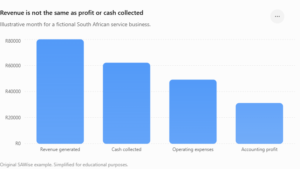
Imagine SAWise Digital Services has the following month:
| Financial activity | Amount |
|---|---|
| Revenue generated | R80,000 |
| Operating expenses | R49,000 |
| Accounting profit before tax and other adjustments | R31,000 |
| Customer invoices still unpaid | R18,000 |
| Cash collected from current revenue | R62,000 |
If we simplify the timing, the business may have generated R31,000 accounting profit but not yet collected all the cash associated with that revenue.
That’s why a business owner needs records, not vibes.
💳 Step One: Stop Receiving Business Money Everywhere
A common micro-business setup looks like this:
Customer 1 pays into your Capitec account.
Customer 2 sends cash.
Customer 3 pays your spouse.
Customer 4 uses eWallet.
Customer 5 pays into an old bank account.
Customer 6 pays your PayShap number.
Customer 7 gives the money to your employee.
At the end of the month:
Good luck reconciling everything.
Where practical, create a clear payment system.
Your invoices should specify the approved way customers pay.
Keep business receipts flowing through as few channels as reasonably possible.
That doesn’t mean a cash-based business must refuse cash.
It means cash also needs a process.
If you receive R2,500 cash from a customer, record R2,500 of business income.
Don’t treat cash as invisible money.
🧮 The “Cash Doesn’t Count” Trap
Let’s say a barber receives:
Card payments: R18,000
EFTs: R12,000
Cash: R15,000
Total receipts:
R45,000
But he only tracks the electronic payments.
His spreadsheet says:
R30,000
He thinks he knows what his business earns.
He’s missing one-third of the money received in this simplified example.
Cash needs documentation.
Keep appropriate records of:
- Date;
- Amount;
- Customer/transaction where relevant;
- Product or service;
- Receipt/invoice number; and
- Deposit or cash-use trail.
Your bookkeeping system should reflect reality.
🛒 Step Two: Stop Buying Groceries From the Business Account
Picture the bank statement:
+R8,000 Customer
−R1,250 Supplier
−R699 Advertising
−R2,300 Checkers
−R450 Takeaway
−R900 Business software
−R1,000 School expense
+R5,500 Customer
−R1,800 Supplier
Now an accountant has to work out which transactions belong to the business.
Maybe R600 of the R2,300 Checkers purchase was cleaning supplies for the business.
Maybe none of it was.
Maybe the takeaway was a legitimate business-related expense under particular circumstances.
Maybe it wasn’t.
The problem isn’t simply the spending.
It’s the ambiguity.
A clean system would make personal spending leave your personal account and business expenditure leave the business account.
That turns bookkeeping from detective work into administration.
📱 “But I Paid for Business Data From My Personal Account”
Real life isn’t perfect.
Sometimes you’ll accidentally pay a business expense personally.
Don’t panic.
Record it.
Keep the invoice or receipt.
Tell your bookkeeper/accountant what happened.
Depending on the legal structure and circumstances, it can be properly accounted for.
The goal isn’t:
Never allow a crossover transaction under any circumstances.
The goal is:
Make crossovers exceptional, identifiable and documented.
That’s completely different from mixing everything every day.
🪣 The Five-Bucket Money System
Here’s an original framework small business owners can adapt.
Instead of seeing every rand as one pile, mentally divide business cash into five buckets.
🟢 Bucket 1 — Operating Money
For ordinary business costs:
- Stock;
- Materials;
- Advertising;
- Software;
- Rent;
- Delivery;
- Business phone/data;
- Wages;
- Contractors.
🔵 Bucket 2 — Tax Provision
Money reserved for potential tax obligations.
This is not a calculation of your final tax liability.
It’s a cash-management reserve.
🟡 Bucket 3 — Owner Pay
Money the business can sustainably make available to you under the appropriate accounting/legal treatment.
🟣 Bucket 4 — Emergency Reserve
Cash for unexpected business problems.
Equipment breaks.
A customer pays late.
Sales fall.
A supplier suddenly requires payment upfront.
🟠 Bucket 5 — Growth
Money deliberately retained for:
- New equipment;
- Stock expansion;
- Website improvements;
- Marketing tests;
- Hiring;
- New locations;
- Product development.
Your business doesn’t necessarily need five separate bank accounts.
The point is to stop mentally treating all cash as available cash.
📊 What R100 of Revenue Might Actually Look Like
This is an illustrative example, not a recommended percentage formula.
Suppose a business receives R100.
Its economics might look like this:
| Destination | Illustrative amount |
|---|---|
| Direct costs | R35 |
| Operating overhead | R22 |
| Tax provision | R8 |
| Owner compensation | R20 |
| Business reserve | R10 |
| Growth allocation | R5 |
| Total | R100 |
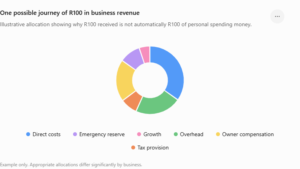
A different business could have completely different economics.
A consultant might have very low direct costs.
A takeaway business could have substantial food, packaging, staff and delivery costs.
A retailer could have heavy inventory requirements.
The chart’s purpose is to break the illusion:
Sales ≠ personal income.
🧑💼 Pay Yourself With Intention
This is where many entrepreneurs struggle emotionally.
When business is good:
Take R15,000.
When business is bad:
Take R2,000.
When there’s a family emergency:
Take R9,000.
Then business is good again:
Take R20,000.
Eventually the owner has no idea whether the business can support their lifestyle.
A more disciplined approach is to decide how owner withdrawals/remuneration will work based on the legal structure and business finances.
For example, a sole proprietor may establish a regular monthly drawing amount for budgeting purposes.
A company owner may receive remuneration under a properly structured arrangement.
Don’t assume those are legally or tax-wise identical—they aren’t.
But both benefit from predictability.
🧪 The R15,000 Owner-Pay Test
Suppose you want your business to provide you with R15,000 per month.
Don’t ask:
“Did R15,000 enter the account?”
Ask:
“Can the business consistently support R15,000 after its obligations?”
Imagine six months of simplified cash available after operating costs:
| Month | Available after operating costs |
|---|---|
| January | R26,000 |
| February | R18,000 |
| March | R11,000 |
| April | R29,000 |
| May | R9,000 |
| June | R22,000 |
Average:
R19,167
At first glance, R15,000 owner pay seems possible.
But look at March and May.
If the business has no reserve, paying yourself R15,000 in those months creates cash stress.
This is why averages alone aren’t enough.
Businesses need buffers.
🛟 Build a Business Emergency Fund Too
People talk constantly about personal emergency funds.
Businesses need resilience as well.
What happens if:
- Your biggest customer pays 30 days late?
- Your laptop dies?
- Your delivery vehicle needs repairs?
- Load shedding or infrastructure failure disrupts operations?
- Your advertising stops converting?
- A supplier increases prices?
- A major client leaves?
- You need to refund customers?
Without a reserve, the owner usually does one of three things:
Use personal savings.
Use expensive credit.
Stop paying somebody else.
None is ideal as a default strategy.
📉 The Customer Who Pays Late
Imagine your business normally collects R70,000 per month.
One customer accounts for R25,000.
They suddenly pay 30 days late.
Expected cash:
R70,000
Actual cash received:
R45,000
But your business still has:
- R18,000 wages;
- R10,000 supplier payments;
- R7,000 rent/overhead;
- R4,000 advertising/software;
- R3,000 other costs.
Total:
R42,000
You now have only R3,000 before owner pay and other obligations.
The business may still be profitable.
It has a timing problem.
A cash reserve buys time.
And in business, time can be the difference between a temporary problem and a crisis.
🧱 How Big Should the Business Reserve Be?
There is no magical number.
You’ll sometimes hear:
“Every business needs exactly six months of expenses.”
That’s a useful aspirational benchmark for some businesses, but it shouldn’t be presented as a universal rule.
A more practical approach is to calculate your essential monthly operating costs.
Suppose they are:
R25,000 per month.
Then:
One month = R25,000
Two months = R50,000
Three months = R75,000
Six months = R150,000
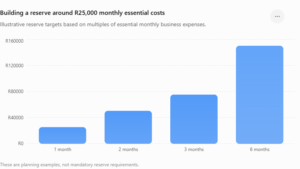
If R150,000 feels impossible, don’t conclude:
“Then I’ll save nothing.”
Build R5,000.
Then R10,000.
Then one month of essential costs.
Financial resilience grows gradually.
🇿🇦 Tax Money Is Where Mixing Finances Gets Dangerous
Tax deserves special attention because South Africa’s small-business tax environment changed materially in 2026.
A common entrepreneurial mistake is:
“I’ll worry about tax when SARS asks.”
By then, the money may already have been spent.
The better habit is to understand your likely tax position and reserve cash accordingly.
But there isn’t one tax system that applies identically to every South African small business.
Depending on structure and eligibility, a business could encounter:
- Individual income tax;
- Corporate income tax;
- Small Business Corporation rates;
- Turnover Tax;
- VAT;
- PAYE;
- UIF;
- SDL;
- Other applicable taxes and obligations.
That’s why generic advice like:
“Put away 30% of every sale for SARS.”
can be misleading.
Your actual tax position depends on your circumstances.
🆕 A Major 2026 Change: Turnover Tax Expanded
For SAWise readers, this is worth understanding.
From 2026, South Africa significantly expanded the Turnover Tax regime for qualifying micro businesses.
SARS says the qualifying annual turnover ceiling increased from R1 million to R2.3 million, while the tax-free turnover threshold increased to R600,000. (South African Revenue Service)
For the applicable 2027 year of assessment, SARS publishes the following bands:
| Taxable turnover | Turnover Tax rate |
|---|---|
| R0 – R600,000 | 0% |
| R600,001 – R950,000 | 1% above R600,000 |
| R950,001 – R1.4 million | R3,500 + 2% above R950,000 |
| R1,400,001 – R2.3 million | R12,500 + 3% above R1.4 million |
(South African Revenue Service)
This is a simplified tax regime aimed at qualifying micro businesses, and registration is elective rather than automatically being the correct choice for everyone.
SARS says qualifying entities can include sole proprietors, partnerships, companies, close corporations and co-operatives, subject to the regime’s requirements and exclusions. (South African Revenue Service)
⚠️ Turnover Tax and Normal Income Tax Think Differently
This distinction is extremely important.
Ordinary income tax generally focuses on taxable income/profit, subject to the tax rules.
Turnover Tax is based on taxable turnover.
Let’s create two fictional businesses.
Business A
Sales: R1,000,000
Expenses: R250,000
Simplified profit before other tax adjustments:
R750,000
Business B
Sales: R1,000,000
Expenses: R850,000
Simplified profit:
R150,000
Both have the same R1 million turnover.
Their profitability is dramatically different.
Under a turnover-based system, the sales figure has direct importance regardless of the difference in their margins.
That’s why you shouldn’t choose a tax regime simply because somebody says:
“Turnover Tax is cheaper.”
Whether it is appropriate depends on your business and eligibility.
Get tax advice where needed.
🧮 What Would Turnover Tax Look Like at Different Sales Levels?
Using SARS’s published 2026/27 bands, we can calculate illustrative tax amounts for qualifying businesses, assuming the amounts represent taxable turnover and ignoring complexities outside this simplified demonstration.
At R500,000:
R0
At R800,000:
1% × (R800,000 − R600,000)
= R2,000
At R1.2 million:
R3,500 + 2% × (R1,200,000 − R950,000)
= R3,500 + R5,000
= R8,500
At R1.8 million:
R12,500 + 3% × (R1,800,000 − R1,400,000)
= R12,500 + R12,000
= R24,500
At R2.3 million:
R12,500 + 3% × R900,000
= R39,500
These calculations follow SARS’s published 2026/27 Turnover Tax bands. (South African Revenue Service)
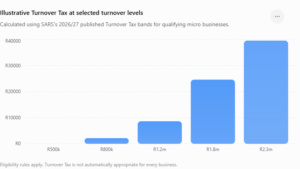
Notice why accurate business records matter.
If you don’t know your turnover, you can’t intelligently evaluate your tax position.
🧾 VAT Changed in 2026 Too
Another important update: SARS says the compulsory VAT registration threshold increased from R1 million to R2.3 million, effective 1 April 2026.
The voluntary registration threshold increased from R50,000 to R120,000, subject to the applicable requirements. (South African Revenue Service)
That is a substantial change for South African small businesses.
But don’t interpret it as:
“If I make less than R2.3 million, VAT never matters.”
Businesses can have different circumstances, voluntary registration may be possible, and specific rules apply.
The important point for this article is simpler:
You need clean turnover records to know when tax thresholds become relevant.
If your personal and business transactions are mixed across three accounts and cash, determining actual turnover becomes unnecessarily difficult.
🏢 What If You Run a Company?
The standard South African company income-tax rate remains 27% for years of assessment ending between 1 April 2026 and 31 March 2027. (South African Revenue Service)
But qualifying Small Business Corporations (SBCs) can access progressive tax rates.
For qualifying SBCs in the applicable 2026/27 period, SARS publishes:
R0–R99,000 taxable income: 0%
R99,001–R365,000: 7% above R99,000
R365,001–R550,000: R18,620 + 21% above R365,000
Above R550,000: R57,470 + 27% above R550,000. (South African Revenue Service)
Qualification requirements apply.
Again, the lesson isn’t that you should restructure your business because you saw a lower tax bracket.
The lesson is:
Business structure affects tax.
Speak to an appropriately qualified tax professional before making structural decisions based solely on an online article.
📚 Records Are Not Boring When They Save You Money
Many entrepreneurs hate bookkeeping.
They want to:
Sell.
Build.
Advertise.
Create.
Deliver.
Not categorise transactions.
But consider the alternative.
Your accountant receives 12 months of mixed bank statements.
They ask:
“What was this R18,500 transfer?”
You don’t remember.
“And this R7,000?”
No idea.
“Was this R3,400 business or personal?”
Maybe business.
“Do you have the invoice?”
Probably somewhere on WhatsApp.
That is expensive chaos.
A ten-second habit today can save an hour of investigation later.
🗂️ Create a Monthly Money Folder
Your system doesn’t need to be fancy.
Create:
2026 → September →
Inside it:
- Sales invoices;
- Supplier invoices;
- Receipts;
- Bank statements;
- Payment confirmations;
- Payroll records if applicable;
- Tax documents;
- Contracts;
- Important correspondence.
Use consistent file names.
Instead of:
IMG_93827.jpg
try:
2026-09-05_Takealot-Business-Supplies_R1299.pdf
Now searching becomes easy.
Your future self will thank you.
📆 Have a Monthly “Money Day”
Once a month, sit down with your business finances.
Not to buy anything.
Not to sell anything.
Just to understand the numbers.
Ask:
💵 What came in?
Total customer receipts and revenue.
🧾 What went out?
Business expenditure.
⏳ Who still owes me?
Outstanding invoices.
🚨 Who do I owe?
Suppliers, taxes, loans, payroll or other obligations.
🏦 What’s actually in the bank?
Cash position.
📊 Did the business make money?
Profitability.
👤 How much did I take personally?
Owner withdrawals/remuneration.
🛟 Is my reserve growing?
Business resilience.
This habit can change how you experience entrepreneurship.
Instead of constantly wondering:
“Where did the money go?”
you know.
📈 Your Bank Balance Is a Snapshot; Cash Flow Is the Movie
Suppose today your account has:
R75,000
Looks fantastic.
Tomorrow:
Supplier payment: −R30,000
Wages: −R20,000
Rent: −R10,000
Tax provision/payment: −R8,000
Remaining:
R7,000
Yesterday’s R75,000 balance did not mean you had R75,000 available for yourself.
It meant R75,000 happened to be sitting there at that moment.
This distinction is one of the biggest mental upgrades a business owner can make.
🚗 What About Petrol, Phones and Other Mixed Expenses?
Some expenses genuinely have both personal and business elements.
Examples include:
- Vehicle use;
- Mobile phone;
- Internet;
- Home office;
- Laptop;
- Electricity.
Don’t simply decide:
“I own a business, therefore my whole fibre bill is a business expense.”
Tax deductibility depends on the relevant tax rules, business purpose and evidence.
Keep records that allow the appropriate business portion to be determined where applicable.
For vehicle use, that could involve appropriate travel records.
For shared services, keep invoices and document the basis used.
Ask a tax practitioner when unsure.
Clean records make these conversations much easier.
💸 Stop Calling Every Purchase an “Investment”
Entrepreneurs love this word.
New R30,000 laptop?
Investment.
R15,000 social-media campaign?
Investment.
Expensive office?
Investment.
New car?
Business investment.
Maybe.
But spending business money doesn’t automatically make something a good investment.
A useful question is:
What measurable benefit should this expenditure create?
If you spend R10,000 on advertising, what result would make that worthwhile?
Suppose:
Advertising spend: R10,000
New customers: 50
Average gross contribution per new customer: R300
Contribution generated:
50 × R300 = R15,000
Now you have something to evaluate.
But if you don’t track customer acquisition or profitability, “marketing investment” can become another phrase for money disappearing.
📣 Revenue Growth Can Hide a Weak Business
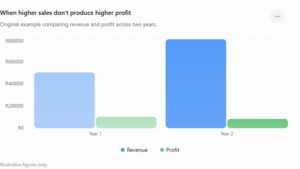
Here’s an example.
Year 1
Revenue: R500,000
Profit: R100,000
Profit margin:
20%
Year 2
Revenue: R800,000
Profit: R80,000
Profit margin:
10%
Revenue increased:
60%
Profit fell:
20%
Is the business definitely healthier?
No.
Maybe costs exploded.
Maybe prices are too low.
Maybe advertising became inefficient.
Maybe staffing costs rose faster than productivity.
Maybe discounts are destroying margins.
Turnover makes businesses look big.
Profit and cash help tell you whether they are becoming stronger.
🔥 The Lifestyle Trap
This deserves its own section because it destroys discipline.
Business has three great months.
The owner thinks:
“We’ve made it.”
Personal spending rises.
Better car.
More takeaways.
New phone.
Expensive clothes.
Weekend away.
Family starts relying on larger transfers.
Then business has a weak month.
The lifestyle doesn’t shrink as quickly as the revenue did.
Now the owner starts extracting cash the business needs.
This is why separating finances is partly psychological.
When business revenue enters a dedicated financial system, you stop seeing every good month as permission to permanently increase your personal lifestyle.
🧮 Build Your Personal Salary Around the Weak Months, Not Only the Strong Ones
Suppose monthly business profit before owner compensation looks like this:
| Month | Amount |
|---|---|
| Jan | R40,000 |
| Feb | R35,000 |
| Mar | R12,000 |
| Apr | R38,000 |
| May | R15,000 |
| Jun | R44,000 |
If you build your personal life around R40,000 per month, March and May become emergencies.
A steadier owner-pay strategy plus retained business reserves can reduce the rollercoaster.
That doesn’t mean you can never take additional distributions where appropriate.
It means your rent shouldn’t depend on every month being your best month.
🧱 Your Business Should Eventually Be Able to Stand Without Your Personal Wallet
Here’s a useful test.
If the business has a slow month, do you immediately transfer personal money into it?
Occasionally, that can be a deliberate business decision.
But if it happens constantly, ask why.
Maybe:
- Prices are too low;
- Expenses are too high;
- Customers pay too slowly;
- Owner withdrawals are excessive;
- Stock turns too slowly;
- The business is undercapitalised;
- Sales are inconsistent;
- Debt repayments are too heavy.
Mixing finances can hide these weaknesses because your salary or personal savings quietly keeps the business alive.
Separate finances reveal the truth.
Sometimes that truth hurts.
But you need it.
🧪 The 90-Day Separation Challenge
If your finances are currently completely mixed, don’t try to build a multinational accounting department overnight.
Do this for 90 days.
Month 1 — Separate
Choose the appropriate account structure.
Direct business income into the business channel.
Move personal spending out.
Start keeping receipts.
Month 2 — Measure
Track:
- Revenue;
- Expenses;
- Owner withdrawals;
- Outstanding invoices;
- Cash balance.
Month 3 — Optimise
Ask:
- Which expenses can be reduced?
- Can owner pay become more predictable?
- How much should stay in reserve?
- Are customers paying quickly enough?
- Is the business genuinely profitable?
After 90 days, you’ll probably understand the business better than you did after the previous year of simply watching money come and go.
🚨 Seven Warning Signs Your Business and Personal Money Are Too Mixed
1. You don’t know your monthly profit.
You know sales, but not profit.
2. You pay household bills directly from customer deposits.
Money comes in and immediately disappears personally.
3. You constantly pay suppliers from your personal credit card.
Without recording the transactions properly.
4. You don’t know how much you’ve taken from the business.
Withdrawals happen randomly.
5. Tax surprises you every year.
No money was reserved.
6. Your accountant constantly asks what transactions were.
And you can’t remember.
7. You don’t know whether you’re funding the business or the business is funding you.
This is the biggest warning of all.
📋 A Simple Monthly Business Dashboard
You don’t need 50 KPIs.
Start here:
| Metric | This month | Last month |
|---|---|---|
| Revenue | R___ | R___ |
| Cash collected | R___ | R___ |
| Business expenses | R___ | R___ |
| Profit | R___ | R___ |
| Outstanding customer invoices | R___ | R___ |
| Cash reserve | R___ | R___ |
| Owner withdrawals/pay | R___ | R___ |
| Business debt | R___ | R___ |
Add metrics specific to your business later.
A retailer might track inventory.
A publisher might track page views and advertising revenue.
A restaurant might track food cost.
A service business might track billable hours.
But first understand the money.
🤝 What If You Run a Business With Your Spouse or Friend?
Separation becomes even more important.
If two partners both take money whenever they need it, resentment can develop quickly.
One thinks:
“I only took R5,000.”
The other says:
“You took R5,000 three times.”
Agree in advance:
- Who can spend business money;
- Spending approval limits;
- Owner compensation;
- Expense reimbursement;
- Capital contributions;
- How profits are distributed;
- Who maintains records.
And put important agreements in writing.
Friendship is not an accounting system.
Neither is marriage.
Clear rules protect relationships.
🏷️ Give Every Rand a Job
When R20,000 enters the business account, don’t think:
“We have twenty grand.”
Think:
What is this R20,000 responsible for?
Maybe:
R7,000 — supplier.
R3,000 — operating costs.
R2,000 — tax reserve.
R3,000 — owner pay.
R3,000 — emergency reserve.
R2,000 — growth.
Now the money has purpose.
This is business budgeting at its simplest.
🌱 When Should You Reinvest Instead of Paying Yourself More?
There is no universal answer.
Reinvestment makes sense when additional money has a credible opportunity to create greater future value.
For example:
You currently manufacture 100 products per month.
A R20,000 machine could increase capacity to 180.
Demand already exists.
Margins are healthy.
The investment may deserve serious consideration.
But:
“I saw a cool machine on TikTok”
isn’t an investment thesis.
Ask:
What problem does it solve?
How much will it cost?
How much additional profit could it reasonably generate?
How long before the business earns back the cost?
What happens if sales disappoint?
Good businesses don’t only spend.
They allocate capital.
📐 A Simple Payback Calculation
Machine cost:
R24,000
Expected additional monthly profit attributable to machine:
R4,000
Simple payback period:
R24,000 ÷ R4,000 = 6 months
If additional profit is only R1,000:
R24,000 ÷ R1,000 = 24 months
Same machine.
Very different decision.
These simplified calculations don’t account for financing costs, tax, depreciation, maintenance, uncertainty or time value of money.
But they force you to think beyond:
“Can I afford to buy it today?”
💳 Should You Use Personal Credit to Finance Your Business?
Sometimes entrepreneurs do.
But understand what you’re doing.
If you take a personal loan to fund the business, the lender generally expects you to repay according to that agreement regardless of whether the business succeeds.
Don’t tell yourself:
“The business will pay it.”
Ask:
“What happens if the business cannot pay it?”
If the answer is:
“Then I can’t afford my personal expenses either,”
you are taking meaningful risk.
Business optimism should never replace a downside plan.
🧠 Separate Your Identity From the Business Too
This isn’t accounting advice.
It’s survival advice.
Entrepreneurs often say:
“I am my business.”
That can make every bad month feel like personal failure.
A business is an economic system.
It can have:
Bad pricing.
Poor marketing.
Wrong products.
Weak margins.
Cash-flow problems.
Operational mistakes.
Those are problems to solve.
They aren’t proof that you are worthless.
Financial separation helps create psychological separation too.
You can say:
“The business cannot afford this expense.”
instead of:
“I am broke.”
That distinction matters.
❓ Frequently Asked Questions
Do I need a separate business bank account in South Africa?
It depends on your business’s legal structure and the bank/product requirements applicable to you. A sole proprietorship isn’t legally identical to a private company. Even where separate banking isn’t strictly required, keeping business transactions separate can dramatically improve record-keeping and financial management. SARS distinguishes sole proprietorships, partnerships and incorporated entities for tax purposes. (South African Revenue Service)
Is business revenue my personal income?
Not automatically. Business revenue may need to cover costs, liabilities, tax and future operating requirements before determining what is appropriately available to the owner.
Can I pay myself from my business?
Yes, but the appropriate method and tax/accounting treatment depends on the legal structure and circumstances. A sole proprietor’s drawings and remuneration from a company aren’t automatically the same thing.
Can I use my business card for personal groceries?
Physically, a payment may go through. From a record-keeping perspective, routinely mixing personal purchases into business transactions creates unnecessary complexity and can cause accounting and tax problems.
What if I accidentally pay a business expense personally?
Keep the documentation and record the transaction correctly. Speak with your accountant/bookkeeper about the appropriate treatment.
How much should I keep for tax?
There is no universal percentage appropriate for every South African business. Your obligations depend on business structure, taxable income, turnover, tax regime and other circumstances.
What is the Turnover Tax limit in South Africa in 2026?
SARS increased the qualifying annual turnover ceiling to R2.3 million in 2026, subject to the regime’s eligibility requirements. (South African Revenue Service)
Is the first R600,000 of Turnover Tax taxable?
For the applicable 2026/27 Turnover Tax bands, SARS publishes a 0% rate for taxable turnover from R0 to R600,000. Eligibility requirements still apply. (South African Revenue Service)
What is South Africa’s company tax rate?
The standard company income-tax rate is 27% for years of assessment ending from 1 April 2026 to 31 March 2027. Qualifying Small Business Corporations may have progressive rates. (South African Revenue Service)
What is the VAT registration threshold in 2026?
SARS says the compulsory VAT registration threshold increased to R2.3 million, effective 1 April 2026, while the voluntary threshold increased to R120,000, subject to applicable requirements. (South African Revenue Service)
Should I take all my profit out every month?
Not necessarily. A business may need retained cash for working capital, emergencies, future expenses, debt repayment and growth. Your appropriate strategy depends on the business and ownership structure.
Is turnover the same as profit?
No. If your business sells R100,000 and incurs R70,000 of relevant costs, the R100,000 represents sales/turnover—not R100,000 of profit.
Why am I making sales but never have money?
Possible causes include low margins, high expenses, customer-payment delays, excessive owner withdrawals, debt repayments, inventory requirements and poor cash-flow management. You need records to identify the actual cause.
Should I hire an accountant?
As a business grows or its tax and accounting affairs become more complex, professional assistance can be extremely valuable. Choose someone appropriately qualified for the work you need.
🧭 From Side Hustle to Real Business
There is a moment when a side hustle starts becoming something more serious.
It isn’t necessarily when you register a logo.
It isn’t when you print business cards.
It isn’t when you reach 10,000 Instagram followers.
It’s when you start treating the money like it belongs to an economic system rather than treating every payment as a personal payday.
A R500 sale gets recorded.
A R15,000 sale gets recorded.
Business expenses are documented.
Personal expenses stay personal.
Tax is planned for.
Owner pay becomes intentional.
Cash reserves begin growing.
Profit is measured.
Suddenly, you can answer:
“How is business?”
with something better than:
“Busy.”
You can say:
“Revenue is growing, margins are stable, customers owe us R18,000, we have two months of operating cash and we’re saving toward new equipment.”
That’s a business owner who understands their business.
🌟 The Goal Isn’t Complicated Accounting—It’s Clarity
You don’t need to become a chartered accountant.
You need to know enough to avoid running your business blind.
When personal and business money are mixed together, the numbers become foggy.
And fog creates bad decisions.
You withdraw too much because the balance looks high.
You underspend on growth because you think the business is broke.
You don’t notice expenses creeping upward.
You don’t realise a major customer is paying late.
You underestimate tax.
You think revenue is profit.
You think profit is cash.
Then one day the account is empty and you’re wondering:
“Where did all the money go?”
Separating finances gives every rand a story.
You know where it came from.
You know why it left.
You know what remains.
And most importantly, you know whether the business is actually working.
💚 A Final Thought
A business doesn’t become financially strong simply because more money enters the account. It becomes stronger when the owner learns what every rand is supposed to do.
Your first goal doesn’t need to be R1 million in sales.
Start smaller.
Know what you earned this month.
Know what you spent.
Know what belongs to the business.
Know what belongs to you.
Know what must stay behind.
Then repeat the process next month.
Revenue gets attention.
Profit creates value.
But cash discipline keeps the doors open.
Build that discipline early, and the business you create tomorrow will have a much stronger foundation than the side hustle you started yesterday. 🇿🇦📈
Illustrative month for a fictional South African service business.
| measure | amount |
|---|---|
| Revenue generated | 80,000 |
| Cash collected | 62,000 |
| Operating expenses | 49,000 |
| Accounting profit | 31,000 |
Illustrative allocation showing why R100 received is not automatically R100 of personal spending money.
| purpose | amount |
|---|---|
| Direct costs | 35 |
| Overhead | 22 |
| Tax provision | 8 |
| Owner compensation | 20 |
| Emergency reserve | 10 |
| Growth | 5 |
Illustrative reserve targets based on multiples of essential monthly business expenses.
| reserve | amount |
|---|---|
| 1 month | 25,000 |
| 2 months | 50,000 |
| 3 months | 75,000 |
| 6 months | 150,000 |
Calculated using SARS’s 2026/27 published Turnover Tax bands for qualifying micro businesses.
| turnover | tax |
|---|---|
| R500k | 0 |
| R800k | 2,000 |
| R1.2m | 8,500 |
| R1.8m | 24,500 |
| R2.3m | 39,500 |
Original example comparing revenue and profit across two years.
| year | revenue | profit |
|---|---|---|
| Year 1 | 500,000 | 100,000 |
| Year 2 | 800,000 | 80,000 |
SAWise Note
SAWise.co.za provides general educational information for South African readers and business owners. Tax treatment, registration obligations, allowable deductions and the appropriate way of paying or distributing money to an owner depend on factors including the business’s legal structure and individual circumstances. Tax thresholds and rates can also change. Consult SARS and, where appropriate, a qualified South African accountant or tax practitioner before making important tax or business-structure decisions.