Sending an EFT to the wrong person can happen in seconds. Getting the money back can be far more complicated. This guide explains what South Africans should do immediately after making an incorrect bank payment, when a payment recall may be possible, why banks cannot simply take the money back, and how to reduce the risk of making the same mistake again.
You open your banking app to pay R2,500.
You select a beneficiary, enter the amount, confirm the payment and approve it. A few seconds later, you look at the proof of payment and realise something is wrong.
Maybe you selected “Thabo M” instead of “Thabo N.”
Perhaps one digit in the account number was incorrect.
Or maybe you intended to pay your landlord R8,500 but sent the money to an old beneficiary you haven’t used in two years.
That moment can cause instant panic.
The natural reaction is:
“Can’t my bank just reverse it?”
Unfortunately, once a valid EFT has been processed into another person’s account, recovering it is not necessarily as simple as pressing an undo button.
The good news is that an incorrect payment isn’t automatically lost forever. Banks can have processes for requesting a payment recall or reversal, and the recipient may return the money voluntarily.
The critical factor is what you do next.
Act quickly, contact your bank through its official channels, preserve all transaction information and don’t assume a recall is guaranteed.
This SAWise guide explains the process from beginning to end.
Quick Answer: Can You Reverse an EFT Sent to the Wrong Account?
Sometimes the bank can attempt to recover the payment, but you shouldn’t assume that an ordinary EFT can simply be reversed after it has reached the recipient.
For example, FNB’s published payment information states that an EFT is final and irrevocable once made and that a reversal requires the bank to obtain the recipient’s authorisation. FNB also provides a formal payment-reversal process for qualifying incorrect payments. (FNB Online)
The exact procedure depends on:
- Your bank;
- The type of payment;
- Whether it has already been processed;
- The recipient’s bank;
- Whether the funds are still available;
- How quickly you report the mistake; and
- Whether the transaction was an error or actually involved fraud.
So the first rule is simple:
Contact your bank immediately.
Don’t wait until tomorrow hoping the transaction will somehow correct itself.
How Do Wrong Bank Payments Happen?
Most people don’t deliberately send thousands of rand to a stranger.
Incorrect payments usually happen because of ordinary human mistakes.
Common causes include:
| Mistake | Example |
|---|---|
| Selecting the wrong saved beneficiary | Paying “John Work” instead of “John Rent” |
| Entering an incorrect account number | Typing ...4587 instead of ...4857 |
| Using outdated banking details | Paying a supplier’s old account |
| Paying the wrong amount | Sending R12,000 instead of R1,200 |
| Duplicate payment | Paying an invoice twice |
| Incorrect payment reference | Money reaches the right account but can’t be allocated correctly |
| Copy-and-paste error | Using banking details from the wrong WhatsApp conversation |
| Fraudulent substituted details | A criminal changes legitimate invoice banking information |
The last example is especially important.
A mistaken EFT and a fraud-induced EFT aren’t necessarily the same problem and shouldn’t automatically be handled the same way.
We’ll return to fraud later.
What Happens After You Press “Pay”?
It helps to understand why a bank can’t always simply pull the money back.
When you initiate an electronic payment, you’re instructing your bank to transfer money according to the details you’ve provided.
Before confirming a payment, banking systems typically give you an opportunity to review information such as:
- Beneficiary;
- Bank;
- Account details;
- Amount;
- Reference; and
- Payment date.
Once you authorise the instruction and the transaction is processed, the money may leave your account and ultimately be credited to the beneficiary’s account.
At that point, the situation is very different from cancelling an unsent email.
The recipient’s bank account now contains money resulting from an instruction you authorised.
That’s why the recovery process is generally called a recall or reversal request, rather than simply an automatic cancellation.
FNB’s published rules illustrate this clearly: its documentation says an EFT cannot simply be reversed once completed unless the required authorisation can be obtained from the recipient. (FNB Online)
The First 10 Minutes Matter
Imagine Sipho intends to pay his mechanic R6,800.
He accidentally selects an old beneficiary and sends the R6,800 there instead.
He notices 30 seconds later.
What should he do?
Not this:
“I’ll see tomorrow whether it comes back.”
Instead:
1. Take a screenshot or save the proof of payment
Record:
- Transaction reference;
- Amount;
- Date;
- Time;
- Recipient/beneficiary details shown;
- Payment reference; and
- Payment method.
2. Contact your bank immediately
Use an official channel from your banking app, bank website, card or branch.
Tell the bank clearly:
“I made an EFT to the wrong beneficiary and need to request a payment recall.”
3. Follow the bank’s instructions
The bank may require:
- A form;
- Written confirmation;
- Identification;
- Transaction information;
- An indemnity/waiver;
- Additional documentation; or
- A recall fee.
4. Obtain a reference number
Keep it.
5. Follow up
Don’t assume that submitting a request means the money has been recovered.
A request for a recall is not confirmation of a successful recall.
Why Speed Matters
An important distinction exists between:
Money still sitting in the recipient’s account
and
Money that has already been withdrawn, transferred or spent.
Suppose you accidentally transfer R10,000 to another person.
Scenario A
You report it immediately.
The R10,000 remains in the recipient account when the relevant recovery process begins.
Scenario B
You wait five days.
The recipient has already transferred or spent the funds.
The second situation can make recovery much more difficult.
FNB’s published reversal guidance, for example, says reversals should be initiated quickly because doing so improves the chance of success. Its published process also says qualifying reversal attempts are made on a best-effort basis rather than guaranteed.
That’s why “I’ll deal with it later” is one of the worst responses to an incorrect EFT.
Example: The Cost of Waiting
The following is an illustrative scenario, not measured bank data.
Assume Lerato accidentally sends R7,500 to the wrong beneficiary.
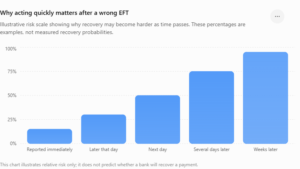
The percentages aren’t statistics.
They simply illustrate the logic: the longer the money is outside your control, the greater the opportunity for circumstances to change.
Can Your Bank Automatically Take the Money Back?
Don’t count on it.
This is one of the biggest misunderstandings surrounding incorrect EFTs.
You might think:
“It’s my money. I made a mistake. Just debit the other person’s account.”
But once the payment has been processed, the receiving bank cannot necessarily debit its customer’s account simply because another customer says the transfer was accidental.
There are banking rules, authorisation requirements and legal rights involved.
For example, FNB’s published reversal information says reversals cannot be executed without the necessary recipient authorisation and are performed on a best-effort basis.
That means submitting a recall request does not create a guarantee.
What Is a Payment Recall?
A payment recall is essentially a formal request to attempt to recover a payment that has already been sent.
The exact terminology varies between institutions.
You may see:
- Payment recall;
- EFT reversal;
- Payment reversal;
- Recall request; or
- Incorrect payment recovery.
The underlying idea is similar:
You tell your bank that a payment was sent incorrectly and ask it to initiate the applicable recovery process.
Your bank may then need to communicate with the receiving institution and recipient according to the applicable process.
What Information Should You Have Ready?
When reporting an incorrect payment, collect everything before contacting your bank if possible.
A simple checklist:
| Information | Why it matters |
|---|---|
| Your account details | Identifies the sending account |
| Payment amount | Identifies the transaction |
| Date and time | Helps locate the transaction |
| Transaction/reference number | Distinguishes the payment |
| Beneficiary name | Helps identify who was paid |
| Beneficiary account details | Identifies destination |
| Payment reference | Helps verify the transaction |
| Proof of payment | Provides transaction evidence |
| Explanation of mistake | Explains why recall is requested |
Don’t send these details to random social-media accounts claiming to represent your bank.
Use official bank channels.
Is a Payment Recall Guaranteed?
No.
This point is important enough to repeat.
A recall request means:
“Please attempt to recover this payment.”
It does not necessarily mean:
“My money will definitely be returned.”
FNB’s reversal documentation expressly describes the process as best-effort and identifies possible reasons a reversal may fail, including insufficient funds in the recipient account or inability to obtain the necessary authority.
Your bank’s current terms determine the process applicable to you.
Can There Be a Fee for Recalling an EFT?
Yes, a bank may charge for attempting a recall.
The amount varies by bank, account, transaction type and current pricing.
Don’t rely on a random article that says:
“An EFT reversal costs R___ at every South African bank.”
There isn’t one universal reversal fee for every bank and payment type.
Some payment-recall services charge a fee even if recovery is unsuccessful.
So when contacting your bank, ask:
“Is there a recall fee, and is it charged even if the recovery fails?”
That’s a much better question than assuming the process is free.
Example: Wrong Person vs Wrong Amount
These are two different mistakes.
Example 1: Right amount, wrong person
You intend to pay:
Naledi — R4,500
but select:
Naledzani — R4,500
The entire R4,500 has gone to the wrong beneficiary.
You need to report the incorrect payment.
Example 2: Right person, wrong amount
You owe your plumber:
R850
but accidentally enter:
R8,500
The correct recipient received the money, but you’ve overpaid by:
R8,500 − R850 = R7,650
In this situation, contacting the recipient directly may be particularly useful because there is no dispute about whether they were supposed to receive some money.
You simply need the R7,650 overpayment returned.
Still keep records and involve your bank if necessary.
What If You Know the Person Who Received the Money?
If you’ve accidentally paid someone you know—a friend, relative, landlord, employee or supplier—contacting them may be the quickest practical solution.
Keep the message factual:
“I accidentally transferred R3,200 to your account today. That payment was intended for another beneficiary. Please don’t use the funds. I’ve contacted my bank regarding the incorrect transfer.”
Avoid threats or aggressive accusations.
They may genuinely not have noticed the payment.
If they agree to return it, carefully verify your banking details before they make the repayment.
Beware of the “I Accidentally Paid You” Scam
Now turn the situation around.
Imagine someone contacts you and says:
“Sorry! I accidentally sent you R5,000. Please send it back immediately.”
They attach a proof-of-payment screenshot.
Do you transfer R5,000?
Not yet.
First check your own banking app or account through an official channel.
A screenshot isn’t proof that cleared funds are safely available in your account.
Fraudsters can:
- Create fake proof-of-payment documents;
- Alter screenshots;
- Send fraudulent notifications;
- Pressure victims into making a separate payment; or
- Use other forms of payment fraud.
The safe response is:
Verify independently with your bank before sending money anywhere.
If the sender claims to have initiated a formal recall, follow your bank’s instructions rather than sending money to a different account supplied over WhatsApp.
Never “Refund” Money to a Different Bank Account Without Verification
This deserves special emphasis.
Someone says:
“I sent R8,000 by mistake. Please return it—but send it to my wife’s account instead.”
That’s a red flag.
If money genuinely entered your account incorrectly, don’t become part of a chain of transfers you don’t understand.
Contact your bank.
Explain what happened.
Let the bank advise you on the correct procedure.
This can protect you from fraud and from becoming involved in disputes about where money ultimately went.
What If the Incorrect Payment Was Caused by Fraud?
Suppose you weren’t careless.
You received what looked like a legitimate invoice from a supplier.
The banking details had been changed by a criminal.
You paid R45,000.
Later, the real supplier says:
“That’s not our bank account.”
This is no longer merely:
“I clicked the wrong beneficiary.”
It may be fraud.
FNB’s published process specifically distinguishes an incorrect EFT from suspected fraud and directs suspected fraudulent transactions to its fraud department instead of treating them merely as ordinary reversal requests. (FNB Online)
If you suspect fraud:
- Contact your bank’s fraud department immediately.
- Explain exactly what happened.
- Preserve emails, invoices, WhatsApp messages and proof of payment.
- Don’t delete communications.
- Follow your bank’s instructions regarding further reporting.
- Where appropriate, report the matter to the police and retain the case information.
Speed becomes even more important because fraudsters may move funds rapidly.
Invoice Fraud: A Serious Business Risk
Small businesses are particularly exposed to payment-detail substitution.
Imagine SAWise Office Supplies regularly buys stock from ABC Packaging.
ABC’s genuine account has always been:
Bank Account A
One month, the business receives an email saying:
“Please note that our banking details have changed.”
The attached invoice looks legitimate.
The company pays R78,000 into:
Bank Account B
Three days later, ABC asks why its invoice hasn’t been paid.
The email account was compromised.
The R78,000 went to criminals.
This is why businesses should have a rule:
Any change in supplier banking details must be independently verified using trusted contact information already on file.
Don’t use the telephone number contained in the suspicious email itself to verify the change.
Call the supplier using a number you already know or obtain independently from an official source.
A Simple Supplier-Payment Verification System
For businesses, a two-minute check can protect a payment worth tens of thousands of rand.
Before paying a new or changed beneficiary:
Check 1: Does the company name match?
Check 2: Did banking details change unexpectedly?
Check 3: Has the change been independently confirmed?
Check 4: Has another employee reviewed large payments?
Check 5: Are you paying from information copied directly from an email that could have been compromised?
For large payments, consider making a small test payment where appropriate and confirming receipt before transferring the balance.
Some banking platforms also provide account-owner verification services. FNB, for example, describes a fee-based Verify Account Owner facility for participating banks. (FNB Online)
What If You Enter the Wrong Account Number?
There are several possible outcomes.
Outcome 1: The account doesn’t exist
The transaction may fail or ultimately be returned, depending on the payment system and circumstances.
Outcome 2: The details don’t meet validation requirements
Your banking platform may prevent the payment before processing.
Outcome 3: The account exists and belongs to somebody else
This is the dangerous scenario.
The money may reach a legitimate but unintended account.
Don’t assume:
“Surely the bank checks the name.”
Account verification capabilities and payment processes differ, so you should never use the displayed beneficiary label as a substitute for checking the actual banking details.
What If You Use the Wrong Payment Reference?
This can be much easier to solve because the money may have reached the correct organisation.
Suppose you owe a university R6,000.
You pay the university’s correct bank account but enter:
Student number 123456
instead of:
Student number 123465
The university received the R6,000, but its system may struggle to allocate it to your account.
You might then receive a message saying your fees remain unpaid.
In this situation:
- Don’t immediately pay another R6,000.
- Obtain your proof of payment.
- Contact the organisation’s accounts department.
- Explain the incorrect reference.
- Supply the correct reference.
- Ask for the payment to be reallocated.
This type of mistake isn’t necessarily an EFT reversal problem.
It’s often an allocation problem.
SARS Is a Good Example of Why References Matter
SARS uses specific payment reference numbers so payments can be allocated correctly.
SARS currently explains that the correct 19-digit payment reference number (PRN) should be used for applicable payments so that funds can be identified and allocated to the appropriate taxpayer account. (South African Revenue Service)
The lesson applies beyond tax:
Correct account + wrong reference can still create a payment problem.
Always check both.
EFT vs Instant Payment: Does It Make a Difference?
It can.
South African banking platforms offer different payment methods, and faster payment doesn’t necessarily mean easier recovery.
In fact, the opposite can be true.
FNB’s current published business-payment information says certain payment types, including its Pay & Clear Now service, aren’t eligible for its standard payment-reversal process. (FNB Online)
That doesn’t mean every instant-payment product at every South African bank follows identical rules.
It means you should understand a crucial principle:
The faster and more final a payment method is, the more important it is to verify the recipient before pressing confirm.
Never assume an instant payment comes with an instant undo button.
What About eWallet or Send-Money Payments?
These can have different reversal rules from ordinary EFTs.
For example, FNB currently says an eligible eWallet may be reversed within 72 hours, subject to conditions including whether the recipient has already used the funds. It also says reversal attempts attract a charge. (FNB)
This illustrates why you shouldn’t search:
“How do I reverse a bank payment?”
and assume the first answer applies to everything.
You need to identify the actual payment type:
- Ordinary EFT;
- Immediate/real-time payment;
- eWallet/send-money service;
- Card transaction;
- Debit order;
- Scheduled payment; or
- International transfer.
Different processes can apply.
Wrong Payment vs Unauthorised Transaction
Another important distinction:
Wrong payment
You authorised the transaction, but you entered or selected incorrect information.
Example:
You intentionally approve a R5,000 EFT but accidentally send it to the wrong beneficiary.
Unauthorised transaction
You didn’t authorise the transaction.
Example:
Someone gains access to your banking credentials and transfers R5,000 without your permission.
These situations shouldn’t automatically be reported in exactly the same way.
If you didn’t authorise a transaction, tell your bank that clearly and follow its fraud/dispute procedure.
Don’t describe suspected fraud merely as:
“I made a mistake.”
Accurate information helps the bank route the case appropriately.
What If the Recipient Refuses to Return the Money?
This can become more complicated.
An accidental payment doesn’t necessarily become a gift simply because it reached someone else’s bank account.
But that doesn’t mean you should take matters into your own hands.
Don’t:
- Threaten the person;
- Publish their personal information online;
- Attempt to access their accounts;
- Impersonate bank staff;
- Harass their family;
- Make false accusations; or
- Try to recover the money through another unlawful method.
Keep documentation and continue through the appropriate banking and, where necessary, legal channels.
For a substantial amount, consider obtaining advice from an appropriately qualified South African legal professional about the circumstances and available recovery options.
Should You Contact the Recipient Yourself?
It depends.
If it’s someone you know
Usually reasonable, provided you remain calm and document the communication.
If it’s a business
Contact its legitimate accounts department.
If it’s a complete stranger
Contact your bank first.
Your bank may have a formal process that should be followed.
If fraud is suspected
Don’t negotiate with suspected criminals.
Contact the bank’s fraud department and follow official reporting procedures.
Example: Three Different Wrong-Payment Situations
Consider these scenarios.
| Situation | Amount | Best first response |
|---|---|---|
| Paid known friend instead of brother | R800 | Contact bank and known recipient |
| Paid unknown beneficiary accidentally | R12,000 | Contact bank immediately for recall process |
| Paid altered invoice details | R85,000 | Contact bank’s fraud department immediately |
They all involve money going somewhere unintended.
But they don’t carry identical risk.
The Financial Impact of a Wrong EFT
The obvious loss is the money sent.
But secondary consequences can be equally painful.
Suppose Kabelo has R14,000 available.
He needs to pay:
- Rent: R7,500
- Vehicle insurance: R1,300
- Groceries: R3,000
- Electricity: R1,000
He accidentally sends R7,500 to the wrong landlord beneficiary.
The money is gone from his available balance, but his real landlord still hasn’t been paid.
Financially, Kabelo now faces:
Original R7,500 payment + another R7,500 still owed = R15,000 of immediate cash pressure.
Even if the incorrect R7,500 is eventually recovered, the timing problem can cause:
- Late rent;
- Failed debit orders;
- Borrowing;
- Missed essential expenses; or
- Emergency-fund withdrawals.
That’s why wrong payments aren’t merely administrative inconveniences.
They can become genuine cash-flow emergencies.
Example: How One Mistake Can Affect a Monthly Budget
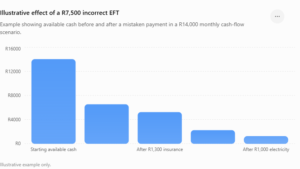
The real landlord’s R7,500 is still outstanding.
That’s the hidden damage.
What If You Accidentally Pay the Same Beneficiary Twice?
Duplicate payments are common.
You pay a supplier on Monday.
On Wednesday, you forget that payment was already made and pay the same invoice again.
First:
Confirm that both transactions actually processed.
Don’t rely solely on two notifications.
Then contact the recipient.
For a legitimate business, provide:
- Both proofs of payment;
- Invoice number;
- Amounts;
- Dates;
- Your customer/account number; and
- Banking details for an approved refund where requested through legitimate channels.
Ask whether the duplicate amount can be refunded or, if appropriate, credited against a future invoice.
If you need the money back urgently, explain that.
What If You Send R10,000 Instead of R1,000?
This is easier to do than it sounds.
A misplaced zero turns:
R1,000
into:
R10,000
Your overpayment is:
R9,000.
If the recipient is legitimate and known, contact them immediately and simultaneously check with your bank about the appropriate process.
Don’t send a second R1,000 payment until you’ve established how the original transaction will be handled.
What If You Pay an Old Bank Account?
This often happens after suppliers, landlords or family members change banks.
Possible outcomes include:
- The old account remains active and receives the payment;
- The account is closed and the payment is ultimately returned;
- The payment fails;
- The money reaches an account that still belongs to the intended recipient but isn’t regularly monitored; or
- Further investigation is required.
Don’t assume the payment will automatically return.
Contact your bank and intended recipient.
What If the Beneficiary Says They Never Received the Money?
This is slightly different from paying the wrong person.
If you believe you’ve paid the correct beneficiary but they say nothing arrived:
- Check whether the payment status is actually successful.
- Check the beneficiary details.
- Check the amount.
- Check the payment date.
- Check whether it was an ordinary or immediate payment.
- Provide legitimate proof of payment.
- Contact your bank if the transaction shows successful but remains unresolved.
Absa, for example, currently directs customers whose successful payment has left their account but hasn’t reached the beneficiary to provide transaction information for investigation. (Absa)
Don’t immediately pay again unless you’re sure the first payment failed.
Seven Things NOT to Do After Sending Money to the Wrong Account
1. Don’t wait several days
Time matters.
2. Don’t assume the bank guarantees recovery
A recall request may fail.
3. Don’t send more money to “unlock” a refund
That’s a classic warning sign of fraud.
4. Don’t share your PIN or OTP
Your bank doesn’t need your PIN or OTP to investigate an incorrect payment.
5. Don’t delete transaction evidence
Keep everything.
6. Don’t harass the recipient
Use formal channels.
7. Don’t confuse a mistaken payment with fraud
Tell the bank exactly what happened.
How to Prevent Wrong EFTs
Prevention is far easier than recovery.
Here is a simple system that takes less than a minute.
The SAWise 5-Point Payment Check
Before approving an EFT, check:
1. PERSON
Am I paying the correct person or company?
2. ACCOUNT
Have I checked the important account details?
3. AMOUNT
Is it R950 or R9,500?
4. REFERENCE
Will the recipient know what this payment is for?
5. PAYMENT TYPE
Am I intentionally using an ordinary EFT, immediate payment or another service?
Then press confirm.
Five seconds of checking can save days of stress.
Be Careful With Saved Beneficiaries
Saved beneficiaries are convenient—but familiarity can make us careless.
Imagine your beneficiary list contains:
M. Daniels – Rent OLD
and
M. Daniels – Rent NEW
Six months later, you forget which is current.
That’s unnecessary risk.
Clean up beneficiary lists periodically.
Where your bank allows it:
- Rename beneficiaries clearly;
- Remove obsolete beneficiaries;
- Avoid vague names such as “John”;
- Add meaningful identifiers; and
- Verify updated details before first use.
Use a Small Test Payment for Important New Beneficiaries
If you’re paying a new supplier R50,000 and the situation permits, consider whether a small test transaction is appropriate.
For example:
R10 test payment
Recipient confirms receipt.
Then you pay the balance.
This isn’t necessary or practical for every payment, and transaction costs or payment requirements may make it unsuitable in some cases.
But for certain high-value first-time payments, verification is worth considering.
Verify Banking Detail Changes Independently
This should be a hard rule for businesses.
If an email says:
“OUR BANKING DETAILS HAVE CHANGED.”
Do not automatically update the beneficiary.
Instead:
- Find the supplier’s previously verified telephone number.
- Call them.
- Speak to an authorised person.
- Confirm the account change.
- Record who confirmed it.
- Use any available bank-account verification functionality where appropriate.
Never verify changed banking details by replying only to the same suspicious email.
Slow Down for Large Payments
Banking apps are designed to make payments convenient.
Convenience is useful for R150.
It deserves more caution at R150,000.
Create your own threshold.
For example:
Any payment above R10,000 gets checked twice before confirmation.
A business might require two people to approve larger transactions.
There is nothing technologically sophisticated about this.
It works because it interrupts human error.
Keep Proof of Important Payments
For major transactions, retain:
- Invoice;
- Banking-detail confirmation;
- Proof of payment;
- Email correspondence;
- Contract/order information; and
- Any payment reference.
If something goes wrong, reconstructing events becomes much easier.
Payment Safety Checklist
Before pressing Pay, ask yourself:
| Check | Yes/No |
|---|---|
| Is this definitely the correct beneficiary? | ☐ |
| Have I verified new/changed banking details? | ☐ |
| Is the amount correct? | ☐ |
| Is the reference correct? | ☐ |
| Is the payment method appropriate? | ☐ |
| Have I checked suspicious account-change messages independently? | ☐ |
| For a large payment, has someone else verified it? | ☐ |
This is especially useful for small businesses where one person handles dozens of payments every month.
Frequently Asked Questions
Can I reverse an EFT after sending it?
You may be able to request a recall/reversal, depending on the bank and payment type, but successful recovery isn’t guaranteed. FNB, for example, describes completed EFTs as final and says its qualifying reversal process depends on obtaining the necessary recipient authorisation. (FNB Online)
How quickly should I report a wrong EFT?
Immediately. The sooner you begin the process, the better. FNB’s published guidance specifically says initiating the reversal speedily improves the chances of a successful outcome.
Can my bank just debit the recipient?
Not necessarily. Once a payment has been processed, banks need to follow applicable recovery and authorisation processes. A mistaken payment doesn’t automatically give your bank unrestricted authority to remove funds from another customer’s account.
What if the recipient already spent the money?
Recovery may become more difficult. Contact your bank and follow its instructions rather than attempting to resolve a substantial dispute informally.
Does an EFT reversal cost money?
It can. Fees vary by bank and transaction type. Ask your bank whether a recall fee applies and whether it is payable even when recovery is unsuccessful.
What if I paid the correct account but used the wrong reference?
Contact the recipient organisation with your proof of payment and correct reference. The issue may be payment allocation rather than needing the EFT itself reversed.
Can an instant payment be reversed?
Don’t assume so. Rules differ by payment service. Some faster payment types may not qualify for the same reversal process as ordinary EFTs. (FNB Online)
Can I reverse an eWallet payment?
Specific send-money products can have their own rules. FNB currently says eligible eWallet reversals can be requested within 72 hours, subject to conditions and charges. (FNB)
What if someone says they accidentally paid me?
Verify the transaction independently through your banking app or bank. Don’t rely on their screenshot or proof-of-payment document, and don’t send money to a different account without verifying the situation.
What if I was tricked into paying a fraudster?
Contact your bank’s fraud department immediately. Preserve all evidence and follow the bank’s instructions for reporting the incident. Fraud should not simply be treated as an ordinary mistaken EFT. (FNB Online)
Can I contact the recipient myself?
If you know the recipient, that may be reasonable. For an unknown recipient, a large amount or suspected fraud, start with your bank and follow formal channels.
What happens if I pay the same invoice twice?
Confirm both transactions processed, then contact the recipient with both proofs of payment and request a refund or account credit as appropriate.
Will an invalid account number automatically return my money?
Don’t assume it will. Contact your bank if the payment has left your account and you discover incorrect beneficiary information.
The Most Important Thing Is What You Do Next
Sending money to the wrong bank account is one of those financial mistakes that can happen frighteningly quickly.
The instinct is often to panic, repeatedly call the recipient or assume the bank can simply press a button and return the money.
A better response is systematic.
Save the transaction evidence. Contact your bank immediately. Clearly explain whether it was an ordinary mistake or suspected fraud. Ask for the appropriate recall or investigation process. Get a reference number. Then follow up.
Remember that a recall is an attempt to recover the payment, not a promise that recovery will succeed.
And once the immediate problem is resolved, fix whatever allowed the mistake to happen.
Remove old beneficiaries. Verify changes in banking details independently. Double-check large amounts. Use meaningful payment references. Slow down before approving unusually large transfers.
The best EFT reversal is the one you never need to request.
For South African consumers and businesses, a useful payment habit can be reduced to five words:
Person. Account. Amount. Reference. Confirm.
Take a few seconds to check all five before your money leaves your account.
| response | risk |
|---|---|
| Reported immediately | 15 |
| Later that day | 30 |
| Next day | 50 |
| Several days later | 75 |
| Weeks later | 95 |
| stage | available |
|---|---|
| Starting available cash | 14,000 |
| After wrong R7,500 EFT | 6,500 |
| After R1,300 insurance | 5,200 |
| After R3,000 groceries | 2,200 |
| After R1,000 electricity | 1,200 |
A Final Thought
One financial mistake doesn’t define your future. Whether it’s a wrong payment, a missed debit order or a budgeting setback, what matters most is how quickly you respond and what you learn from it. Stay informed, double-check before you act, and keep building smarter money habits—one decision at a time.